India’s indigenous unmanned aircraft engine manufacturers captured attention not only for propulsion innovation but also for the advanced tooling, precision machining, and manufacturing discipline underpinning these programmes. For Indian machine tool builders, cutting tool manufacturers, and precision engineering firms, this moment marks a turning point in the evolution of India’s aerospace-grade manufacturing.
The indigenous UAV engine showcase demonstrated India’s growing capability in precision crankcase machining, 5-axis turbine and impeller profiling, tight-tolerance bearing housings, and high-speed cutting of aluminium and titanium components. Engine systems designed for medium- and high-altitude UAV platforms require machining tolerances often within ±0.01 mm, particularly for shaft alignment, combustion-chamber geometry, and rotor balancing. Such performance standards demand world-class tooling, fixtures, and validated manufacturing processes.
Precision Press Operations: The Foundation of Aerospace Tooling
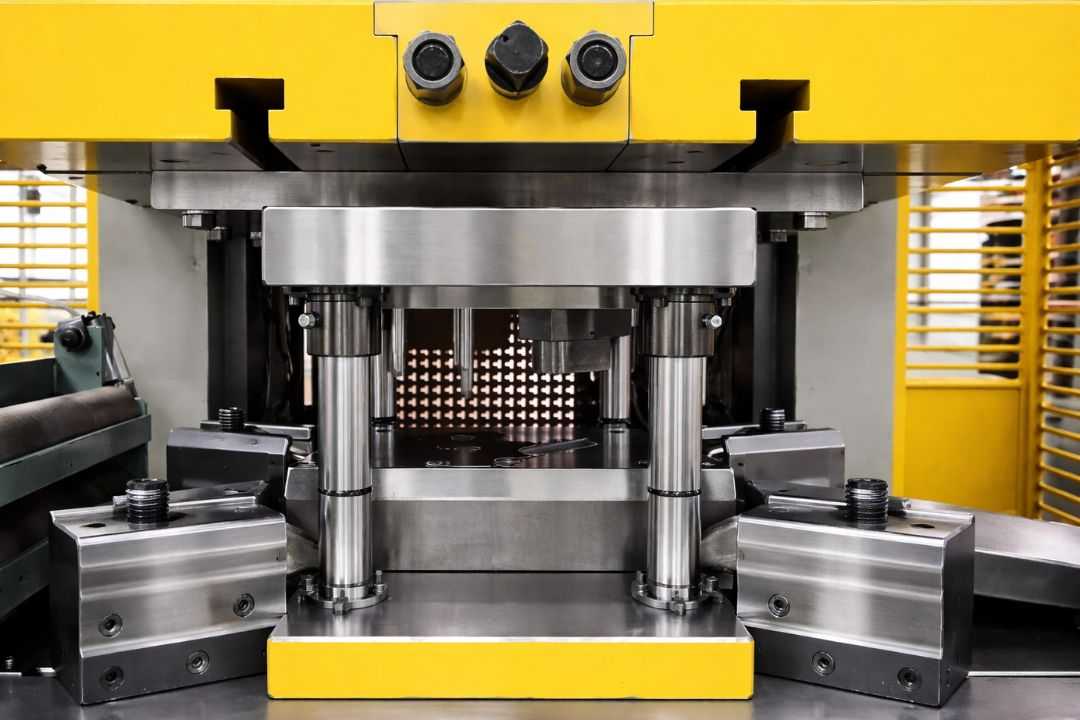
Aerospace manufacturing excellence begins long before final assembly. It starts in controlled press operations and precision component forming. Heavy-duty hydraulic presses, such as the one shown below, are critical for producing washers, shims, structural brackets, and precision-blanked components used in aerospace assemblies.

In aerospace tooling environments, presses must ensure burr-free punching, controlled material flow, repeatable load distribution, and fully documented validation cycles. Multi-spring compression systems maintain an even pressure distribution across aerospace-grade components, reducing the risk of deformation and ensuring dimensional integrity.
From Drawing to Reality: Aerospace Tolerance, Machine Finishes Discipline
Engineering drawings define the precision backbone of aerospace manufacturing. Dimensional tolerances, surface finish requirements, and inspection criteria directly influence machining strategy, tooling selection, and quality validation processes.
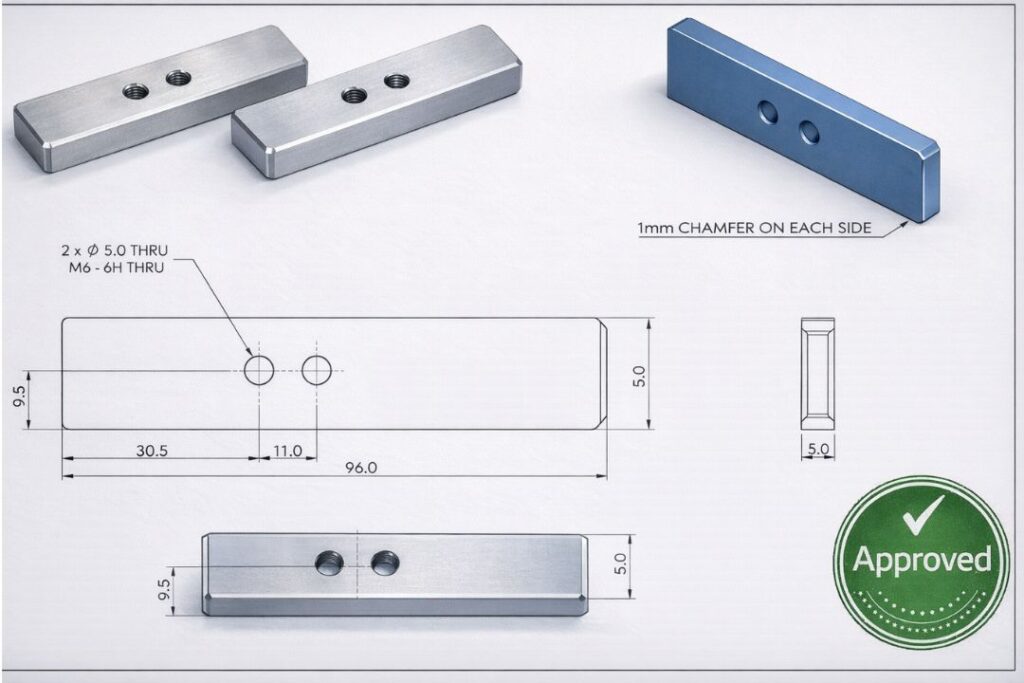
The pressed part drawing illustrates tight dimensional tolerances, defined section views, burr-free exit surface requirements, and explicit instructions prohibiting witness marks. Such requirements reflect aerospace-grade compliance and align with internationally recognised quality systems such as EN 9100, which emphasise production documentation, first article inspection, configuration management, and full traceability.
Every drawing dimension must connect directly to calibrated measurement systems, tool wear monitoring strategies, and statistical process control. For Indian machine makers, this demands disciplined process validation, documented inspection routines, and structured nonconformance management.
Singapore Airshow 2026: Machine Making & Tooling Benchmarks
The 2026 Singapore Airshow reinforced the global shift toward high-precision, smart aerospace manufacturing. Advanced CNC and 5-axis machining systems capable of sub-0.01 mm tolerances were demonstrated for complex aerospace geometries. High-speed dynamic machining for turbine components, structural housings, and MRO applications underscored the increasing demand for rigidity, thermal stability, and digital integration in machine tools.
Specialised tooling innovations included RFID-enabled tool tracking systems for Foreign Object Damage prevention and precision sealant dispensing technologies. These advancements align with aerospace mandates requiring product preservation, accountability, and process control.
Advanced Materials and Machining Challenges
The increased use of titanium and nickel superalloys in UAV engines and aerospace structures presents machining challenges that demand enhanced spindle stability, advanced carbide tooling, optimised coolant strategies, and vibration-damped fixturing. Machining such materials requires validated special processes, documented approvals, and stringent monitoring under aerospace quality frameworks.
AI-Driven Production and Digital Tool Management
Artificial intelligence is rapidly transforming aviation tooling, press work, and machining by embedding intelligence directly into production and quality ecosystems. In precision press operations, AI-driven sensors and machine learning models monitor force distribution, stroke consistency, and material behaviour in real time, ensuring burr-free forming and eliminating defects such as micro-cracks or deformation.
In machining, AI enables adaptive cutting by continuously analysing spindle load, vibration, and tool wear, automatically adjusting feeds and speeds to maintain tight tolerances—often within ±0.01 mm—critical for aerospace components. On the quality and inspection side, computer vision systems and AI-powered metrology platforms can detect surface anomalies, dimensional deviations, and tool-induced defects far faster and more consistently than traditional methods, while also enabling 100% inspection rather than sampling.
Furthermore, predictive analytics improves component performance by correlating manufacturing data with in-service behaviour, enabling engineers to optimise tool paths, material removal strategies, and process parameters to enhance fatigue life and structural integrity. Together, these capabilities create a closed-loop manufacturing environment in which tooling, machining, and inspection continuously learn, improve, and ensure aerospace-grade reliability.
Smart manufacturing trends highlighted at the show included AI-assisted predictive maintenance, real-time tool wear monitoring, integrated digital tool libraries, and automated inspection feedback loops. Indian aerospace manufacturers must now adopt MES-integrated CNC systems, closed-loop inspection platforms, and cloud-enabled documentation systems to achieve global competitiveness.
Implications for India’s Machine Tool Industry
India’s indigenous UAV engine capability signals a strategic shift from assembly-based operations to precision-driven manufacturing. This transformation demands aerospace-certified tooling supply chains, EN 9100-aligned quality systems, and enhanced metrology capabilities.
For Indian SMEs in tooling and machining, the path forward requires investment in 5-axis machining platforms, aerospace-grade documentation systems, validated process control, and traceable production records. Export readiness and global supply chain integration depend on disciplined adherence to international aerospace standards. An illustration of a tooling example below:
India is no longer merely consuming aerospace technology; it is producing it. The indigenous UAV engine showcase at Singapore Airshow 2026 demonstrated not only propulsion capability but also the maturation of India’s tooling and machining ecosystem. The next generation of Indian aerospace excellence will be machined, pressed, measured, validated, and certified on Indian shop floors — and that journey is already underway, which could include AI.