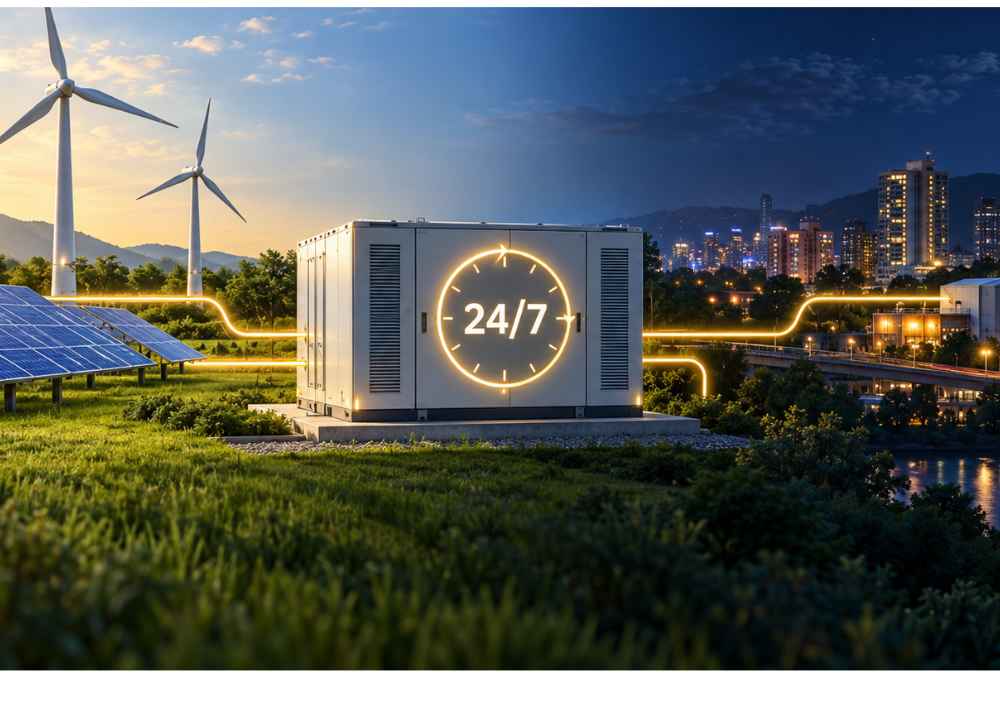
On the morning of March 30, 2026, India’s grid lost 34 gigawatt-hours of clean electricity in a single day, enough to cover the daily electricity use of roughly five million urban middle-class householdsnot because the sun did not shine, but because the transmission network could not carry the power already generated. Episodes like this are becoming routine as India’s renewable capacity outpaces the infrastructure meant to move, store and dispatch it. The next phase of the energy transition depends less on adding more solar and wind, and more on making that power available reliably, around the clock.
India crossed 283 gigawatts of non-fossil generation capacity by March 2026, including about 150 gigawatts of solar and 56 gigawatts of wind, putting the country on course for its 500-gigawatt non-fossil target by 2030. Renewables already meet more than half of electricity demand on strong generation days. Yet this growth has been driven almost entirely by capacity additions rather than by the flexibility needed to use that capacity fully. Transmission lines, battery storage and grid operating practices have not kept pace, and the gap between what renewable plants can generate and what the grid can absorb is widening each quarter.
The consequences show up as curtailment renewable power that is generated but discarded. Ember estimated that about 2.1 terawatt-hours of renewable electricity was curtailed in financial year 2025-26, largely to keep coal plants running above their minimum technical load. Government data placed curtailment even higher in some months, driven this time by delays in transmission line construction rather than coal inflexibility. roughly a third of recently commissioned renewable capacity was being evacuated only through temporary network access as of May 2026, with curtailment during solar hours reaching 50 to 60 percent in high-generation states such as Rajasthan and Gujarat. The pattern is structural: solar output peaks at mid day while demand peaks later, forcing coal plants to cycle deeply every day, and new transmission corridors are, on median, taking well over ten months longer than scheduled to commission.
Three responses are converging to close this gap. Battery storage is scaling quickly: installed capacity reached about 5.9 gigawatt-hours by March 2026, up from under a gigawatt-hour a year earlier, with a project pipeline exceeding 69 gigawatt-hours. The Central Electricity Authority projects India will need roughly 411 gigawatt-hours of storage, split between batteries and pumped hydro, by 2031-32. Procurement design has also shifted toward firmness rather than raw capacity: the share of hybrid, storage-backed tenders rose from about 12 percent of renewable auctions in 2021 to nearly half by 2024, and recent round-the-clock tenders now require developers to guarantee 90 percent power availability during peak hours, with awards clearing at close to five and a quarter rupees per unit. Policy support viability gap funding for standalone storage, production-linked incentives for battery cells, and storage obligations on distribution utilities is improving project economics, though transmission expansion remains the binding constraint, with over 61,000 circuit kilometres of new inter-state lines still needed by 2029-30. For engineering and manufacturing firms, the harder problem is no longer generation hardware but system integration sizing storage correctly, managing degradation, and designing hybrid plants that behave predictably on the grid. Companies across the solar manufacturing and EPC value chain, including Swelect, are building this integration capability into their project execution.
Where new capacity is sited matters as much as how much of it is added. Solar irradiation and wind potential vary significantly across regions, so the best resource sites are not always close to demand centres, and generation cannot simply be relocated to wherever consumption is highest. But where resource quality permits, developing generation closer to major load centres can reduce transmission losses, ease congestion and lower the need for costly network expansion. Project planning should therefore weigh the combined cost of generation and transmission together, rather than optimising for the lowest generation cost alone.
Distribution-level measures can complement this national buildout. Time-of-Day tariffs can encourage consumers to shift consumption toward hours of high solar or wind availability, smoothing some of the demand-supply mismatch that currently forces coal plants to cycle. With adequate metering, grid connectivity and export compensation, distributed solar and storage systems can also feed surplus electricity back into the grid. Deploying many smaller, grid-connected units offers a modular and scalable complement to utility-scale transmission investment, though its success depends on distribution-network capacity and clear regulations for power export.
For policymakers, the priority should be treating transmission delivery with the same urgency as generation targets, publishing binding commissioning timelines for inter-state lines the way capacity targets are tracked. For distribution utilities and grid operators, enforcing storage obligations consistently, rather than leaving them as guidelines, would create predictable demand for flexibility assets. For developers and equipment manufacturers, tariffs discovered in recent round-the-clock auctions confirm that firm renewable power is now commercially viable in India; the remaining task is engineering execution rather than proving the underlying economics. Investors should price transmission and execution risk explicitly, rather than treating storage-backed renewable projects as a simple extension of solar.
India has already shown that round-the-clock renewable power can be procured at tariffs competitive with conventional generation. What remains is closing the gap between that commercial proof and physical delivery: enough transmission capacity to move the power, enough storage to shape it, and enough regulatory consistency to make both bankable at scale. The technology and the tariffs are no longer the constraint; execution is. Getting that execution right over the next few years will determine whether India’s renewable capacity translates into reliable electricity, or continues to be curtailed at the very moments it is most needed.