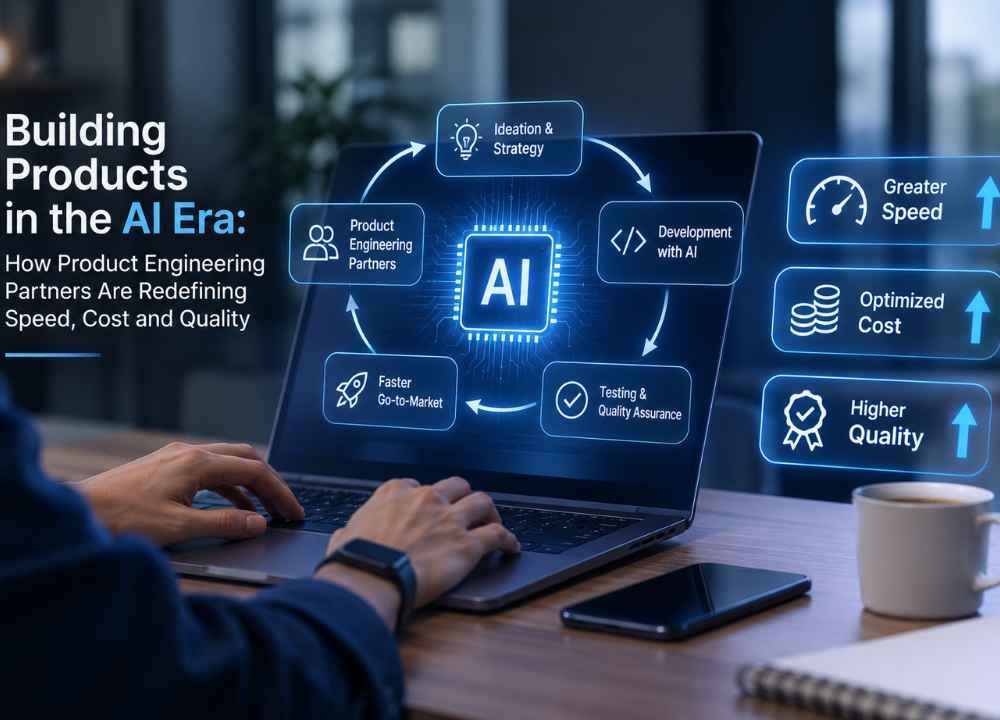
Every founder and product leader is asking the same thing right now: how do we build better software, faster, without burning through the budget? AI has changed what is possible, but it has also raised expectations. Customers want polished products, investors want early traction, and competitors keep shipping. Yet here is the part that often gets missed: AI on its own does not give anyone an edge. Everyone has access to the same tools. The real advantage comes from pairing AI with sharp product judgment, disciplined engineering and solid execution. That is exactly where product engineering partners are making a difference.
AI Is Now Part of the Everyday Engineering Toolkit
The shift has already happened. A January 2026 JetBrains survey of more than 10,000 professional developers found that 90% regularly use at least one AI tool at work for coding and development. Sonar’s 2026 State of Code Developer Survey adds that 72% of developers who have tried AI coding tools now use them every day.
When almost every team uses the same tools, the tools stop being the differentiator. What matters is how thoughtfully they are used.
Speed: Faster Coding Is Not the Same as Faster Launches
AI is a real help with boilerplate code, prototypes, test generation and documentation. A good product engineering partner uses that to move quickly from an idea to something people can click, try and react to. Early prototypes also make it easier to plan integration with a company’s existing systems, which is where many projects quietly lose time.
But writing code quickly is only one part of getting a product to market. Launches get delayed by unclear requirements, features nobody asked for, integration surprises and late-stage fixes. A team can generate code in hours and still spend months building the wrong thing. Real speed comes from knowing what to build, in what order, and why.
Cost: Validate Early, Spend Wisely
Savings in the AI era do not come from cutting corners. They come from avoiding waste. JetBrains-based analysis estimates that developers save around 3.6 hours a week with AI coding tools. That is a useful gain, but it only becomes a lower product cost when the time goes into the right work.
This is why early validation matters so much. Testing an idea with real users through a quick prototype or a focused pilot is far cheaper than discovering a problem after full development. Catching a wrong assumption in week three costs a fraction of fixing it in month six. Experienced partners build this habit into the process, which cuts engineering rework and keeps budgets under control.
Quality: AI-Generated Code Needs Real Scrutiny
Generating code is easy now. Generating code you can trust is harder. Sonar’s survey found that 96% of developers do not fully trust AI-generated code to be functionally correct, yet only 48% always check it before committing.
That gap is where fragile products come from. AI-generated code can carry hidden bugs, security gaps and inconsistencies with the rest of the codebase. Strong engineering teams treat AI output as a first draft. They apply code reviews, automated testing, security checks and clear quality benchmarks before anything reaches users. The result is software that is reliable, easier to maintain and ready to scale.
What the Right Partner Actually Does
The best partners do far more than accelerate coding. They help businesses move from an idea to a validated concept, then to a reliable product and finally to something that can grow. That means asking hard questions at the start, testing assumptions early, building on existing systems rather than around them, and holding a high bar for quality at every stage.
When choosing a partner, look for teams that can explain how they use AI, not just that they use it. Ask how they validate ideas, verify code, measure quality and communicate progress. Transparent processes, domain experience and a collaborative mindset matter more than any single tool.
The Road Ahead
AI has made building software faster than ever, but speed alone does not make a great product. The products that succeed will not be remembered for how quickly they were built. They will be defined by how well they solve real problems and how reliably they deliver for the people who use them. Moving fast is useful. Moving in the right direction, with quality you can trust, is what lasts.