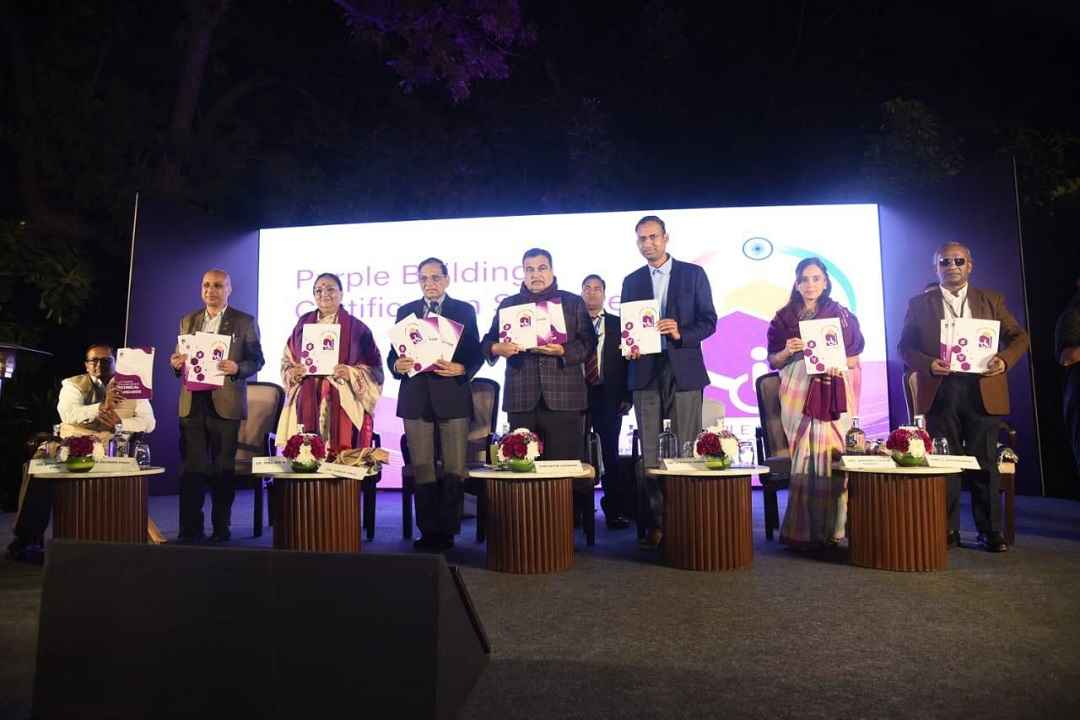
On the occasion of the International Day of Persons with Disabilities, Union Minister for Road Transport and Highways Nitin Gadkari introduced the Purple Building Certification Scheme, the country’s first accessibility rating framework for buildings and public spaces. The programme has been developed by the Andhra Pradesh MedTech Zone (AMTZ) in collaboration with the Indian Council of Medical Research (ICMR) and the Inclusive Divyangjan Entrepreneur Association (IDEA).
Calling for mandatory accessibility norms across India’s built environment, Shri Gadkari urged NITI Aayog to draft a proposal for such provisions and recommended that the Ministry of Social Justice and Empowerment prepare a Bill to establish uniform accessibility as a legal right. “This step reflects our Prime Minister’s vision for barrier-free public spaces. India must match the standards followed in Europe and the United States. When accessibility becomes a legal obligation, compliance improves, accountability increases, and millions of people with disabilities gain greater independence,” he said.
He commended AMTZ and ICMR for shaping the Certification Scheme, noting AMTZ’s contribution to developing high-quality, affordable medical technologies. The Purple Building Certification Programme, which has drawn significant attention, is India’s first voluntary national framework designed to assess and recognise accessibility standards across schools, hospitals, housing, workplaces, shopping centres, transport hubs, sports arenas, and other public areas.
Explaining the journey behind the initiative, Dr Jitendra Sharma, Managing Director and Founder-CEO of AMTZ, said accessibility must be regarded as a fundamental element of construction in an inclusive society. He noted that AMTZ is driving a nationwide effort to ensure dignity, safety, and equal access in the built environment for all, including persons with disabilities.
Aligned with International Accreditation Forum (IAF) quality standards, AMTZ and the Quality Council of India will train and accredit auditors and certification bodies to take this programme forward. Three expert committees, with guidance from ICMR, have developed a national benchmark to help bridge the gap between policy promises and practical implementation.
The initiative embeds universal design principles into India’s expanding urban and semi-urban landscape, ensuring safer and more equitable access for people with disabilities, older adults, pregnant women, and individuals with temporary or permanent mobility or sensory challenges.
Speaking at an event attended by persons with disabilities at the Taj Mahal Hotel—which lit up in purple to honour the cause—NITI Aayog Member Dr VK Paul encouraged the government to adopt the certification scheme in public buildings first. Dr Mallika Nadda, President of Special Olympics Bharat, stressed that accessibility is essential, especially as India aims to host major global sporting events. She called the scheme a significant leap toward an “accessibility revolution.”
Manmeet Kaur Nanda, Additional Secretary, Department of Empowerment of Persons with Disabilities, emphasised that accessibility must be built into every sector’s standards. She noted that the department has collaborated extensively with stakeholders to define core accessibility requirements, reaffirming that inclusivity is a shared responsibility across all levels of government.
With the rollout of the Purple Building Certification Programme, AMTZ has created a national roadmap for inclusive and equitable infrastructure. The initiative brings together government agencies, architects, disability rights organisations, builders, and civil society to strengthen India’s commitment to universal accessibility.