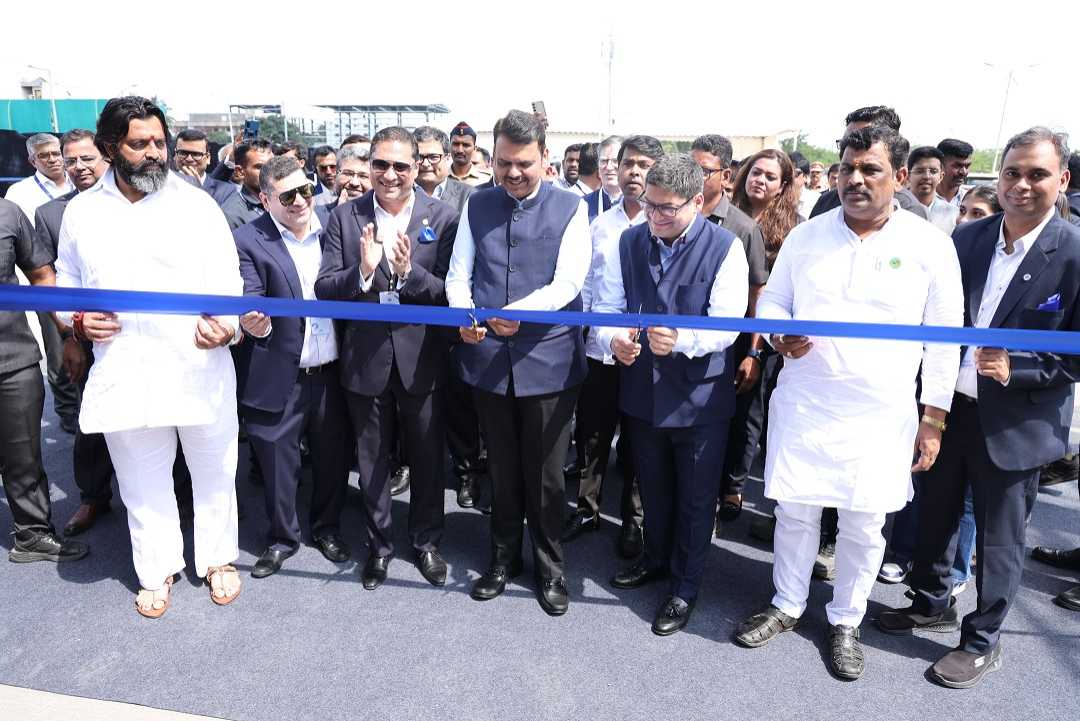
Blue Energy Motors (BEM), a pioneer in sustainable heavy-duty transport solutions, has launched India’s first electric heavy-duty truck featuring battery-swapping technology. The new vehicle was revealed by the Hon’ble Chief Minister of Maharashtra, Devendra Fadnavis, at BEM’s 10,000-unit production facility in Chakan, Pune.
In a landmark development for the country’s green mobility sector, the Chief Minister also inaugurated India’s first electric freight corridor on the Mumbai–Pune route. This dedicated corridor is the starting point of a broader initiative to electrify key national highway freight routes over the next three years—aiming to cut emissions, boost efficiency, and support India’s Net Zero ambitions.
To meet growing demand for electric trucks, BEM has signed a Memorandum of Understanding (MoU) with the Maharashtra government to build a new manufacturing plant capable of producing 30,000 electric trucks annually. The project will involve an investment of ₹3,500 crore.
The company is currently signing MoUs to deliver more than 10,000 electric trucks across the country. Its electric truck platform—designed for Indian road and climate conditions—delivers the lowest total cost of ownership (TCO) in its class, while offering high payload capacity and the flexibility of battery swapping for minimal downtime.
Chief Minister Devendra Fadnavis said “This launch reinforces Maharashtra’s position as a frontrunner in clean industrial innovation. The rollout of India’s first Made-in-India electric truck with battery-swapping capability and the Mumbai–Pune electric corridor reflects our commitment to self-reliance and sustainable development. I commend Blue Energy Motors for their role in accelerating India’s transition toward a green future.”
Anirudh Bhuwalka, Founder and Managing Director, BEM, stated “We see this as a defining moment for electric freight mobility in India. Our truck offers zero tailpipe emissions, an unlimited driving range with battery swapping, and the highest payload in its segment. With our Energy-as-a-Service model, fleet operators benefit from lower upfront costs and operational efficiency—helping to reshape the future of freight logistics in India.”
Anshuman Ruia, Director at Essar, added “This marks a key step in India’s journey toward decarbonised transport. The collaboration between technology, infrastructure, and cleaner energy solutions underlines our shared commitment to building a low-emission, resilient logistics network.”
Blue Energy Motors’ newly launched electric heavy-duty truck is the first in India to feature battery-swapping technology, offering a groundbreaking solution for long-haul freight. With the launch of the Mumbai–Pune corridor as the nation’s first electric highway route, the company is setting a new benchmark in sustainable logistics. The truck is supported by a Battery-as-a-Service model, significantly reducing upfront capital costs for fleet operators and making the transition to electric fleets more financially accessible.
Built specifically for Indian conditions, the truck combines high payload capacity with industry-leading total cost of ownership (TCO). Its design enables unlimited range through rapid battery swaps, minimising downtime and maximising efficiency. Equipped with Advanced Mobility Intelligence, the vehicle also enhances fleet performance through real-time monitoring and optimisation. Together, these innovations make Blue Energy Motors’ electric truck a future-ready solution for green freight transport in India.
This launch builds on the success of BEM’s LNG-powered truck fleet, positioning the company at the forefront of clean freight innovation. The integration of new technologies, infrastructure, and scalable service models represents a significant leap forward for sustainable logistics in India.
Blue Energy Motors is a trailblazer in manufacturing low-emission, heavy-duty trucks powered by electric and LNG technology. With a mission to redefine commercial transport, BEM combines cutting-edge vehicle design with energy and maintenance services to offer viable solutions for a cleaner, more efficient freight sector. The company is actively developing a nationwide ecosystem to support the transition to sustainable transport at scale.