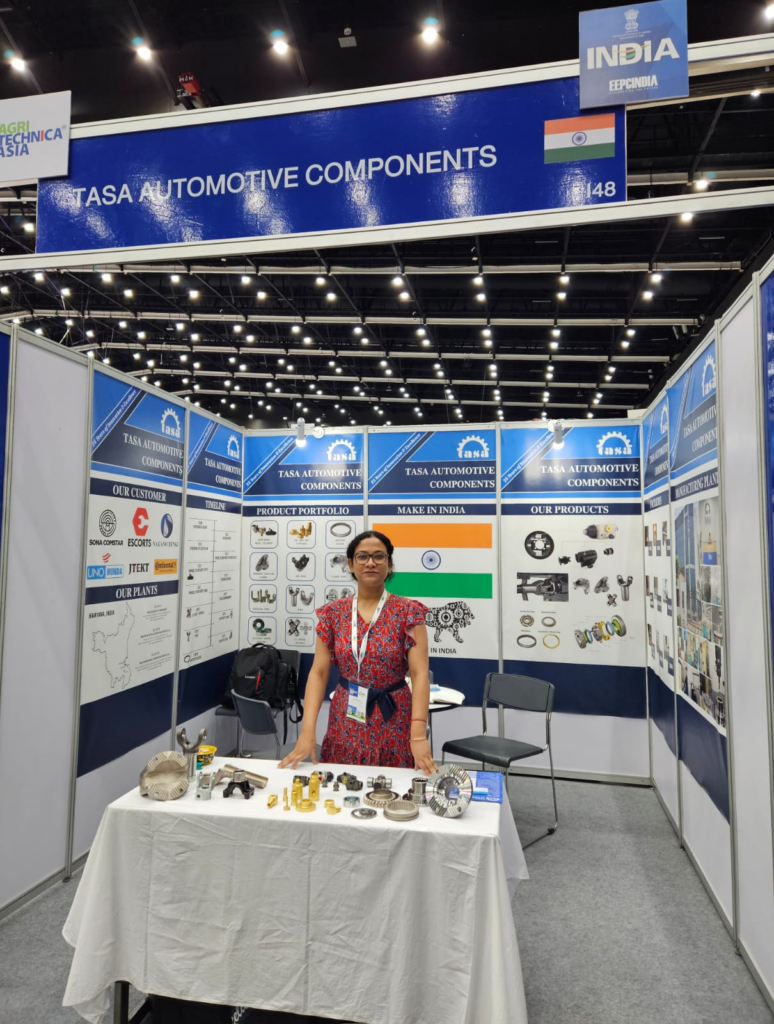
Growing up between Delhi and Gurugram, Tanushree saw her father, who was deeply committed to expanding his business, return home exhausted from long days. She was motivated to follow in her father’s footsteps by his entrepreneurial ventures and success in the field of mechanical engineering. She was impressed and drawn to mechanical engineering by what she saw in his innovations and how they worked. Today, she is the Plant Manager at TASA Automotive Components, the company her father, Ashok Kumar Sen, founded in 2000. A mechanical engineer with an MS in Manufacturing Management from BITS Pilani, Tanushree manages production, people, quality, and delivery on a daily basis and brought women onto the shopfloor when there were none.
TASA Automotive Components, based in Gurugram, is a second-generation precision engineering business founded in 2000. What began as a job machining unit, serving the Sona Group, has since grown into a diversified manufacturer of automotive and non-automotive components, offering machining, process development, jig and fixture design, and design consultancy. The company now operates across two verticals: component manufacturing, led by Tanushree, and machine building, led by her younger brother Aroop Sen, who holds a postgraduate degree in ultra-precision engineering from Cranfield University in the UK. Between them, they are building what their father started.
Parents Shaping a Woman Engineer in a Male-Dominated Industry
Tanushree was raised in a traditional Bengali home where children are encouraged to be all-rounders, but education is the foundation. While her father, Ashok Kumar Sen, was away expanding the company, her mother, Sumita Sen, a geography teacher, essentially nurtured the two kids. She set clear expectations for her kids: You have to be a versatile individual. She was strict and meticulous. While education was the first priority, it wasn’t the sole factor.
Her father got more involved as she grew older. He asked the crucial questions and started to inspire her. How would she like to advance her career? He didn’t think twice when she expressed her desire to pursue engineering. When she picked mechanical, a branch that most Indian families would have advised their daughters to avoid, her father never objected to it.
“Any other parent would have said, oh, it’s a male-dominated industry, you are a woman, you should not pick it up. He did not. He never said no.”
Her mother wanted her to get married as soon as she graduated. She had a strong desire to continue her education, and her father encouraged her by saying, “Let her study first.” She worked full-time at Sona Group, which sponsored her Master’s degree.
“I grew up with two extremely forward-thinking, self-assured, and involved parents, and that shows in our careers, how we make decisions, how we mold ourselves as individuals, and how we envision moving our lives ahead. Their involvement has played a very, very big role.”
The Male Mentors Who Changed How She Leads
Tanushree was campus-placed at Sona Group straight from engineering. When she joined, the company had just started recruiting women on the manufacturing side. There were three women in the entire organisation: one in finance, one in HR, and Tanushree in engineering and manufacturing. She says the company did not differentiate. What they demanded from men, they demanded equally from women. And the women delivered.
She worked under several leaders who mentored and shaped her. TK Pal taught her how to plan, showed faith in her, encouraged her to be involved in everything and how to manage a project end to end. VV Varma taught her something different: he taught her to look beyond the obvious, consistently guiding her to investigate the root cause of a problem. He challenged her to drill down to the smallest detail, helping her identify the precise factors that drive the greatest impact.
Another significant contributor in her career was her immediate manager Vishal Raj who frequently motivated her to take ownership and execute tasks independently, building her confidence and individual capability. Today her father is also her mentor in the business and who challenges her to master the technical side of the industry and maintains a firm focus on the importance of ‘shopfloor intelligence.’ “I actually don’t consider them as my bosses. I consider them as my teachers. They’ve taught me how to be what I am today.”
All these men were exceptional mentors. She wants that acknowledged, because the conversation about women in manufacturing too often focuses only on the barriers, and not enough on the men who chose to open doors.
How Tanushree Built a Women-Inclusive Manufacturing Shop Floor from Scratch
When Tanushree joined TASA, there were no women at the plant. She changed that. She took the initiative to hire women on the shop floor, to give them roles running machines, doing sub-assembly work, working in testing and inspection. She has seen what happens when women are given the chance.
“I have seen that where men have not been able to punch in the kind of numbers, women have been able to achieve the target. There is an inherent desire in a woman to do better. You can’t take that away from her.”
She also believes that a woman in a leadership role changes what is possible for every other woman in the organisation. When women on the shop floor see a woman at the top, the hesitation to speak up, to share a problem, to ask for something, drops. They feel that if she can be there, so can they.
“Having a woman at a leadership position is a necessity in the industry right now. It would encourage other women to have a vision that we can reach there. It would give a woman the comfort that if I have a problem, she would listen to me.”
Why Manufacturing Companies Must Offer Daycare and Mental Health Support for Women
Tanushree is honest about something the manufacturing industry has not yet solved. A working woman in India carries two full-time jobs. She manages the plant and her home. After a full-day shift, she goes back in the evening and the second shift starts, except nobody calls it a shift. “A woman a manager at home, then she’s a manager at work, then she goes back home and takes up the role of manager again. She is a manager 24 hours a day.”
The corporate world, she says, asks women for 100% efficiency while they are mentally split between the plant and the child at home. That is not a reasonable ask. What would change it? Two things. First: daycare. Not as a perk. As a necessity. She lived this herself. When her daughter was six months old, she brought her to the workplace because there was no other option. Her husband Balram Kumar Sinha, a chartered accountant, was never the one who questioned it. He was the one who said: she’ll be fine, bring her.
Second: mental health support. Women reach the top and quit at a higher rate than at any other stage of their career, she says. Not because they have failed. Because the guilt of not being present at home catches up with them at exactly the moment they have the most to offer professionally. “If you want women to deliver results, she has to be mentally at work. She can’t be halfway at home and halfway at work and expect her to give 100% efficiency. That’s not going to work.”
Raising the Next Generation Without Passing On the Baggage
When the interview request came in, Tanushree’s first reaction was: what are you going to interview me about? She says this with a laugh and a recognition: women tend to undermine themselves. They reach a point, look back, and still wonder if there is enough there to talk about. Her daughter had no such doubts. “She was more excited for this interview than I was. You’re going to have an interview. This is so nice.”
Tanushree has a daughter she is quietly, deliberately raising without the baggage she herself was handed by society. Not because that baggage was forced on her, she was fortunate. But because she knows that what her mother passed to her was hard-won, and what she passes to her daughter can go even further. “If I have been able to reach here, there is a far bigger possibility for her to go farther than us.”
Her brother Aroop gives her reality checks. Her father gave her a vision. Her mother gave her discipline. Her husband gave her space. Her daughter gives her a reason to keep going. And her team at TASA made the work possible. “I couldn’t have done whatever I’ve done without them.”
What Keeps a Woman Plant Manager Going When Things Get Hard
When things get hard, Tanushree has a system. She calls her father, her brother, or her husband, and shares everything that is weighing on her. And they respond with the easy, unbothered energy that men often carry through problems that feel enormous to her in the moment. This should pass. You’ll be fine. And she thinks: am I overthinking this? Usually, she is. She takes a breath, drinks some water, zones out for a while. And then she comes back. “Today it’s a dark night. There is always a bright morning. It will come no matter what happens. It is just unstoppable. Nothing is permanent. Your difficult time is not permanent.”
And when someone asks her what she tells herself in those moments, the answer comes after a pause, honest and simple: “There is nothing I can’t do.”