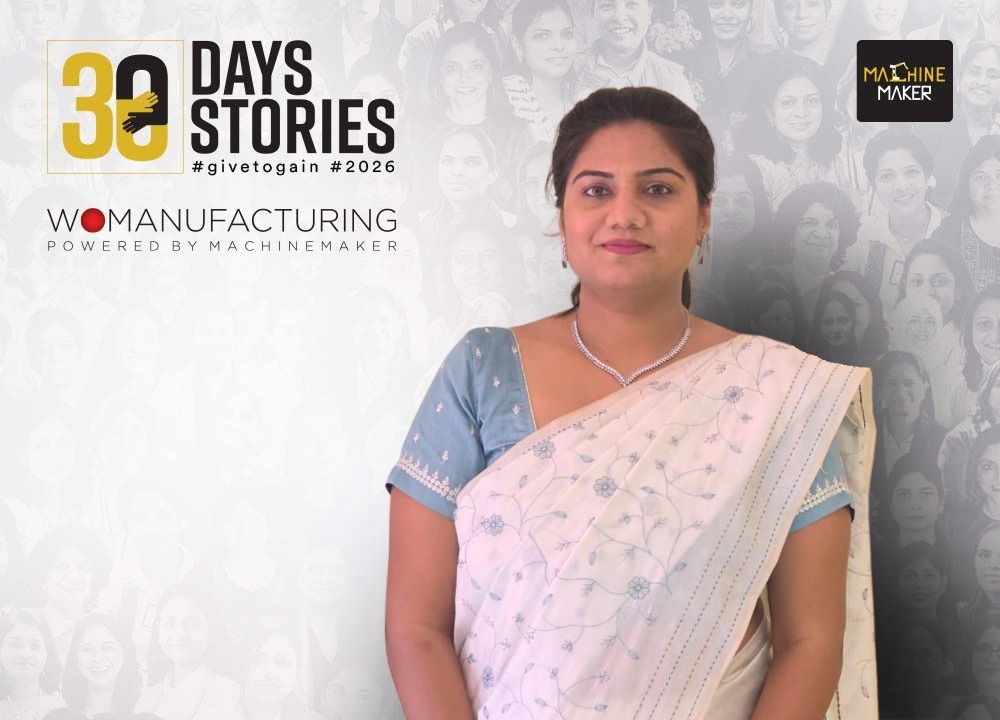
She was not looking for a startup to join. She had a good job, a Pre-Placement Offer from Cummins India before she even finished her master’s, and a career in structural analysis that was going exactly where it was supposed to go. Then her weekends changed everything. Some stories in Machine Maker’s Womanufacturing campaign are about women who planned their way into manufacturing. This one is about a woman who chose it, twice, and built something that now supports thirty to forty families.
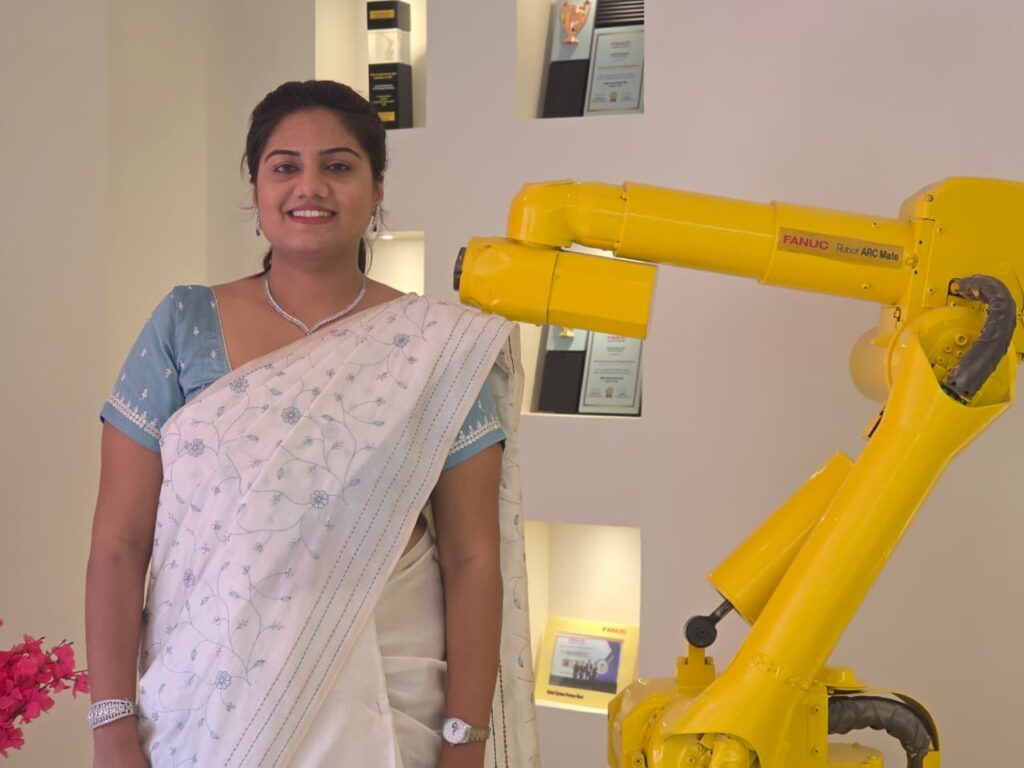
IRTI-Robotics, based in Pune, is one of India’s leading robotic system integrators. Founded in 2016, the company designs and delivers end-to-end automation solutions for industries across automotive manufacturing, heavy engineering, packaging, pharmaceuticals, and more. It is a FANUC India Authorised Robotic System Integrator, has installed hundreds of industrial robots across ten-plus countries, and in 2025 won the FANUC Robotic System Integrator Award. What makes IRTI unusual is not just what it does, but where it goes. While most integrators stay in well-trodden territory, IRTI has deliberately moved into applications that are rare in the Indian market: robotic sculpturing, 3D metal printing, press tending, and metal forging. Someone at the company decided that doing what everyone else was doing was not interesting enough.
That someone, in part, is Sanika Sonawane.
Two Doctors, One Daughter Who Chose Machines
Sanika grew up in a small town in Maharashtra, raised by two doctors. Her mother, Dr Geeta Karande, was Head of Department at Krishna Institute of Medical Sciences in Karad, one of Maharashtra’s leading medical institutions, before moving into a professorial role in medical education. Her father, Dr Satish Karande, is an ENT surgeon. In a household built on science, discipline, and the idea that education is never wasted, Sanika absorbed something early: ambition is not optional.
She was, by her own admission, a bit lazy as a child. Her mother saw through it.
“My mother understood early that I had a lot of potential but needed that push. I got used to it, and then it became my own. But there are still times when I need that push, and now Tejas plays that role. They are very similar, both of them.”
She chose mechanical engineering after her 12th grade exam, not because she loved cars or machines, but because it was challenging and unusual for a girl from her background. She liked that.
“I have a competitive spirit. I like to do something that is unusual, not to show that I am different, but because it gives a sense of challenge that lights me up.”
After engineering she worked briefly at Reiter, then pursued a master’s in Mechanical Design from CABED Institute, simultaneously landing an internship at Cummins India in the structural analysis team. She worked on thermal and structural analysis of turbines and engine components, serving customers including Walmart, Caterpillar, and mining truck manufacturers. Before she even finished her master’s, Cummins offered her a PPO. She joined full time and stayed for almost three years.
Monday to Friday at Cummins, Weekends at a Robotics Startup
Around 2018, Sanika’s husband Tejas Sonawane had just started IRTI-Robotics as a training institute. She began spending her weekends there, learning about robotics, watching what was being built, asking questions. Her mechanical engineering background gave her a foothold. Her curiosity did the rest.
At the same time, IRTI was beginning operations in Germany. Managing a growing company, a German entity, a full-time job, a new marriage, and a new city was not sustainable for either of them. They sat down and made a decision: Sanika would leave Cummins and join IRTI full time.
It was not an easy call. She had spent years building an employee mindset, earning credibility inside a large organisation, learning how structured professional environments work. Moving from that to a co-owner role in a young company meant unlearning as much as learning.
“The main challenge was moving from an employee mindset to a business mindset. That took a lot of time. And simultaneously I was balancing my personal life because working with your partner is very challenging.”
She was aware that the personal and professional did not separate neatly. They do not, when you build a company with the person you live with. What they had to develop instead was a shared framework, an understanding that spans the dinner table and the boardroom equally.
“If you want to run a house, a company, and raise a child together, you always have to have that bond. If I am lacking somewhere, you fill up there, and vice versa. That did not just happen. It took a lot of time and effort from both sides.”
COVID Hit Three Times But She Stood Tall
When people say COVID was hard, Sanika knows exactly what that means. Tejas was affected three times. The second time, she was four months pregnant. When their daughter was born, both mother and baby contracted the virus. Tejas was on site in Chennai. She managed it alone.
The company took a hit too. Everything did. But what pulled them back was not a strategy. It was the weight of responsibility.
“We realised there are thirty to forty families dependent on us. If we do not work, if we do not give them the growth we planned, that is of no use. They look at us with the hope that the company is going to grow and give them the exposure they deserve.”
Three months after her daughter was born, Sanika was back at the office. With the baby.
She acknowledges she had a privilege others do not: as co-owner, she could bring her child in. But she does not leave it there. She talks about what companies can do, what infrastructure makes it possible for new mothers to stay in the workforce, and what happens when that infrastructure is absent.
“A lot of companies now have creches, in-built childcare in the office where you can leave your child during work hours and visit during breaks. That sense of stability, my child is here and safe, lets you focus your energy on your work.”
From One Woman to Sixteen
When Sanika joined IRTI-Robotics, there was barely one female employee in the company. Today there are sixteen. That shift did not happen by itself.
She worked to create an environment where women felt safe, not just professionally but physically. She tracks whether her employees reach home. She ensures maternity leave is followed by a genuine path back. She extends work-from-home flexibility not as an exception but as policy.
“I make sure to call my employees to check if they have reached home safely. It is a small step, but when my people are working late, it is important for me to know they are safe.”
She is also honest about what makes hiring women in manufacturing difficult. Freshers get hired, then get married, or become pregnant, and leave. She has lived both sides of this: as the woman who stayed, and as the employer who had to build a structure that made staying possible.
“We as women have the ability. It is just the perspective of the world that makes us believe we do not. You need to bring your uniqueness to the table. You do not have to let the world’s opinion drown your own energy.”
What She Will Not Compromise On
Ask Sanika what she expects from her team and she gives four things: honesty, the willingness to ask for help, dedication, and respect. She means all four, but the last one she means without exception.
“Respect is non-negotiable. For everyone, be it someone who serves you tea. The Maushi who makes our coffee every day, we are so addicted to her coffee that I have asked twice for it this morning. I do not treat her any differently. Nobody should.”
She is also clear that morality sits above performance in her hierarchy. Technical skills can be taught. Values cannot.
“If you make a mistake, own it. If you need help, ask for it. We are not perfect and we cannot do everything. Own your strengths, own your weaknesses, and work on them every day to become a better version of yourself.”
Automation Is Not About Replacing People
One thing Sanika pushes back on is the framing of robotics as labour replacement. She has heard it too many times and she disagrees with it directly.
“Automation is not fairly new. It is quite traditional. What has developed is the way people look at it and accept it. Initially people thought buying a robot means replacing human labour. But if you look at the broader picture, it is improving quality, improving productivity, not relying on traditional methods but adapting new technologies to make things better and faster. And along with it, making it sustainable.”
IRTI-Robotics started in automotive, then deliberately moved to less saturated ground. Robotic sculpturing, 3D metal printing, press tending, and metal forging are not common in the Indian market yet. That is exactly why IRTI-Robotics ventured in those sectors.
“There is so much saturation in generic industries. We do not want to do what everyone else is doing. We want to do something challenging, something fun, something our team can be ferocious about.”
The team she describes is young, passionate, and deeply bought in. They work until two or three in the morning not because they are told to, but because they treat the company as their own. Sanika says this is something Tejas built, and that she amplified it by bringing a different dimension to the culture.
“He started it. It was his team. I kind of amplified it. I brought a different side to it. And together it worked very beautifully.”
Gratitude as a Way of Living
When asked what keeps her going, Sanika gives one word. Gratitude.
“What you get so easily is a very rigid, very long dream for someone else. I get to travel the world. I get to build something valuable with my partner at a young age. I feel so grateful for that. Even sitting at a beach, I feel lucky to experience the sea, the sound, the breeze. It is very simple.”
And when it gets hard, as it has, as it will again, she has a way of holding it.
“There is always going to be something better. If you do not have the bad things, you will never appreciate the good things when they come. When bad things come, accept them humbly. And when the good things come, remind yourself: I have been through worse. The best things are still coming.”
Almost a decade into IRTI-Robotics, with a FANUC award on the wall, sixteen women on the team, thirty to forty families depending on the company, and a daughter she once brought to the office at three months old, Sanika Sonawane is still building. Still grateful. Still going.