Researchers at the Oak Ridge National Laboratory (ORNL) have developed a new tool condition monitoring system that uses tactile sensing technology to detect wear in machining tools with high precision, helping manufacturers reduce downtime, improve productivity, and lower operational costs. The innovation addresses one of the most persistent challenges in precision manufacturing — identifying the optimal time to replace cutting tools before excessive wear affects part quality or leads to equipment failure.
Machining operations, which involve the controlled removal of material to manufacture high-precision components, rely heavily on the condition of cutting tools. Over time, tool edges gradually wear down, causing instability in machining performance, inconsistent product quality, and the risk of unexpected tool breakage. To avoid production disruptions, manufacturers often replace tools earlier than necessary, resulting in increased tooling costs, more machine stoppages, and inefficient use of resources.
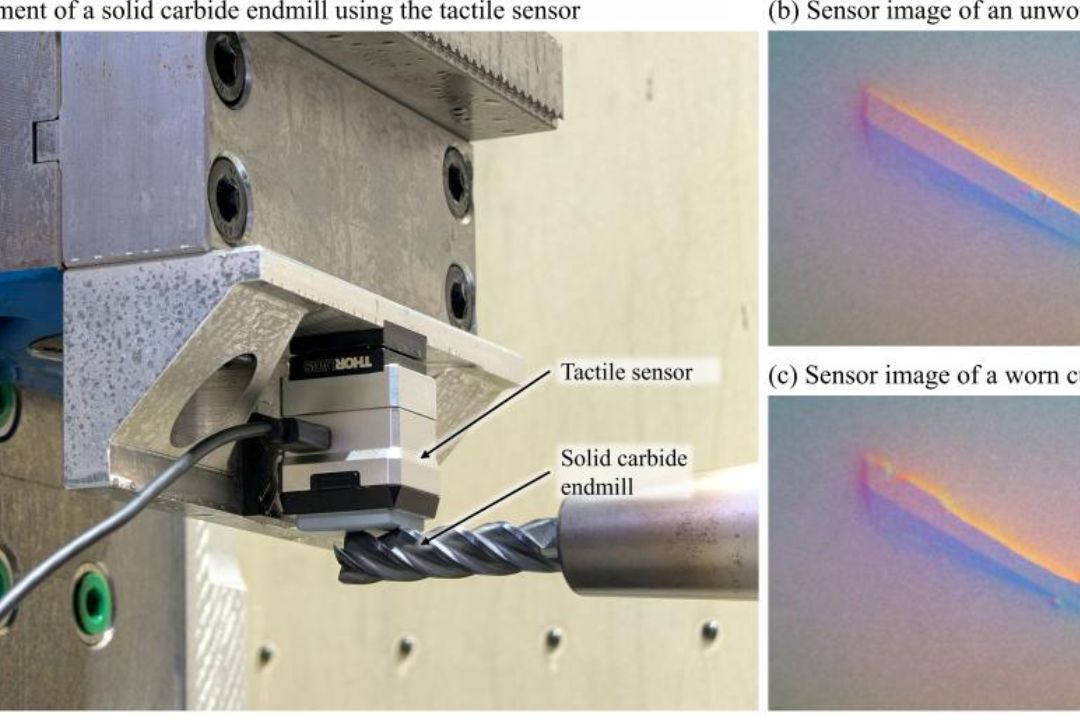
Current tool wear monitoring systems frequently struggle with inconsistent sensor readings, unreliable imaging conditions, and signal noise, limiting their effectiveness in real-world industrial environments. To overcome these limitations, ORNL researchers designed a monitoring system that uses a flexible tactile sensor capable of physically conforming to the shape of a cutting tool’s edge. By pressing against the tool surface, the sensor captures highly detailed impressions of the cutting geometry and wear patterns.
The collected data is then analysed in real time using advanced computational algorithms that can identify even minor signs of wear or surface damage. This allows manufacturers to make accurate maintenance decisions based on actual tool condition rather than estimated wear cycles.
Ritin Mathews said the new system bridges the gap between accurate sensing and practical factory-floor decision-making by giving manufacturers reliable insights into tool health and operational readiness. The tactile sensing system provides several advantages compared to traditional tool condition monitoring methods.
The technology delivers wear measurements within seconds, making it suitable for automated industrial environments and real-time monitoring applications. Researchers reported an accuracy rate of approximately 98 percent, while performance remains unaffected by changing lighting conditions that commonly impact vision-based systems. The sensor is also designed to integrate easily into existing manufacturing workflows and is comparatively cost-effective for industrial deployment.
Chris Tyler said the system enables proactive tracking of tool wear progression, allowing manufacturers to detect and address problems before machining quality is compromised, particularly for critical industrial components.
The technology is expected to deliver significant benefits in industries working with expensive and difficult-to-machine materials such as titanium alloys and nickel-based superalloys used in aerospace, defence, and advanced engineering applications. Additional contributors to the project include Greg Corson, Josh Harbin, and Scott Smith.
The project was supported by the US Department of Defense Industrial Base Analysis and Sustainment Program and conducted at ORNL’s Manufacturing Demonstration Facility, a collaborative research platform focused on advancing next-generation manufacturing technologies across the United States.