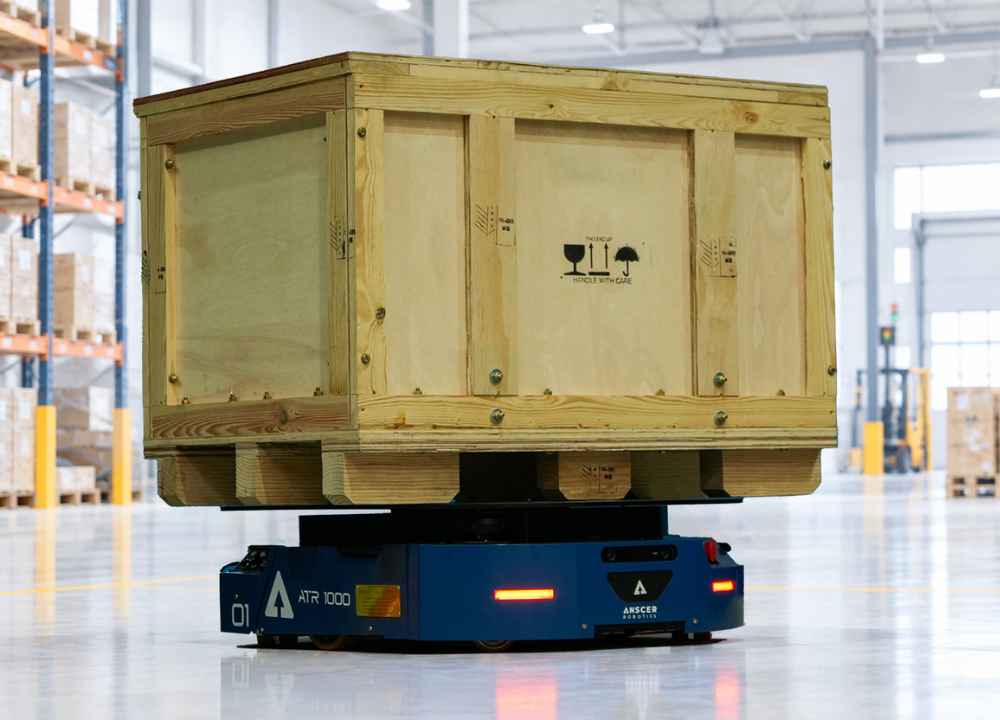
ANSCER Robotics has launched the ATR 1000 (Autonomous Turntable Robot), designed to automate heavy material movement in manufacturing plants and warehouses with limited operating space. The robot can carry loads of up to 1,000 kg while combining autonomous lifting, rotation and transport in a footprint of less than one square metre.
The ATR 1000 is intended to address a common challenge in industrial automation: moving materials between automated production processes when transfers still depend on manual handling. Narrow aisles, closely positioned equipment and changing production layouts can restrict the use of conventional material-handling systems.
Ribin Matthew, Chief Executive Officer of ANSCER Robotics, said the robot was developed to help manufacturers expand automation within existing facilities. He said its combination of heavy-load capacity, compact movement and precise load positioning would allow companies to automate material transfers between production stages.
The ATR 1000 features a turntable that rotates loads through 360 degrees, reducing the need for manual repositioning. It can dock at specific angles and provide access to multiple sides of a load at a single station, helping position materials for subsequent operations.
With a turning diameter of 1,020 mm and a maximum travel speed of 1.5 metres per second, the robot is designed to operate in confined spaces. Autonomous charging is intended to support continued operation. Applications include case picking, goods-to-person operations, line-side delivery, replenishment, work-in-progress transport, trolley handling, empty-bin returns, waste and scrap removal, and point-to-point material movement. ANSCER’s fleet-management software can coordinate the ATR 1000 with other robots and connect it to factory workflows.
The robot uses simultaneous localisation and mapping (SLAM) for navigation without physical tracks or guidance tape. QR-based navigation is also available as an option. Its safety features include 360-degree LiDAR-based collision prevention, adaptive safety zones, visual indicators and audible alarms.
ANSCER states that the safety architecture is designed to meet Performance Level d, Category 3 requirements, with safety functions developed in accordance with ISO 3691-4. The design also addresses applicable requirements under ISO 13849-1, ISO 12100, ANSI/RIA R15.08-1 and EN 1175, alongside site-specific risk assessments and integration measures. The company plans to make the ATR 1000 available in global markets, with India and the United States as priority markets.
Founded in 2020 and headquartered in Bengaluru, ANSCER Robotics develops autonomous mobile robots, pallet-handling robots, automated guided vehicles and fleet-management software. The company reports more than 100 robot deployments and over two million autonomous material-movement trips. It also has a North American presence in Plano, Texas.