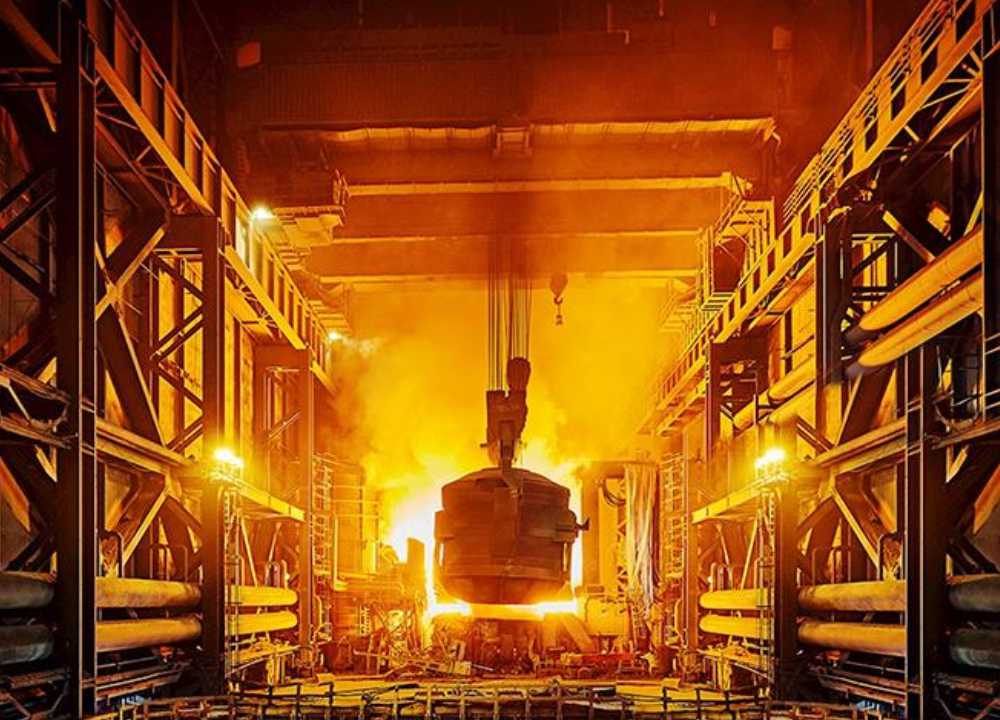
Ask any maintenance head in a steel melt shop about the failure that worries them most, and the answer is rarely a pump or a fan. It is the ladle crane. When it stops, the furnace waits, the caster waits, and molten metal has nowhere to go. What surprises many plants is how often a crane fails soon after a clean inspection report. The gearbox readings were normal. The route-based vibration check showed nothing unusual. Then a bearing or a gear tooth gives way under load. This usually isn’t a failure of people or sensors. It is a mismatch between how cranes actually run and how most monitoring programs were designed. Those programs were built for machines that run steadily. Cranes do not.
Four Reasons Cranes Break Differently
- They rarely run at a steady speed. A pump runs at the same speed for hours. A crane hoist starts, accelerates, lifts, slows, stops and reverses, many times an hour. Most of its life is spent idle or in transition. The minutes of steady, loaded running, when a developing fault shows most clearly, are short and unpredictable.
- Load changes everything. A gearbox lifting an empty hook and the same gearbox lifting a full ladle are, mechanically, two different machines. Gear mesh forces, bearing loads and shaft deflection all change with load. A fault that is invisible at no load can be obvious at full load, and the reverse is also possible.
- The damage happens in short, violent moments. Shock loads during lifting, plugging and emergency stops do disproportionate damage. A program that samples at quiet moments sees a healthy machine, while the wear accumulates during the moments it never sees.
- The environment is hostile. Melt shop cranes work above heat, dust and magnetic fields. Sensors fail, cables are damaged, and access for manual checks is limited and often unsafe. Inspections happen when access allows, not when the machine is telling its story. The result is a machine whose health can only be read at the right moment, under the right load. That is the core of the problem.
Why Conventional Monitoring Misses It
- Route-based checks catch a snapshot, not the story. A technician with a portable analyser visits the crane every few weeks. The reading depends on what the crane happens to be doing at that moment, which is often idle or lightly loaded. Faults that appear only under load go unrecorded until the next visit, or until failure.
- Fixed-interval sensors sample on the clock, not on the load. Online sensors that capture data every few minutes or hours were designed for steady machines. On a crane, most of those captures land during idle time or speed changes. The few that land in a loaded, steady window are mixed with noise and hard to compare over time.
- Alarm thresholds assume steady conditions. Common vibration severity guidelines, such as the ISO 20816 family, evaluate machines under steady operating conditions. Applied to a crane, a fixed threshold either misses real faults at light load or raises false alarms at heavy load. Teams learn to ignore the alarms, which is worse than having none.
- Inspections check compliance, not condition. Regulations such as OSHA 1910.179 in the US require frequent and periodic crane inspections, and they matter for safety. But a visual and functional inspection confirms the crane is safe to operate today. It does not trend the slow mechanical degradation inside a gearbox.
- Data without decisions. Even when plants collect good data, many programs stop at an alert. A maintenance team needs to know which component, which fault, how urgent, and what to do. Without that, an early warning becomes one more notification in a crowded inbox.
What a Crane-Ready Reliability Program Looks Like
None of this requires exotic technology. It requires designing the program around the crane, rather than borrowing one built for pumps. Five principles stand out.
- Capture on operating reality, not on the clock. Trigger data collection when the hoist is running at a stable speed under a known load, so every reading is comparable with the last.
- Read load as part of the signal. Pair every vibration reading with the operating context: speed, load and direction. A trend only means something when like is compared with like.
- Monitor the whole torque path. Faults move along the drive train, from motor to gearbox to drum. Watching only the motor misses where most crane gearboxes fail.
- Turn alerts into prescriptions. Every warning should name the component, the likely fault, the urgency and the recommended action, ideally checked by an experienced reliability analyst before it reaches the shop floor.
- Plan repairs into shutdown windows. The real prize is not just avoiding failure. It is gaining enough warning to fix the problem during a planned stop, instead of losing production to an unplanned one.
Cranes are an extreme case of a wider truth in industrial reliability: monitoring only works when it matches how a machine actually behaves. The same mismatch shows up in roller tables, mill stands and any asset with variable speed and load. The plants that get ahead will stop asking, “Are we monitoring this crane?” and start asking, “Are we reading it at the moments that matter, and are we acting on what we see?”