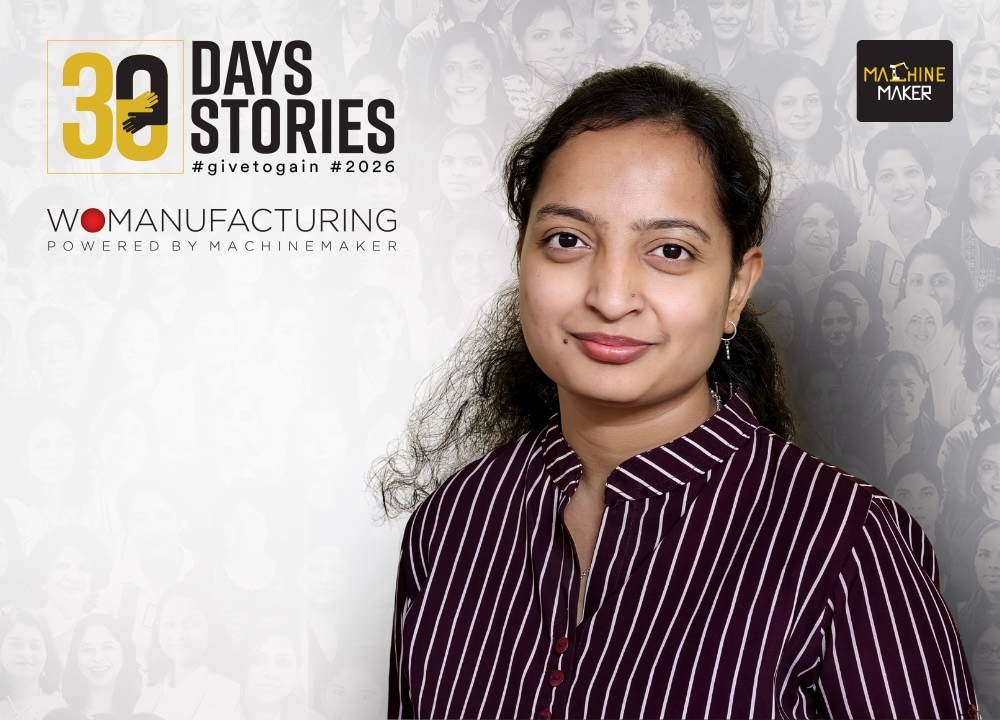
As part of the #Womanufacturing 30 Days 30 Stories campaign 2026, Machine Maker continues to bring forward the journeys of women who are contributing to India’s manufacturing and technology ecosystem in their own unique ways. While many stories highlight leadership and entrepreneurship, this campaign also recognises young professionals who are entering the industry and building their careers from the ground up. One such journey is that of Pratiksha Birajdar, a Junior Software Engineer at Daifuku Intralogistics India, where she is part of a team developing digital systems that power modern warehouse operations.
Daifuku Intralogistics India Private Limited is part of the global Daifuku Group, one of the world’s leading providers of material handling and intralogistics automation solutions. The company designs and delivers systems that help manufacturers and logistics companies manage the movement, storage, and retrieval of materials inside factories and warehouses. From automated storage systems to warehouse management software, Daifuku solutions support industries such as automotive, manufacturing, retail, and e-commerce, helping them improve efficiency, accuracy, and speed in their supply chains.
Within this environment, software engineers play a crucial role in developing the Warehouse Management Systems (WMS) that connect machines, inventory, and operational workflows. Pratiksha Birajdar joined Daifuku Intralogistics India in August 2022, soon after completing her BTech in Computer Science and Technology from Shivaji University, Kolhapur. Before that, she completed a Diploma in Computer Engineering from the Maharashtra State Board of Technical Education, building a strong technical foundation in programming and system development.
At Daifuku, she works on Warehouse Management System (WMS) development, helping design and implement software modules that support inventory storage, retrieval operations, and warehouse process optimisation. Her role involves working with technologies such as Java, SQL, Oracle databases, and enterprise development tools, ensuring that the systems developed meet the operational needs of large manufacturing and logistics companies. In the course of her work, she has contributed to projects serving well-known industrial customers, where software solutions help improve warehouse efficiency and streamline logistics operations.
For Pratiksha, this role marks her first job and the beginning of a journey in a sector where software engineering, manufacturing, and logistics technology intersect.
Growing Up in Kolhapur and Discovering Technology
Pratiksha Birajdar comes from Kolhapur, a historic city in Maharashtra known for its rich culture, traditional food, and the famous Kolhapuri chappals, which have recently even appeared on international fashion runways. Growing up in this city, Pratiksha was part of a close-knit middle-class family that valued education and hard work.
Her father, Ramesh Birajdar, works in the industrial sector at a chemical factory, while her mother, Gokarna Birajdar, manages the household. She also has an elder brother, Mahesh Birajdar, who works as a software engineer at Infosys, and a sister-in-law, Kavita, who is a mathematics teacher. “My family comes from a small middle-class background,” Pratiksha shares.
Growing up in such an environment, Pratiksha saw firsthand the value of steady work and education. Her early schooling and college education were all completed in Kolhapur, where she gradually developed an interest in technology and software systems. “I did my engineering from Shivaji University in computer science.”
Her curiosity about how software works began during her school days. She was fascinated by the idea that digital systems could solve real-world problems. “I was always curious about how software works behind the scenes,” Pratiksha explains. “How logic, innovation, and technology come together to solve real-world problems.”
This curiosity eventually led her to choose software engineering as her career path, where she could explore how digital systems support real-world industrial operations.
Growing Up with a Sense of Equality
While discussions around gender equality are common in today’s professional world, Pratiksha says she was fortunate to grow up in a family where equality was always a natural part of life. “My parents always believed in equality,” she says. “Whatever opportunities my brother received, they ensured I received the same.”
She also recalls that her school environment played an important role in shaping her outlook. Pratiksha studied at Vidyapeeth High School in Kolhapur, an institution with a long history that encouraged every student to explore knowledge freely. “The school had a Gurukul-like concept where everyone had the opportunity to learn anything, anytime,” she recalls.
Because of this environment at home and school, the idea that certain careers were meant only for men or women never strongly influenced her early ambitions. However, as she began interacting more with broader society and the professional world, she noticed that such perceptions still exist. “In society, sometimes people think that women cannot perform certain technical roles as well as men,” she says. “They believe women may not be as physically strong or capable.”
Despite these perceptions, Pratiksha chose not to let such assumptions influence her choices.
Today, working in the field of automation and intralogistics software systems, she is part of a sector that many still consider male-dominated. Yet her journey so far has reinforced her belief that capability and dedication matter far more than stereotypes.
Work has no Gender: Finding Confidence in Automation
Daifuku Group, as a multinational enterprise, believes in empowering the youth to become the leaders of tomorrow. Through campus placements across colleges, the company searches for young talent, provide them with opportunities of learning and growth and help them make their paths to success. At one such placement drives, Pratiksha found her future.
“This is my first job after my college campus placement,” Pratiksha shared how her professional journey started with Daifuku Intralogistics India. For a young engineer stepping into the world of industrial automation and warehouse management systems, the transition from college to a global technology company was both exciting and challenging.
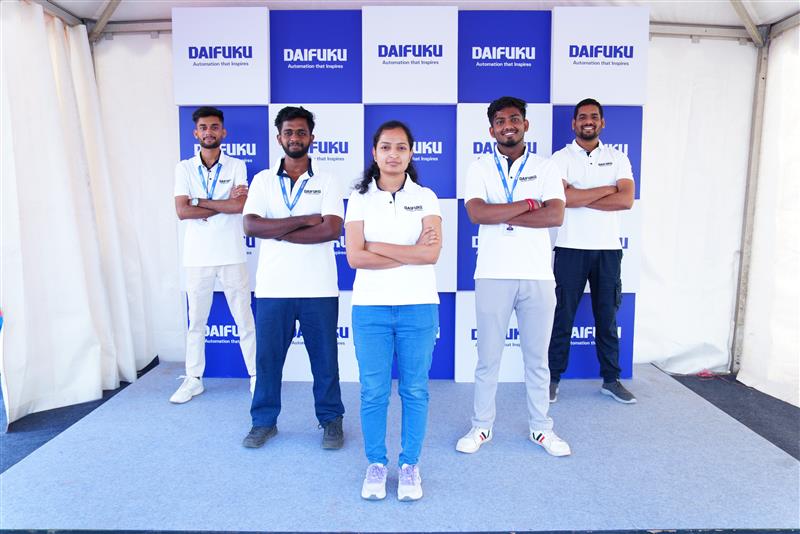
On her first day at the office, she noticed something that many young women entering technical industries experience. “When I entered the office on my first day, there was only one woman in the office and around forty men,” she recalls. A bit challenged and confused, she found a reassuring moment that shaped her confidence. Her first manager, Sanskar Godha, who led the software department at that time, reassured her that capability has nothing to do with gender.
“He told me that work has no gender,” she says. “Anyone can do anything if they believe in themselves and find their comfort in the work.”
Her present manager, Vishal Mane, continues to push her beyond her limits and has complete faith in her capabilities, even when clients or other team members have their doubts.
Over time, her responsibilities expanded beyond office-based development work. As part of her role in developing warehouse management system solutions, she also began interacting with customers and visiting industrial sites. These client visits exposed her to a variety of manufacturing environments, including some of the leading manufacturing houses in India.
Initially, stepping into these environments felt slightly unfamiliar. But as she continued working with clients and solving technical problems, she realised that professional capability quickly becomes the most important factor. “As a working professional, I feel that skills and knowledge matter the most,” she explains. “It is not about whether you are male or female.”
In many of these workplaces, she again noticed that women engineers were rare on the shopfloor. While automation and technology are creating new opportunities, the number of women working directly in plant environments is still limited. The growing role of automation could open more opportunities for women on the shop floor, but Pratiksha believes certain practical factors still influence participation.
Many manufacturing environments demand long hours on-site, extended periods of standing, and operational flexibility, which can pose challenges for women employees if the workplace is not supportive. “Women can definitely do the work,” she explains. “But companies need to provide a safe environment, flexible work culture, and supportive policies.”
In some of the client facilities she has visited during commissioning activities, Pratiksha noticed that companies introduce operational adjustments for women employees. “Some companies allow women to work in the first shift, while later shifts are handled by men.”
Despite these realities, she believes the situation is gradually evolving. With better workplace infrastructure, stronger safety policies, and more flexible work cultures, the number of women participating in manufacturing and automation roles can increase over time. Pratiksha also points out that organisations like Daifuku encourage diverse perspectives and inclusive work environments. When she had joined, she was the second female employee. But over the last couple of years, the management of Daifuku Group took initiatives to empower women and now the company has over 20 women employees in their workforce. Such initiatives, Pratiksha believes, will help create more opportunities for women in the industry in the years ahead.
“It may take time,” she says, “but slowly it can change.”
Technology Shaping the Future of Manufacturing
When Pratiksha joined Daifuku Intralogistics India, she initially imagined that her role as a software engineer would largely remain in the office. Like many young engineers entering the software field, she assumed most of her work would revolve around development tasks and system configuration.
However, the reality turned out to be very different.
“It was a completely new experience for me,” Pratiksha says. “I thought that working in automation software meant all the work would happen in the office.” Soon after joining the company, she was introduced to the full lifecycle of Warehouse Management System (WMS) implementation. Her team encouraged her to visit client sites and observe how warehouse operations actually function on the ground. “Every client has different workflows, different production systems, and different ways of managing their warehouses”, she explains.
These visits helped her understand the real impact of technology in industrial environments. Instead of viewing software as just lines of code, she began to see how digital systems directly influence efficiency, accuracy, and operational performance inside factories and warehouses. “Watching how technology can transform warehouse operations is very inspiring,” she says. “You see how WMS can solve real problems, optimise timing, and help companies improve their operations.”
For Pratiksha, these experiences turned her job into a continuous learning journey. Each project and each customer site bring a different perspective on how automation and software solutions can support modern manufacturing and logistics. “It is really an enjoyable experience,” she says. “You realise how technology is shaping the future of manufacturing.”
Building Awareness and Confidence for the Future
When asked about the theme of International Women’s Day, “Give to Gain”, Pratiksha believes that the most important step to encourage more women to enter the manufacturing and automation industries is raising awareness. During her engineering education, she had very little exposure to warehouse automation and intralogistics technology.
“When I was studying engineering, I did not know much about this industry,” she explains. “So, the first step is creating awareness in colleges about automation and manufacturing.” She believes industries can play a key role by engaging with educational institutions and helping students understand emerging career opportunities.
“Automation and warehouse technology are fast-growing industries,” she says. “Both men and women can build careers in this field.” At the same time, she encourages young students to build the right mindset for the future. “Believe in yourself. Be adaptable. Be a quick learner,” she advises. “And always stay curious about the future.”
For Pratiksha Birajdar, this journey represents the beginning of a promising career at the intersection of software engineering, automation, and modern manufacturing, a field where technology continues to transform how industries operate.