
The fast-paced development of robotics is transforming the harsh manufacturing sector, particularly in the areas of palletising, depalletizing, and warehouse automation. The operations that used to be human labour-based, fraught with mistakes, and variable have been turned into a precision-engineered, data-driven ecosystem that guarantees improvements in productivity, dependability, and safety at the workplace. As the global supply chains get more complicated and the customers’ demands are leaning towards quicker and more reliable deliveries, manufacturers are willing to experiment with advanced automation technologies to optimise their end-of-line and warehouse operations.
The Shift Toward High-Payload Robotics
Palletising in the past was greatly dependent on manual labour or low-tech automation systems with little flexibility and limited load capacity. However, today, the emergence of high-payload, next-generation robotic arms and gantry systems has opened up new horizons for manufacturers. The modern robots can take on weights ranging from 50 kg all the way up to more than 1,000 kg with incredible speed and accuracy. These systems are designed to operate non-stop through multi-shift work without getting tired or having the risk of being inconsistent.
The combination of servo-driven mechanisms, cutting-edge gripper technology, and advanced force-sensing has changed the abilities of robots. They can now manage intricate product shapes, various packaging materials, and high-speed cycles. Such a mixture of capabilities means that manufacturers are able to have mixed-SKU environments, which is a fundamental requirement for the modern warehouse and fast-moving consumer markets.
The Role of AI and Vision Systems in Palletising Transformation
The newer palletising solutions are no longer based only on pre-established patterns. AI and machine vision, on the other hand, facilitate the process of dynamic decision-making. Vision-guided robotic palletizers are capable of recognising the box’s position, scanning its barcode, measuring its weight, and even testing its stability. They can, in fact, change the pallet build patterns during the process to maximise the filling of space with stability.
The robots are also trained by machine learning algorithms to cope with packaging irregularities such as crushed boxes, bags that are slightly off-size, or slippery bundles wrapped in shrink wrap, issues that would cause earlier automation systems to fail. Such a degree of wit results in the whole production line running smoothly with little or no downtime.
The Rise of Robotic De-Palletising
Manufacturing and warehousing have always considered depalletizing as one of the hardest tasks in terms of physical demands. Heavier bags, cartons, and drums that are unloaded one after another make workers’ lives difficult and their health exposed to repetitive strain injuries and safety hazards. Robotic depalletizers, on the other hand, are able to take care of that by eliminating the most strenuous ones and, at the same time, keeping the cycle time constant.
The most modern depalletizing robots are equipped with 3D vision and depth sensors for pattern recognition of layers, scanning for damaged products, and identifying mixed pallets, which is increasingly becoming a challenge for more and more warehouses with the rise of multi-SKU shipments. The robots determine the safest and quickest pick sequence and vary their grip strength according to packaging type, thus ensuring safe material handling even in complex scenarios.
End-to-End Warehouse Automation
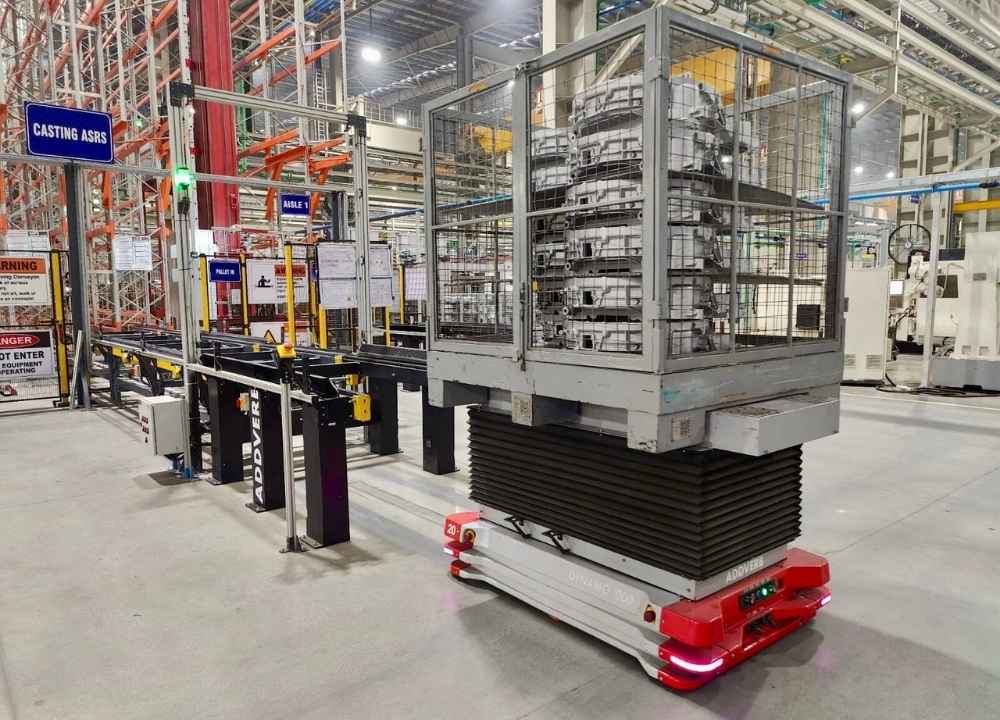
Robotics is not just limited to palletising but is also influencing the whole warehouse ecosystem. Automated Guided Vehicles (AGVs) and Autonomous Mobile Robots (AMRs) are being used more and more for moving heavy loads, refreshing stocks in storage areas, and taking pallets to the shelves. These systems are fully integrated with Warehouse Management Systems (WMS), which track materials in real-time, thus eliminating delays and enhancing total throughput.
High-payload AMRs with sophisticated navigation support can move pallets entirely without human intervention, thus doing away with the requirement of manual forklifts. This transition not only cuts down on safety concerns by decreasing forklift accident likelihood but also contributes to a more efficient and less chaotic logistics setup.
The ROI Case: Why Heavy-Duty Manufacturers Are Adopting Robotics
Though the initial cost of robotic palletising or depalletizing might appear considerable, the benefits in the long run are more than the drawbacks for firms that are engaged in large-scale operations. The main drivers of ROI are:
– Less reliance on human labour in the very repetitive, unsafe tasks
– Reduction in mistakes and increased uniformity
– Output is boosted even in the case of multi-shift production
– Use of space to the fullest with intelligent stacking patterns
– Safety compliance has increased, and injury-related downtime has been reduced
Aside from keeping the product quality through strict control and lowering the potential product damage, robotics is a big help when manufacturers deal with abrasive materials, heavy bags, or irregular packaging.
The Road Ahead
The combination of robotics with artificial intelligence, internet of things, and analytics based in the cloud will gradually lead heavy-duty manufacturing to total autonomy, with the self-optimising floor for the warehouse as an endpoint. Co-bots will be working with humans in the future, while predictive maintenance will, to a great extent, eliminate unproductive periods, and digital twins will allow real-time simulation of the output performance in palletising.
Today, manufacturers that adopt cutting-edge robotic systems will have not only the advantages of a future market but also the competitive positioning through their quick current moves in the global market, which is demanding and thus driven by efficiency.