Forty years of industrial automation produced a stack that executes decisions with astonishing precision and understands almost nothing about the physical health of the machines executing them. A PLC will hold a setpoint to the third decimal while the gearbox beneath it grinds toward failure, because nothing in the deterministic control hierarchy was ever designed to see degradation. The industry’s answer so far, sensors feeding dashboards feeding alarm queues, has moved the blindness one screen to the right without curing it. This article argues that the next layer of the automation stack is Physical AI: models that carry the governing physics of the machine inside them, estimate its true mechanical state continuously, and close the loop back into control, scheduling, and maintenance execution. It offers a working definition, an architecture, a deployment blueprint drawn from heavy process industry, and the operating-model changes that decide whether any of it survives contact with a real plant.
The Architectural Dilemma: A Stack Built to Act, Not to Understand
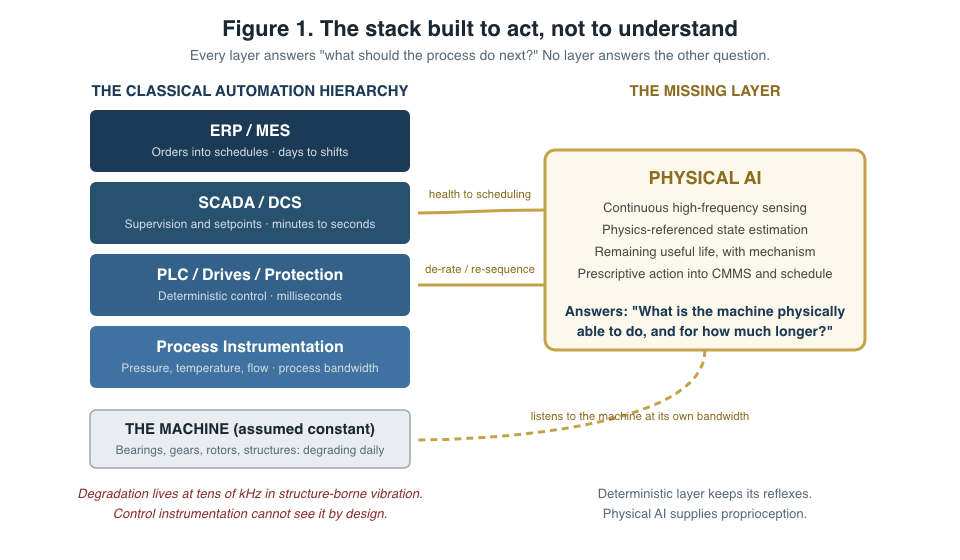
The classical automation hierarchy is a triumph of decision execution. At the bottom, drives and protection relays act in milliseconds. Above them, PLCs and DCS loops hold the process at setpoint, deterministically, exactly as IEC 61131-3 logic dictates. Above that, MES and ERP translate orders into schedules. Every layer answers the same question: what should the process do next?
No layer answers the other question: what is the machine physically able to do, and for how much longer? This is not an oversight; it is a design inheritance. Deterministic control assumes the plant’s iron is a constant. A PID loop treats the raw mill, the compressor, the kiln drive as a fixed transfer function. But the iron is not constant. Bearings develop subsurface fatigue that surfaces as spalling. Gear teeth crack at the root and modulate the mesh. Foundations settle, couplings misalign, rotors foul and unbalance, cavitation erodes impellers. Every one of these mechanisms has a known physical signature, outer-race ballpass frequencies, gear mesh sidebands spaced at shaft speed, vane-pass pressure pulsations, twice-line-frequency magnetic anomalies. And almost none of those signatures is visible to the control layer, because control instrumentation samples process variables at process bandwidth: pressures, temperatures, flows, in seconds. Degradation lives in structure-borne vibration at tens of kilohertz. The control system is not merely uninformed about machine health; it is instrumented in a way that makes the relevant physics invisible.
The first-generation fix was condition monitoring as a parallel silo: route-based vibration rounds monthly, or online systems feeding a dashboard in the reliability office. This produced the current predicament, which I have called the dashboard delusion: plants that are data-rich and decision-poor. The telemetry exists, but it terminates in a screen that a shrinking team of analysts must interpret, triage, and manually convert into work. Alarm thresholds set wide to avoid nuisance trips miss early faults; set tight, they generate the alarm fatigue that trains operators to ignore them. The measure of the failure is simple: ask any plant how many of its vibration alarms last quarter became a scheduled work order before the machine forced the issue. The honest answers are sobering.
So the dilemma is architectural, not technological. We built a stack that acts without understanding, then bolted on understanding that cannot act.
The Framework: From Waveform to Work Order
Closing that gap requires a pipeline with four stages, and the discipline to treat them as one system rather than four products. Stage one: sense at the physics, not at the process. Continuous, high-frequency, tri-axial vibration at the bearings and gearboxes of critical trains, supplemented by temperature, magnetic flux, and acoustic emission where the failure modes demand it. Sampling rates must capture the high-frequency band where bearing and gear faults first appear, long before they migrate down into velocity spectra. Edge devices do the first analysis locally: time-synchronous averaging and order tracking to normalize non-stationary operation, envelope spectra for bearing kinematics, feature extraction so the network carries insight rather than firehose. This keeps OT security intact, because feature telemetry on a segmented backhaul never touches the control VLAN, and the deterministic layer continues doing exactly what it does best.
Stage two: infer against physics, not against averages. Purely data-driven anomaly detection fails in heavy industry for a structural reason: the plant never gives you enough labeled failures of its own machines, and its normal operation is too variable for naive baselines. The inference layer must be seeded with what we already know. Defect frequencies are computable from bearing geometry and gear counts. Severity referencing starts from ISO 10816 and 20816 and adapts to duty. Physics-informed neural networks have a precise role here: by embedding the governing equations, rotor dynamics, structural modes, fatigue laws, as constraints on the learned model, a PINN can estimate stress and degradation states at locations no sensor occupies, and extrapolate remaining useful life credibly from sparse data. The physics does the work the missing training data cannot. The output of this stage must be a fault hypothesis with a damage mechanism attached and a confidence stated, not an anomaly score. “Stage-two outer race defect, drive-end bearing, RUL band six to ten weeks under current load” is actionable. “Asset health 61” is decoration.
Stage three: prescribe, do not merely predict. Prediction without execution is the dashboard delusion with better math. The prescriptive layer converts the hypothesis into a validated work package: isolation requirements, parts against stock, labor and duration, a recommended window aligned to the production schedule. This is where small language models earn a place, fine-tuned on the plant’s own maintenance ontology, CMMS history, and OEM documentation, drafting the package a reliability engineer approves. The human moves from doing the paperwork to governing the decision.
Stage four: close the loop into operations. The health estimate becomes an input to control and scheduling, not only to maintenance. A degrading hoist can be de-rated in its acceleration profile, trading seconds of cycle time for weeks of life. A compressor carrying a developing fault can shed to the spare before the trip, not after. A scheduler that knows the state of its machines re-sequences production around a planned intervention at near-zero cost, instead of absorbing an unplanned stop at maximum cost.
The Deployment Blueprint: Where Programs Actually Die
Most industrial AI programs do not fail on algorithms. They fail on commissioning discipline, environment, and organizational wiring, so those deserve equal rigor.
Environment first. Heavy industry is hostile instrumentation territory: radiant heat above molten metal, cement dust that defeats optical methods, washdown, vibration levels that fatigue the sensor mounts themselves. Sensor selection, mounting, and battery chemistry are engineering decisions, not procurement line items. Wireless propagation inside steel structures requires a survey, not an assumption.
Commissioning decides data quality forever. Every monitored bearing’s geometry recorded so defect orders are computed rather than guessed. A baseline campaign across the real duty envelope, not a single afternoon of convenient operation. Asset context mapped so that an inference about a gearbox knows which production line, which spare, which criticality ranking it inhabits. A model without context produces findings without consequences.
Latency budgets should be honest. Machine protection for acute events belongs at the edge and in existing protection relays, in milliseconds, exactly where the deterministic stack already excels. The analytic layer operates on minutes to weeks. Architecting analytics as if they were a safety system produces something expensive that is still not a safety system; the two must be designed as complements, not competitors.
Integration is the last mile and the usual grave. Outputs must terminate in the systems the plant already runs: hypotheses and RUL into the historian beside process data, work packages into the CMMS, health states into scheduling. A reliability insight that requires a fourteenth screen has already failed. And the organizational wiring matters as much as the data wiring: someone must own the response to a prescriptive recommendation, with authority to act and a metric that rewards acting early. Technology deployed into an operating model that punishes planned interventions and celebrates heroic repairs will lose to the culture every time.
Physical AI and the Self-Aware Plant
Assemble the stages above across a plant’s critical trains and something qualitatively new emerges: a continuously updated, physically grounded estimate of the plant’s own mechanical integrity, available as an input to every decision. That is what the term Physical AI should mean, stripped of its marketing: not robots as spectacle, but models that carry the laws of the machine inside them, acting on the machine, under policies that humans design and govern.
The end state is not a lights-out plant. It is a plant with a second nervous system. The deterministic layer keeps its reflexes: fast, local, provably safe. The physical AI layer supplies proprioception, the sense of the machine’s own body, and feeds judgments upward: de-rate here, re-sequence there, intervene within this window. Autonomy enters as an operating model, policy by policy, with human approval loops where consequence is high and automation where it is routine, not as a software module installed on a Tuesday. Plants that take this path will discover the same thing aviation discovered about autopilot: the point was never to remove the human, it was to change what the human spends judgment on.
Fund the missing layer, not another dashboard: continuous edge sensing on critical trains, physics-referenced inference, prescriptive output terminating in the CMMS and the schedule. Demand damage mechanisms and RUL bands from any system you evaluate, and reject anomaly scores without physics behind them. Design the division of labor explicitly: deterministic control keeps protection and setpoints, the AI layer estimates state and recommends, humans govern policy. Measure the program on one number that cannot be gamed: unplanned downtime converted into planned interventions. And sequence it so the first validated save funds the fleet. The constraint is no longer sensing, bandwidth, or models. It is the architecture, and the willingness to let the plant’s machines finally be heard by the systems that command them.