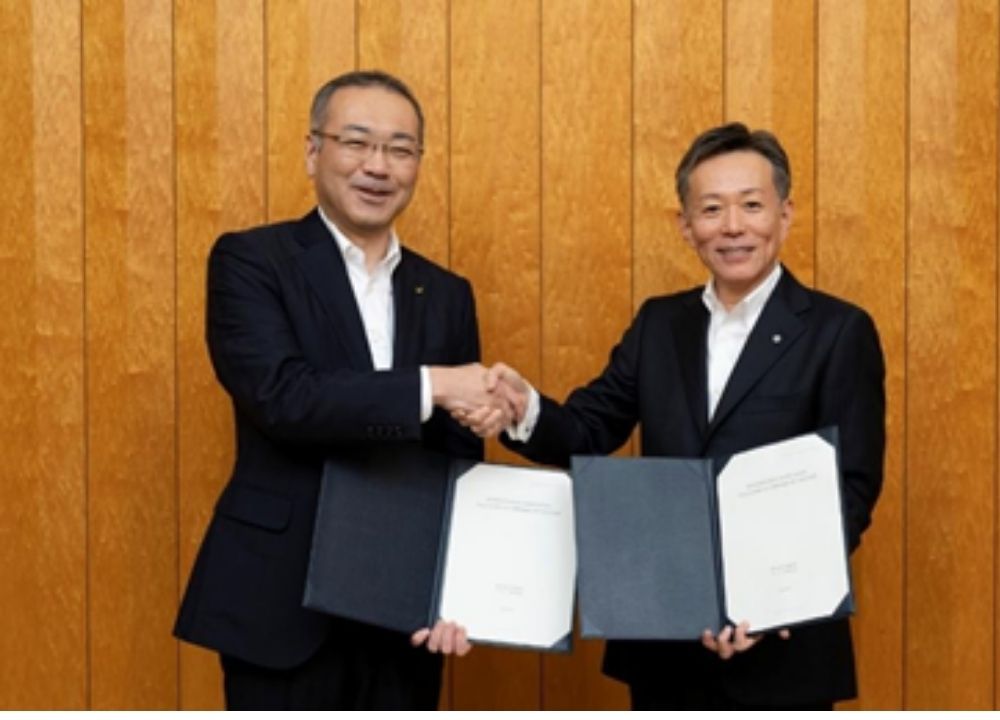
Hitachi and FANUC have entered into a strategic partnership to accelerate the development and deployment of Physical AI technologies for manufacturing. The collaboration combines Hitachi’s artificial intelligence capabilities with FANUC’s industrial robotics and automation expertise.
The companies will focus on developing Physical AI applications that can operate in production environments and adapt to changing conditions and manufacturing tasks. The approach is intended to enable AI systems to learn continuously from real manufacturing processes rather than relying only on simulated environments.
As part of the partnership, factories operated by the Hitachi Group will serve as real-world validation sites for the development and training of Physical AI applications. Initial use cases include picking parts, handling components with different shapes and supporting production changeovers.
The collaboration will bring together Hitachi’s AI technologies, including HMAX Industry, with FANUC’s AI-enabled industrial robots, control technologies and robotics experience. The companies aim to develop manufacturing systems that can perform more tasks autonomously while maintaining the reliability and precision required in industrial operations.
“Hitachi has been working to transform social infrastructure by combining AI with the domain knowledge it has accumulated at social infrastructure sites,” said Toshiaki Tokunaga, president and CEO, Hitachi, Ltd. “Through this strategic partnership with FANUC, we aim to innovate manufacturing sites that support people’s lives and industries through the use of Physical AI.”
Mr Tokunaga said the companies would combine FANUC’s industrial robotics technologies with Hitachi’s manufacturing expertise, production-line engineering and digital capabilities to accelerate implementation at manufacturing sites. He also highlighted the use of Hitachi facilities as validation environments to support deployment and continuous improvement.
Kenji Yamaguchi, president and CEO, FANUC Corporation, said advances in AI are expanding its use across businesses and consumer applications, while Physical AI is enabling systems to perceive, reason and act in the physical world through robots and machines.
“This strategic partnership will accelerate the deployment of Physical AI by combining Hitachi’s advanced AI technologies with FANUC’s highly reliable products, sophisticated control technologies, AI expertise, and extensive robotics experience,” Mr Yamaguchi said.
The companies plan to use the results of their validation activities to begin deploying Physical AI solutions to customers from fiscal 2027. Potential applications span automotive, logistics, semiconductor manufacturing, pharmaceuticals, food production and advanced materials.
The partnership comes as manufacturers face labour shortages, greater production complexity and demand for flexible manufacturing systems. Hitachi and FANUC said their work will focus on practical applications that can support productivity, quality and more autonomous production processes. The companies also plan to apply the knowledge gained from their manufacturing sites to address challenges such as labour shortages and the transfer of skills and expertise between generations of workers.
FANUC Corporation is a Japan-based manufacturer of factory automation and industrial robotics solutions, with operations spanning CNC systems, industrial robots, Robomachines and related automation technologies. Headquartered in Yamanashi, Japan, the company serves industries including automotive, electronics, general manufacturing and other industrial sectors.
FANUC’s portfolio includes CNC controls and servo systems, industrial and collaborative robots, machining centres and automation software designed to improve manufacturing productivity, precision and efficiency. The company has a significant global presence and supports customers through its network of manufacturing, engineering, sales and service operations.