

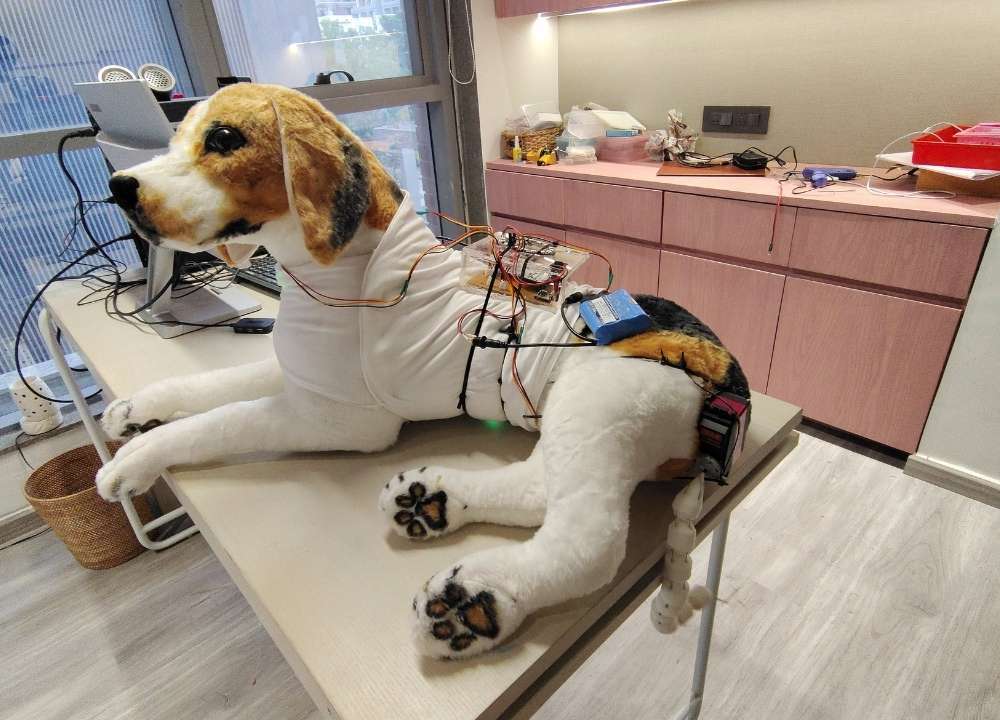
Blending empathy, technology and design thinking, 17-year-old Moksh Desai has developed a pioneering wearable robotic tail for dogs that helps tailless canines regain an important aspect of communication and balance. Titled Touch- and IMU-Driven Prosthetic Tail for Canine Communication and Balance, the innovation combines sensors, motion-tracking technology and 3D printing to create a prosthetic tail capable of mimicking natural canine tail movements.
Developed under the guidance of Dr Priyam Parikh, Assistant Professor, Product Design and Prof Parth Shah, Assistant Professor, School of Design and Manager, Makerspace, at Anant National University, the project demonstrates how interdisciplinary mentorship and access to advanced prototyping facilities can help transform an idea into a functional innovation. The project has been recognised in the International Journal of Engineering Development and Research and represents a significant advancement in animal-assistive technology.
The Innovation
Dogs rely heavily on their tails to communicate emotions, maintain balance and interact socially with humans and other animals. However, dogs that lose their tails due to injury, disease or amputation are often deprived of these essential functions.
Moksh’s innovation addresses this challenge through a smart prosthetic tail that interprets physical interactions and body movements to generate realistic tail-wagging responses. By combining touch sensing and motion analysis, the device recreates natural behavioural cues, helping dog’s express emotions while improving stability during movement.
The Significance of the Project
The project moves beyond conventional animal prosthetics, which are primarily designed for protection or cosmetic purposes. Instead, it focuses on restoring communicative behaviour and enhancing the quality of life for tailless dogs.
By integrating insights from canine psychology, biomechanics and engineering, the prosthetic tail offers a unique solution that strengthens the emotional connection between dogs and their human companions while supporting rehabilitation and mobility. The project also highlights the potential of design-led technological innovation in addressing overlooked challenges in animal welfare.
Key Features
Emotion-Sensing Technology: Capacitive touch sensors embedded within a specially designed vest detect petting and physical interaction.
Motion-Based Adaptation: An Inertial Measurement Unit (IMU) continuously tracks body tilt and movement, enabling the tail to respond dynamically.
Natural Tail Expressions: An Arduino-controlled system translates sensor inputs into realistic tail movements with varying frequencies and intensities, closely mimicking emotional expressions observed in dogs.
Safety and Comfort: The lightweight 3D-printed tail is designed for extended wear and automatically adjusts its movement to minimise strain and prevent injury.
Key Features
The project emerged from Moksh’s interest in combining technology with animal welfare. Through extensive research into canine behaviour and communication, he identified the critical role tails play in expressing emotions and maintaining balance. Recognising the limitations of existing prosthetic solutions, he set out to develop a system that could restore both functionality and emotional expression.
Working closely with mentors at Anant National University, and using the university’s state-of-the-art infrastructural facilities like makerspaces, studios and required equipment, Moksha was able to transform the concept into a fully functional prototype.
To begin with, Moksha designed, assembled and tested the sensor-based circuitry that powers the prosthetic tail on an electronics workbench at Anant, while exploring the intricacies of electronics, coding and system integration under the guidance of Dr Parikh. These explorations helped ensure that the device interprets touch and motion inputs more accurately.
The physical design and prototyping of the tail structure were developed on a 3D printing machine under the mentorship of Prof Shah. It was further fabricated in PLA to ensure more balance, durability, comfort and responsiveness. To make the tail easy to wear, sewing machines were used to develop custom-fitted jackets that house the sensors and electronic components while ensuring comfort for the animal. Furthermore, an acrylic control panel unit was fabricated using high-end laser-cutting facilities to secure and protect the electronic systems attached to the dog’s body.
Multiple rounds of testing, including simulations and mannequin-based trials, were conducted at Anant’s testing labs to evaluate responsiveness, safety and functionality before moving to real-world applications.
Implications for Animal Welfare and Rehabilitation
The prosthetic tail presents several promising opportunities:
- Restores an important form of non-verbal communication for tailless dogs.
- Supports balance and movement during rehabilitation and recovery.
- Enhances interactions between dogs, humans and other animals.
- Creates new possibilities for assistive technologies within veterinary care.
- Demonstrates how affordable and accessible technologies can improve animal well-being.
By addressing both functional and emotional needs, the innovation contributes to a more holistic approach to canine rehabilitation while showcasing how maker-centred learning environments can foster impactful solutions.
The Future Outlook
Following encouraging early results, the development team is preparing for supervised trials with dogs to further evaluate comfort, behavioural response and long-term usability. Future improvements include extending battery life, refining movement algorithms and creating customisable versions for different breeds and body sizes.
Veterinary professionals and animal welfare advocates have already shown interest in the technology, highlighting its potential to transform canine rehabilitation and assistive care. If successfully scaled, this innovation could establish a new category of animal prosthetics that prioritises not only mobility but also emotional expression and social connection.
The project also demonstrates how access to advanced fabrication facilities, interdisciplinary mentorship and a culture of experimentation can empower young innovators to address meaningful real-world challenges.








