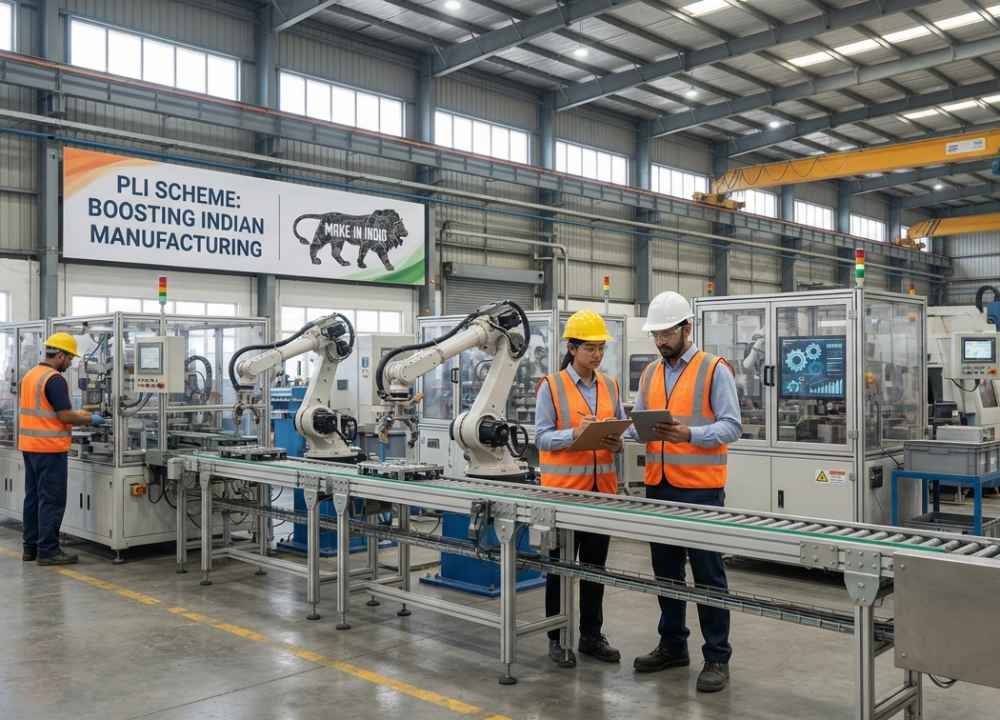
“India’s push for next-generation reforms, backed by production-linked incentives and policy stability, has made the country a global bright spot for growth and hope” – Prime Minister Narendra Modi.The Production-Linked Incentive (PLI) scheme, introduced across 14 strategic sectors, has emerged as one of the most significant policy interventions in India’s journey of becoming a global manufacturing powerhouse. The recently released `Impact Assessment of PLI Schemes’ report by NITI Aayog, prepared in collaboration with IIM Ahmedabad, provides an encouraging assessment of the progress made so far. More importantly, it offers valuable insights into what India needs to do next to sustain its manufacturing growth momentum.
The numbers certainly make a strong case for the scheme. As of March 2026, PLI schemes have attracted cumulative investments of approximately ₹2.40 lakh crore, generated production and sales worth ₹22.66 lakh crore, and created employment opportunities for around 8.49 lakh individuals. Against the combined financial outlay of ₹1.91 lakh crore, the government has disbursed ₹35,354 crore in incentives. Nearly 70% of the targeted segments are broadly on track, with electronics, telecommunications and pharmaceutical drugs emerging as notable performers.
These figures reflect more than just financial commitments. They indicate growing investor confidence in India’s manufacturing potential and the willingness of domestic and international companies to expand their production footprint in the country.
PLI – Changing the dynamics of Indian manufacturing
One of the most significant contributions of PLI has been its shift in approach towards industrial development. Unlike conventional incentive mechanisms, PLI links financial support to incremental production and sales. Companies receive incentives only after meeting prescribed investment and production benchmarks. This performance-oriented structure encourages businesses to invest in capacity, improve productivity and achieve economies of scale.
In my view, this is an important departure from the traditional approach of promoting manufacturing primarily through protection or input-based subsidies. PLI is designed to make manufacturing in India more competitive by encouraging companies to improve their own capabilities.
The scheme has also helped India capitalise on the ongoing restructuring of global supply chains. International manufacturers are increasingly exploring alternative production destinations to diversify their supply-chain risks. India’s large domestic market, improving infrastructure, skilled workforce and policy support offer an attractive proposition.
However, attracting manufacturing investments is only the first step. The larger objective must be to establish India as an integral part of global value chains, where the country is not merely assembling products but also manufacturing critical components, developing technologies and creating intellectual property.
Sectoral success stories
The sector-wise performance highlighted in the NITI Aayog report demonstrates how targeted policy interventions can accelerate industrial development.
Large-scale electronics manufacturing is among the strongest examples. The PLI scheme has helped expand mobile phone manufacturing, attract global manufacturers, and strengthen India’s position as a key electronics production destination. This growth has also created a foundation for developing the domestic electronics component ecosystem.
The white goods sector offers another encouraging example. Domestic value addition in air conditioners and LED products has increased from approximately 20% to 55%, indicating progress in localising components and strengthening domestic manufacturing capabilities. This is particularly important because deeper localisation reduces import dependence and creates opportunities for Indian component manufacturers.
In pharmaceuticals, the scheme has supported investment and production growth, strengthening India’s capabilities in strategic pharmaceutical products. The automobile and auto components sector has witnessed substantial investment, with ₹44,326 crore invested by March 2026. Similarly, solar PV manufacturing capacity has expanded dramatically, from around 8 GW to nearly 116 GW, with approximately 24 GW directly attributable to PLI-supported projects.
The telecommunications, food processing, medical devices and drone sectors also demonstrate encouraging developments.
These examples highlight an important aspect of PLI: its impact extends beyond beneficiary companies. As large manufacturers expand, opportunities emerge for ancillary industries, component suppliers, logistics providers, technology partners and MSMEs. This multiplier effect can gradually create stronger industrial clusters and more integrated manufacturing ecosystems.
The gaps that India cannot afford to ignore
Despite the encouraging progress, the report also highlights several areas requiring attention.
The most noticeable gap is employment generation. While investment has reached approximately 76% of the full-tenure target and production and sales have achieved around 64%, employment generation stands at only 28% of its target. This disparity deserves attention, particularly in a country where employment creation remains a major economic priority.
Capital-intensive manufacturing, automation and the gestation period associated with setting up factories explain part of this gap. Nevertheless, India must ensure that manufacturing growth translates into wider employment opportunities through ancillary industries, supplier networks and labour-intensive segments.
Another important concern is domestic value addition. In sectors such as electronics and telecommunications, manufacturing continues to be substantially concentrated in final assembly, with considerable dependence on imported high-value components. If India wants to become a genuinely competitive manufacturing destination, it must move progressively towards component manufacturing, materials processing, precision engineering and advanced technologies.
The relatively early progress in advanced chemistry cell batteries also highlights the challenges associated with technological capabilities, imported machinery, upstream material availability and skilled manpower.
Export competitiveness is another area that requires a sharper focus. Manufacturing capacity alone does not guarantee success in international markets. Indian manufacturers must consistently meet global benchmarks in quality, cost, technology, reliability and delivery timelines.
What should the Government do next?
The next phase of PLI should focus on moving from capacity creation to ecosystem development.
- Deepen domestic value addition. The government should prioritise critical components, sub-assemblies, industrial materials and technologies where India has significant import dependence. Incentives should encourage genuine localisation rather than merely increasing final assembly volumes.
- Strengthen infrastructure & ease of doing business. Reliable power, efficient logistics, industrial parks, ports, multimodal connectivity and faster regulatory clearances are essential. Central and state governments must work together to reduce operational bottlenecks and ensure that manufacturing investments become commercially viable.
- Introduce demand-side interventions. This is an important recommendation also highlighted in the report. PLI has largely focused on encouraging manufacturers to increase production. The next generation of industrial policies should complement this supply-side push with demand-side measures. These could include strategic government procurement, export market development, incentives for downstream industries and measures that encourage the adoption of domestically manufactured high-value products.
- Strengthen R&D and technology transfer. India needs to encourage collaboration between manufacturers, academic institutions, research organisations and global technology companies. Greater investment in product development, automation, advanced materials, semiconductor technologies and industrial innovation will help Indian companies move up the value chain.
- Improve policy implementation & monitoring. The report rightly identifies the need to standardise data collection across ministries. Consistent reporting of investment, production, exports, employment and domestic value addition will enable better evaluation and timely corrective action. Sector-specific targets should also reflect technology cycles, capital requirements and realistic gestation periods.
Industry must move beyond incentive-led growth
While government support has played an important role, the long-term success of India’s manufacturing ambitions will ultimately depend on the competitiveness of its industries.
Indian manufacturers must use the PLI opportunity to invest in modern manufacturing technologies, automation, digitalisation, quality management and operational efficiency. Incentives should act as catalysts for transformation, not become the primary justification for business expansion.
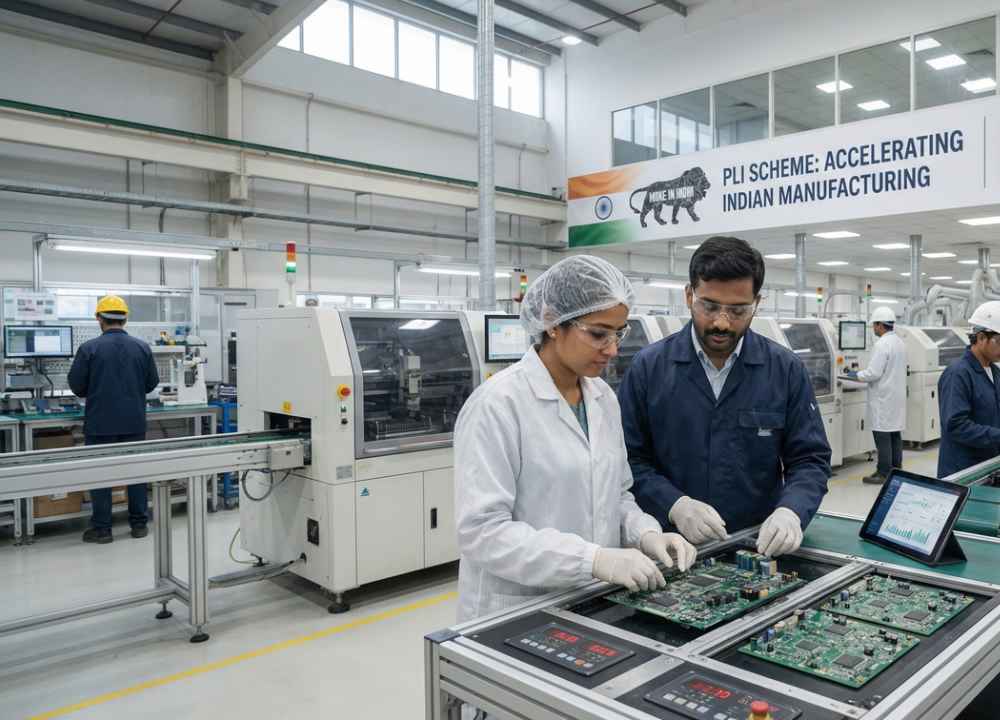
Companies must also increase investments in R&D, product engineering and indigenous technology development. Building strong supplier relationships, developing MSME partners and improving local sourcing capabilities will be equally important.
Another critical priority is to develop a global market orientation. Indian manufacturers should benchmark themselves against international competitors, obtain globally recognised quality certifications, build international distribution networks and understand the evolving requirements of overseas customers.
MSMEs deserve particular attention. Their participation in global supply chains can significantly strengthen domestic value addition and employment generation. Large manufacturers should actively develop local supplier ecosystems by supporting smaller companies with technology, quality standards, financing access and capability development.
The next chapter – Making India a global manufacturing powerhouse
The NITI Aayog assessment establishes that PLI has delivered meaningful progress, although the impact varies across sectors and several outcomes are still emerging. The fact that only 18.51% of the total financial allocation has been disbursed should also be viewed in the context of the scheme’s performance-linked structure, under which incentives are released against verified achievements.
In my assessment, India should not view PLI merely as a time-bound incentive programme. It should be treated as a foundation for building long-term manufacturing competitiveness.
The next phase must focus on five interconnected priorities: scale, localisation, innovation, skilled employment and exports. The government must create an enabling environment, while industry must demonstrate the ambition and commitment to compete globally without permanent dependence on fiscal incentives.
India has already demonstrated that it can attract global manufacturers and establish large-scale production capabilities. The bigger opportunity now is to develop indigenous technologies, strengthen component ecosystems, create globally recognised manufacturing brands and become a preferred sourcing destination for international markets.
Ultimately, the success of PLI will not be measured only by the investments attracted or the production generated during the scheme’s tenure. It will be measured by how many globally competitive manufacturing companies India creates, how deeply it integrates into international supply chains, and how sustainably it strengthens its industrial capabilities. The first phase of PLI has helped India build manufacturing momentum. The next phase must make that momentum self-sustaining, innovation-driven and globally competitive.