When the Government of India launched the Production Linked Incentive (PLI) Scheme in 2020 under the Atmanirbhar Bharat mission, it marked a clear shift in how the country approached industrial policy. Instead of offering upfront subsidies, the government chose to reward manufacturers only for what they actually produced and sold. Six years on, a review released by the Government through the Press Information Bureau (PIB), using data up to 30 June 2026, shows large gains in investment, production, exports and employment across all 14 sectors the scheme now covers. For India’s manufacturing community, the numbers offer both a scorecard and a roadmap.
The design of the scheme is simple. A PLI is a payment the Government makes to a manufacturer as a percentage of its incremental sales of goods made in India, meaning sales above a fixed base year. To qualify, companies must also meet minimum investment and sales thresholds. Each sector’s scheme is run by the relevant administrative ministry, which keeps the incentive close to the industry it is meant to serve. The scheme began with mobile phones and electronic components and was later expanded to 14 sectors.
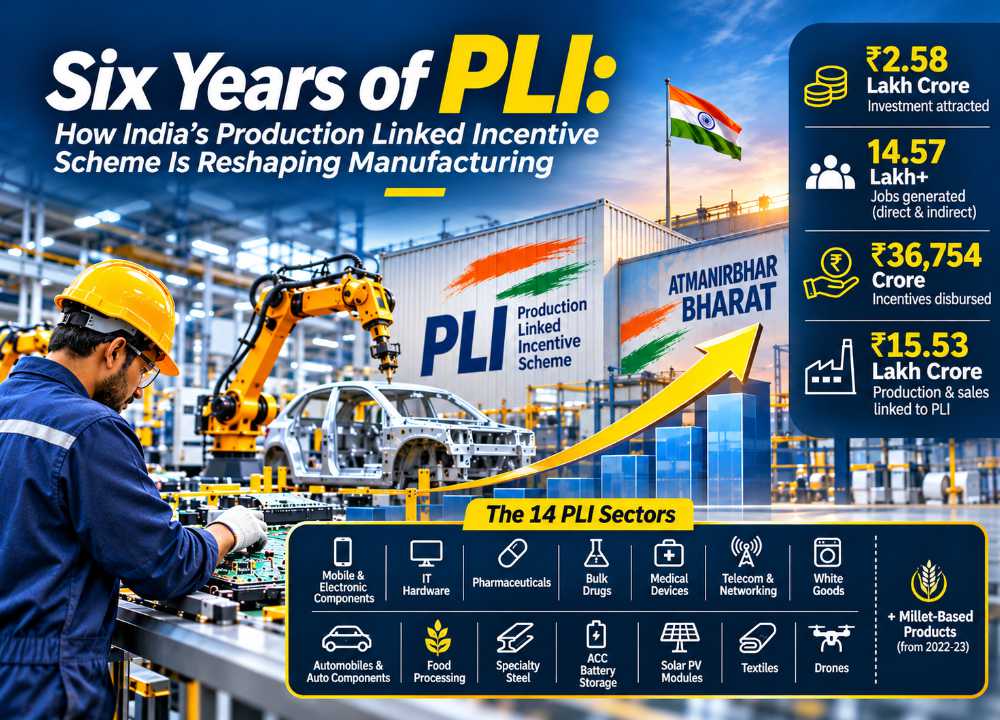
Those 14 sectors are mobile and electronic components, IT hardware, pharmaceuticals, bulk drugs, medical devices, telecom and networking, white goods, automobiles and auto components, food processing, specialty steel, advanced chemistry cell (ACC) battery storage, solar PV modules, textiles and drones. In 2022-23, a separate PLI Scheme for Millet-Based Products was created from savings under the food processing scheme. Together, they cover nearly every part of the value chain that matters to India’s ambition of becoming a global manufacturing hub.
Rs 2.58 Lakh Crore Investment, 14.57 Lakh Jobs
According to the Department for Promotion of Industry and Internal Trade (DPIIT), the PLI schemes have attracted investment of Rs 2.58 lakh crore and generated employment of over 14.57 lakh people, direct and indirect, as of 30 June 2026. Cumulative incentives disbursed to beneficiary companies stand at Rs 36,754 crore. The programme has also been linked to production and sales of around Rs 15.53 lakh crore. These figures show that every rupee of incentive paid out has been matched by many times that amount in private investment and output, which is exactly what a performance-linked model is designed to achieve.
Electronics remains the clearest success story. Of the Rs 36,754 crore disbursed, the largest share, Rs 19,090.98 crore, went to large-scale electronics manufacturing. India’s transformation from an importer of mobile phones to a major manufacturer and exporter of them is now widely cited as the defining outcome of the scheme. Pharmaceuticals and bulk drugs form the second pillar, where the PLI has helped reduce India’s dependence on imported active pharmaceutical ingredients. The Government has also extended the PLI Scheme for Medical Devices up to 2035-36 and invited fresh applications, a signal of long-term confidence in the sector.
Automobiles and auto components, along with ACC battery storage, form the third pillar and are directly tied to India’s electric vehicle transition. These schemes are building the capacity India will need as mobility shifts away from internal combustion engines. Clean energy forms the fourth, through the solar PV module scheme, which aims to build a domestic supply chain for one of the fastest-growing energy segments in the world. Textiles also remains active, with the Ministry of Textiles reopening its PLI portal for Round 4 applications from 1 November to 31 December 2026.
From Assembly to Deep Manufacturing
The review is equally candid about the challenges. Incentives paid so far are far below the total outlay, since many projects are still ramping up. Many sectors continue to rely on imported components, and much of the gain so far is in assembly rather than deep manufacturing. Electronics also accounts for a large share of the results, which means the benefits are not yet evenly spread. For the machine tool, tooling and capital equipment industry that Machine Maker serves, this is the most important point. Deep manufacturing requires precision machines, cutting tools, automation and metrology, and that is where the next phase of PLI-led growth must come from.
The way forward outlined in the review calls for deeper component and supplier ecosystems, stronger support for MSMEs, better infrastructure and logistics, closer links between PLI and research and skills, and regular sector reviews aligned with export competitiveness. Each of these creates demand for the industries that build India’s factories. If the first six years of PLI were about attracting investment and scaling up assembly, the next six must be about building the machines, tools and suppliers behind that assembly. That is where India’s manufacturing sector, and the community of machine builders we represent, has its biggest opportunity.