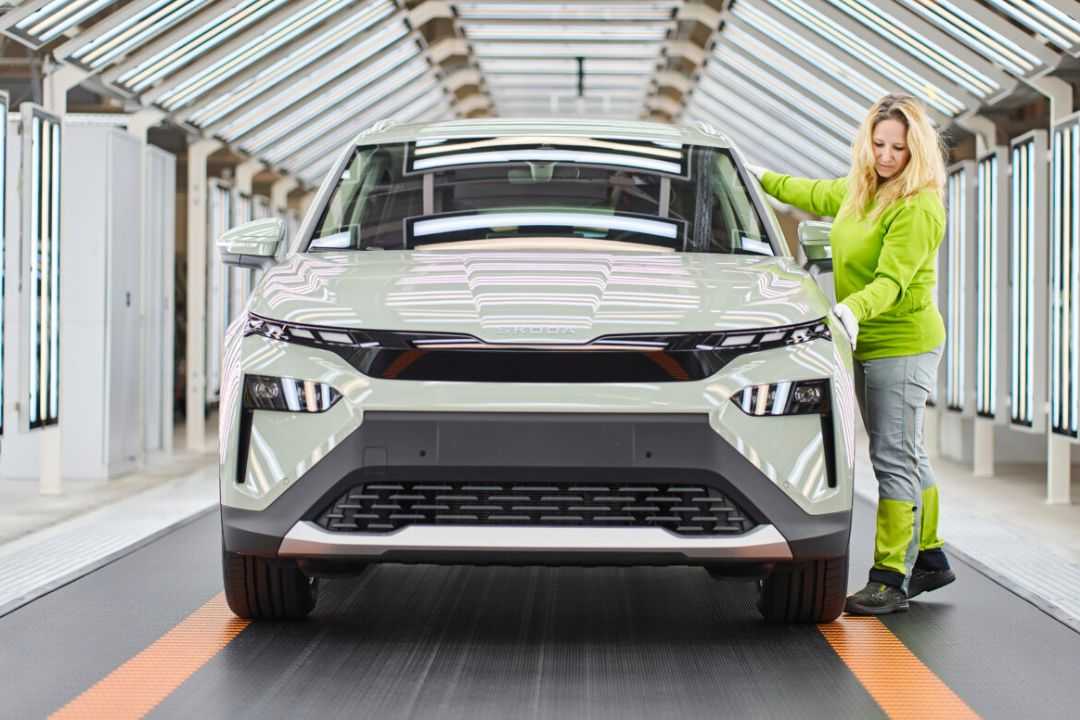
Škoda Auto delivered a strong performance in 2025, manufacturing 1,065,000 vehicles worldwide — a 15% increase compared with the previous year. Alongside vehicle production, the company assembled more than 329,000 battery systems for its electric and plug-in hybrid models as well as for other brands within the Volkswagen Group. Output also included over 1,030,000 transmissions and more than 500,000 engines.
At the brand’s headquarters in Mladá Boleslav, production reached 605,600 vehicles, marking a 4.9% year-on-year rise. Strong customer demand supported the ramp-up of electric models. Since series production began in January 2025, the all-electric compact SUV Škoda Elroq surpassed 112,500 units, while the larger Škoda Enyaq reached approximately 77,000 vehicles.
Beyond Europe, a new facility opened in Vietnam in partnership with Thanh Cong Group. The site assembles the Škoda Slavia and Škoda Kushaq from completely knocked-down kits supplied from India, where demand for the Škoda Kylaq significantly boosted production volumes.
All three domestic plants increased output during the year. At Mladá Boleslav, models including the Škoda Fabia, Škoda Scala, Škoda Octavia and Škoda Kamiq were produced alongside electric models such as the Enyaq family and Elroq. Combustion-engine vehicles built on the MQB platform and electric vehicles based on the MEB platform share a single production line, allowing rapid adjustments in response to market trends — a setup unique within the Volkswagen Group.
The plant also manufactures battery systems for MEB-based vehicles, assembling more than 329,000 units in 2025 for both Škoda and other group brands. In addition, it produced 513,800 EA 211 petrol engines and 311,300 MQ 200 manual gearboxes.
In Kvasiny, annual output climbed to 301,500 vehicles. Production includes the Octavia, Škoda Karoq and Škoda Kodiaq. Strong global interest in the Kodiaq led to the addition of a second production line. The one-millionth vehicle built during the year was a Kodiaq Sportline powered by a 2.0-litre petrol engine. The plant also assembled 40,200 vehicles for SEAT.
In Vrchlabí, 721,400 seven-speed DSG (DQ 200) transmissions were manufactured, with more than half supplied to other Volkswagen Group brands. In February, the facility produced its six-millionth transmission since operations began in 2012.
In Bratislava, the Škoda Superb is built at the Volkswagen Group plant alongside the Volkswagen Passat. Production of the Superb reached 69,500 units in 2025. In China, vehicles manufactured in Changsha, Ningbo and Nanjing included the Octavia, Kamiq, Kamiq GT, Karoq, Kodiaq, Kodiaq GT and Superb, with total output of 12,100 vehicles.
In Solomonovo, Ukraine, 1,200 Karoq SUVs were assembled from semi-knocked-down kits. Kazakhstan contributed 2,800 vehicles assembled from SKD kits, including the Octavia, Superb, Karoq and Kodiaq. India continues to develop as a central pillar of the company’s growth strategy outside Europe. Production there more than doubled to 73,800 vehicles in 2025, while over 85,000 additional Volkswagen Group vehicles were built alongside Škoda models.
The Kylaq SUV has become a major contributor in the competitive sub-4-metre segment. The Pune facility manufactures the Slavia, Kushaq and Kylaq, while the Kodiaq is produced in Chhatrapati Sambhajinagar. A logistics centre in India prepares CKD kits for shipment to Vietnam.
The newly inaugurated Vietnamese plant began assembling the Slavia and Kushaq in 2025, with 2,500 vehicles completed by year-end. Cooperation between Indian and Vietnamese operations supports expansion across the ASEAN region and the Middle East.