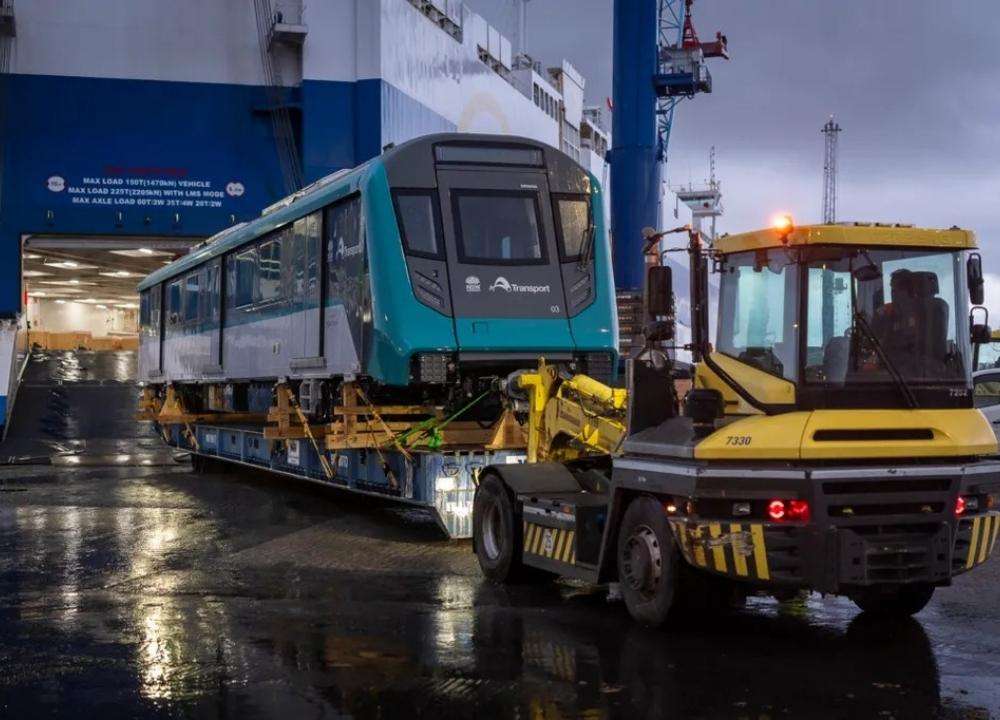
Siemens Mobility has delivered the first of 12 three-car metro trains for the Sydney Metro – Western Sydney Airport turnkey project, marking a major milestone in the development of Australia’s new fully automated metro connection to Western Sydney International Airport. The arrival of the first train in Australia allows the project to move into the next stage of testing and commissioning. Initial testing will take place at the Stabling and Maintenance Facility in Orchard Hills, New South Wales, followed by testing on the main track.
The 23-kilometre metro line will connect Greater Western Sydney with Western Sydney International Airport and Bradfield City Centre. Once operational, the trains will run at Grade of Automation 4 (GoA4), enabling fully automated and driverless passenger services.
Based on Siemens Mobility’s Inspiro High Capacity platform, the trains have been customised for the requirements of the Sydney Metro – Western Sydney Airport line. They feature large windows, wide doors, level access, wheelchair spaces, low-noise technology and open gangways designed to improve passenger comfort and accessibility.
The interiors also reflect the natural and cultural heritage of the Cumberland Plain. Upholstery patterns draw inspiration from First Nations traditions, including references to Ngurra, meaning Country, and Badu, meaning Water. Grey and blue elements represent the night sky, while yellow priority seating reflects daytime gathering places near waterholes and flowering wattle.
“The arrival of the first train in Australia marks an important milestone for the Sydney Metro – Western Sydney Airport project and for Siemens Mobility’s turnkey business globally,” said Léon Soulier, CEO, Turnkey Business Unit, Siemens Mobility. “We can now proceed to the next project phase, which involves dynamic testing in Sydney.”
The trains include digital passenger information displays, CCTV, emergency intercoms and other systems designed to improve safety and passenger information. The project also introduces Siemens’ Railigent X digital platform in Australia. The technology will support predictive maintenance, remote diagnostics, fleet monitoring and early identification of potential issues. These capabilities are expected to improve train availability and operational reliability.
The trains underwent extensive testing and commissioning in Vienna and at the Test and Validation Center in Wildenrath, Germany, before being delivered to Australia. Testing included environmental and wind-performance assessments. Siemens Mobility was awarded the turnkey contract in 2022. The project includes 12 driverless trains, signalling, electrification, telecommunications, platform screen doors and a depot, along with a 15-year full-service maintenance agreement.
The project is being delivered by the Parklife Metro consortium, comprising Siemens Mobility, Plenary Group, Webuild and RATP Dev, in partnership with Sydney Metro. The Siemens Mobility share of the contract is valued at approximately €900 million. Designed as a carbon-neutral and fully automated metro system, the project is expected to support around 14,000 construction jobs and contribute to economic development across New South Wales.
Siemens Mobility is a separately managed company of Siemens AG, providing rolling stock, rail automation, electrification, software, turnkey systems and related services. In fiscal 2025, Siemens Mobility reported revenue of €12.4 billion and employed around 43,400 people worldwide.