

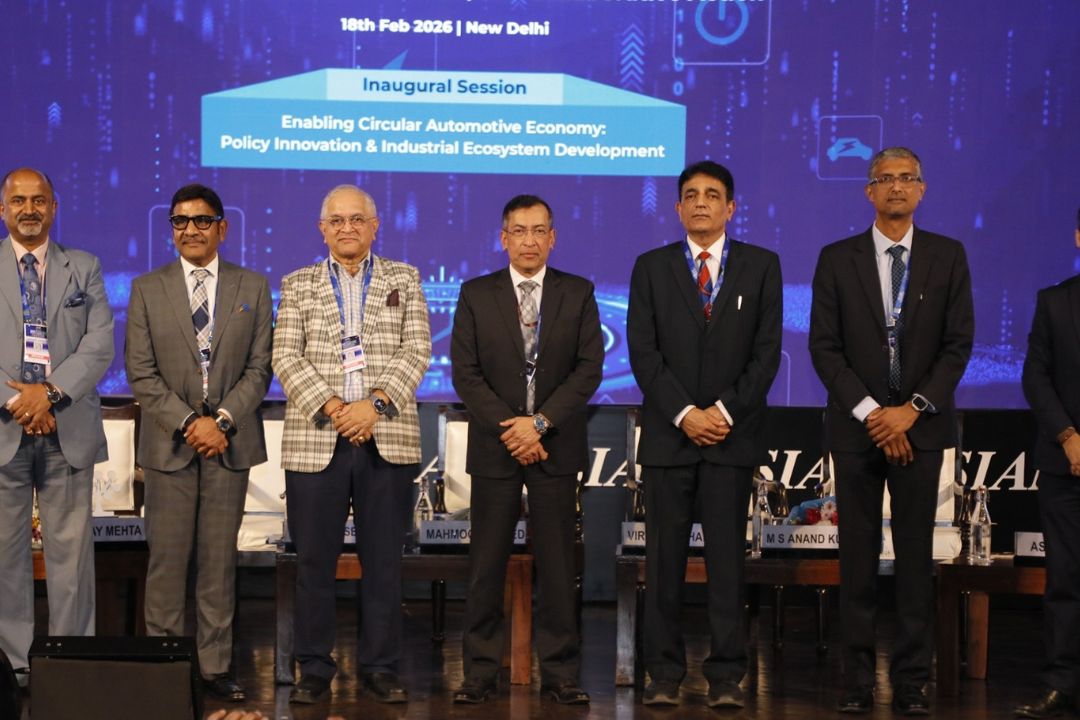
As part of SIAM Sustainable Mobility Week 2026, the Society of Indian Automobile Manufacturers hosted the 4th International Conference on Sustainable Circularity at the India Habitat Centre. The theme focused on helping India move toward a circular automotive economy through supportive policies, innovation, and cooperation across the industry.
SIAM Sustainable Mobility Week, held from February 16–19, brings together policymakers, industry leaders, researchers, and technology experts to discuss the future of mobility. The event also includes a Sustainable Mobility Zone showcasing new vehicle platforms, safety technologies, alternative fuels, and infrastructure solutions.
The conference discussed the full lifecycle of vehicles—from design and materials to recycling and digital tracking. Key topics included reducing emissions, improving resource use, handling end-of-life vehicles, and aligning regulations.
Prashant K Banerjee, Executive Director of SIAM, stressed the need to address air quality and vehicle disposal issues, particularly in Delhi NCR, and called for stronger participation in registered vehicle scrapping facilities.
Mahmood Ahmed, Additional Secretary at the Ministry of Road Transport and Highways, noted that government standards aim to cut emissions and promote cleaner fuels. He highlighted progress in the Vehicle Scrapping Policy, with over 125 registered scrapping facilities now operating.
Dr Virinder Sharma from the Commission for Air Quality Management said digital tracking of end-of-life vehicles has improved monitoring and planning, while Vikram Kasbekar of Hero MotoCorp emphasized the importance of building a structured scrappage ecosystem and involving informal recyclers constructively.
Industry experts also discussed using the “Reduce, Reuse, Recycle” approach, improving automated testing systems, and treating old vehicles as valuable sources of recyclable materials. A context paper titled “Accelerating India’s Transition to an Automotive Circular Economy” was released during the event.
Participants agreed that circular practices must cover the entire value chain, including design, sourcing, production, reverse logistics, and recycling. With continued cooperation between government, industry, and research groups, India can build a more efficient and environmentally responsible automotive sector. Sustainable Mobility Week will conclude on February 19, 2026, with the first International Conference on Automotive Material Compliance and Sustainability.
The Society of Indian Automobile Manufacturers is the national association representing India’s major vehicle and engine manufacturers. The organization works to support industry growth while promoting safety, environmental protection, and sustainable mobility initiatives.








