

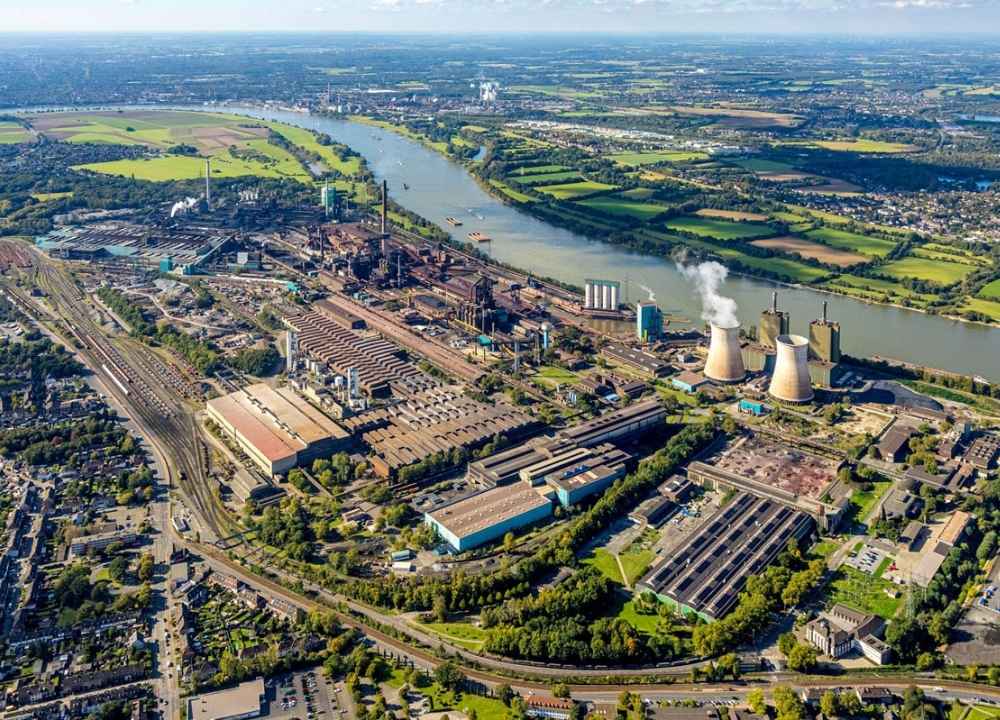
Salzgitter AG has taken a major step towards low-carbon steel production by awarding its subsidiary Hüttenwerke Krupp-Mannesmann GmbH (HKM) a contract with global technology provider Tenova to build Germany’s largest electric arc furnace (EAF) at its Duisburg facility. The project is expected to play a significant role in advancing the country’s steel industry transformation while strengthening sustainable manufacturing capabilities.
The new electric arc furnace will have a tapping weight of 285 metric tonnes and an annual production capacity of approximately 2.5 million tonnes, making it the largest EAF in Germany and the second largest in the European Union. Once operational, the facility will support HKM’s transition towards more environmentally responsible steelmaking while improving production efficiency and competitiveness.
The furnace will incorporate Tenova’s Consteel® technology, enabling the continuous charging of scrap metal through a conveyor belt system. The advanced design allows the furnace to process multiple raw materials, including steel scrap and sponge iron, offering greater operational flexibility and improved resource efficiency.
As part of the project, Tenova will supply the complete electric arc furnace system along with key supporting infrastructure. The scope includes the conveyor-based scrap charging system, furnace transformer, water management system, exhaust gas treatment plant and other critical equipment required for safe and efficient plant operations.
Commenting on the development, Markus Dorndorf, Managing Director of Tenova Projects GmbH, said the new furnace will become Germany’s most powerful and energy-efficient electric arc furnace. He noted that the project represents one of the most significant industrial transformation initiatives currently underway in the European steel sector, demonstrating that decarbonisation and industrial competitiveness can progress together through advanced technologies.
Gunnar Groebler, Chairman of the Executive Board of Salzgitter AG, said the investment marks an important milestone in the company’s long-term strategy to build sustainable and competitive steel production. He added that the new electric arc furnace will strengthen HKM’s position as a leading supplier of green steel for industrial value chains while supporting the growing demand for low-carbon steel products.
The project has also received strong public sector support. The German Federal Government and the State of North Rhine-Westphalia have committed €200 million in funding under the Federal Funding for Industry and Climate Action programme, recognising the strategic importance of accelerating industrial decarbonisation. Andreas Betzler, Spokesperson for HKM’s Management, said the financial support from both governments sends a strong signal in favour of Germany’s industrial transformation. He added that with funding now secured, implementation of the project will proceed without delay.
Construction of the facility is scheduled to begin in August 2026, with commissioning planned for 2029. Once completed, the electric arc furnace will become a cornerstone of HKM’s modernisation programme, enabling more sustainable steel production while reducing emissions and improving energy efficiency.
The investment reflects the growing momentum within Europe’s steel industry to adopt cleaner production technologies that support climate goals without compromising manufacturing capability. Through this project, Salzgitter AG and Tenova are helping accelerate the transition towards low-carbon steelmaking while strengthening Germany’s position as a leader in advanced industrial manufacturing and sustainable steel production.
Salzgitter AG is one of Europe’s leading steel and technology companies, with operations spanning steel production, steel processing, trading and industrial technology. Headquartered in Salzgitter, Germany, the company supplies high-quality steel products and tailored solutions to customers in industries such as automotive, construction, engineering, energy and infrastructure.
Through its subsidiaries, Salzgitter AG also has a strong presence in trading, precision tubes and plant engineering. The company is advancing the transformation of steelmaking with its SALCOS® (Salzgitter Low CO₂ Steelmaking) programme, which aims to significantly reduce carbon emissions by replacing conventional blast furnace processes with hydrogen-based steel production and renewable energy.








