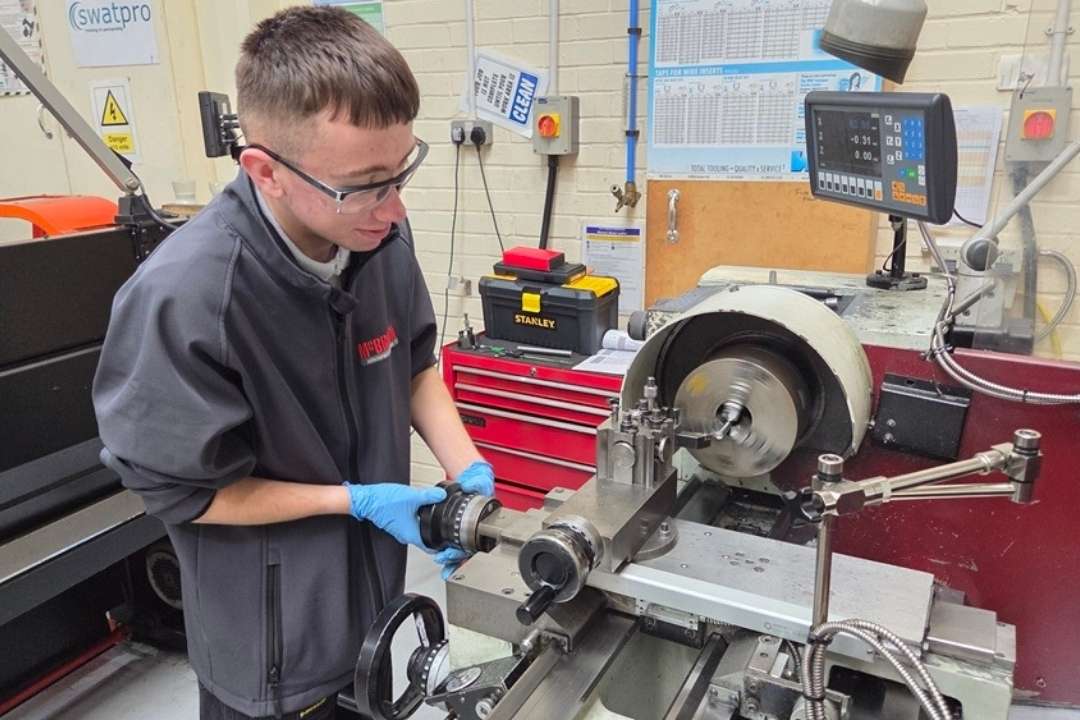
The British Engineering Manufacturers’ Association (BEMA) has strengthened its commitment to developing the next generation of skilled engineers through continued investment in manual lathes and milling machines from MACH Machine Tools. The investment supports apprenticeship training at BEMA’s dedicated engineering training centre in Yate, South Gloucestershire, helping meet the evolving workforce requirements of engineering and manufacturing companies across South West England.
To date, BEMA has installed 11 MACH machines at the facility, comprising six MACH L-1340 manual lathes and five MACH VS-1 milling machines. Operated in partnership with Swatpro Academy, the training centre provides Level 2 and Level 3 engineering apprentices with practical, industry-focused machining experience using equipment commonly found in modern manufacturing environments.
BEMA-supported apprenticeship programmes span four years, with apprentices spending their first 10 months at the training centre undertaking intensive practical instruction before returning to their employers for workplace-based learning. The curriculum is structured around turning, milling and fitting modules, ensuring apprentices gain hands-on experience across key engineering disciplines while developing transferable technical skills.
The MACH machines are used to manufacture precision components and functional workshop tools from a variety of materials, including mild steel, alloy steel, aluminium, brass and engineering plastics. Apprentices produce items such as thread vices, gauges, location plates, V-blocks and toolmakers’ clamps while learning to interpret engineering drawings, set up machinery safely and achieve demanding dimensional tolerances and surface finishes.Training also covers a wide range of machining operations. Turning exercises include facing, threading, grooving, drilling and internal and external diameter machining, while milling activities involve face milling, end milling, drilling and boring.
Andrew Dunster, Lead Workshop and Commercial Training Instructor and Assessor at BEMA, said the practical nature of the programme enables apprentices to develop real manufacturing skills. He noted that producing functional workshop tools, rather than sample components, gives apprentices a stronger understanding of engineering processes and prepares them for industrial environments.Mr Dunster also praised the MACH machines for their reliability, accuracy and ease of operation, adding that their competitive pricing and extensive standard features have consistently made them a preferred choice during procurement.
BEMA first selected MACH Machine Tools in 2019 following a competitive tender process. According to Centre Manager Martin Wear, MACH’s technical capabilities, understanding of engineering education and commitment to supporting the training sector were key factors behind the decision.
The MACH VS-1 manual milling machines feature rigid construction, large worktables, variable-speed 5,000 rpm spindles and two-axis digital readouts, while the compact MACH L-1340 lathes are equipped with quick-change tool posts, stress-relieved beds and digital readout systems for precision machining. Mr Wear said the 11 MACH machines continue to play a vital role in developing the practical turning and milling skills required by engineering apprentices, helping BEMA deliver industry-ready talent to employers across the region.