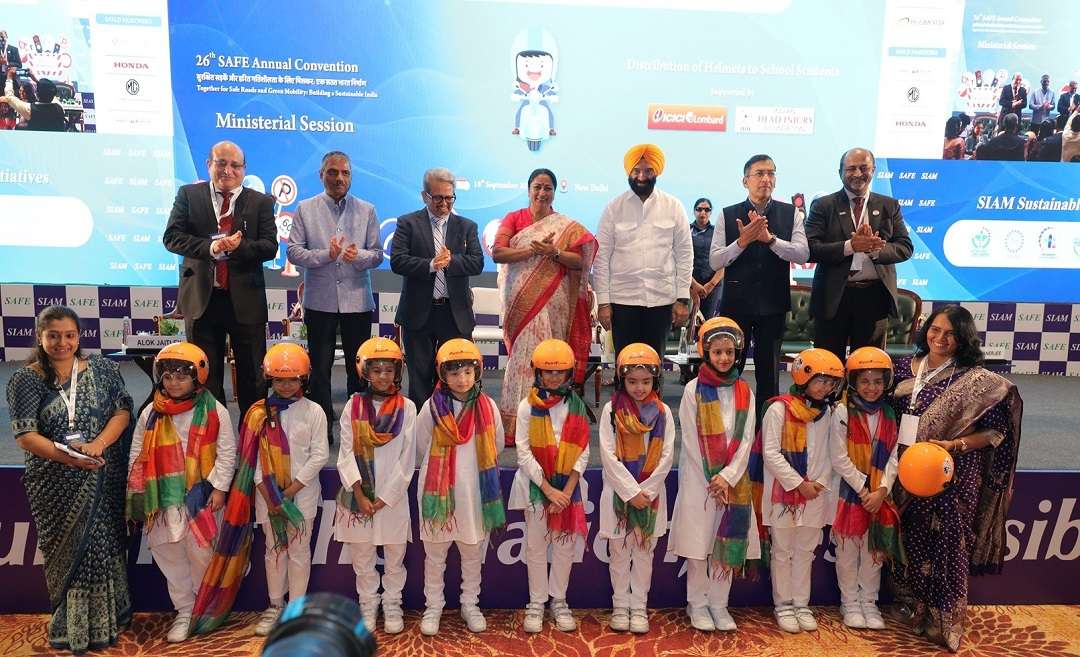
The Society for Automotive Fitness & Environment (SAFE), an initiative by the Society of Indian Automobile Manufacturers (SIAM), hosted its 26th Annual Convention at Bharat Mandapam, New Delhi, under the theme ‘Together for Safe Roads and Green Mobility: Building a Sustainable India.’ The event, held as part of SAFE’s ‘Safe Journey (सुरक्षित सफर)’ programme, brought together senior government officials, policymakers, automotive leaders, and safety experts to explore actionable strategies for improving road discipline and promoting environmentally responsible transport systems across India.
The convention was inaugurated by Rekha Gupta, Hon’ble Chief Minister of Delhi, who served as Chief Guest. Also in attendance was Sardar Manjinder Singh Sirsa, Minister for Environment, Forest & Wildlife, Industries, Food & Supplies, Government of NCT of Delhi, as Guest of Honour. The event saw wide participation from ministries, regulatory authorities, automotive OEMs, and academic institutions.
Prashant K Banerjee, Executive Director of SIAM, opened the session by underlining the importance of shared responsibility in reducing road incidents and embracing sustainable transport. He stated that India’s future depends on safer roads and cleaner mobility, and that this convention was a step in that direction.
In a video address, HD Kumaraswamy, Union Minister for Heavy Industries & Steel, emphasized the need for balance between growth and accountability. Highlighting government investments exceeding ₹60,000 crore towards battery storage and clean energy, he noted that EV sales had crossed the two million mark in 2024, reflecting a positive shift toward circular mobility and domestic innovation.
Speaking at the convention, Chief Minister Rekha Gupta remarked “It’s not vehicles that cause accidents, it’s behaviour. Until we stop glorifying rule-breaking, real safety won’t be achieved. Strict law enforcement is necessary, but true change lies in voluntary discipline.” She reaffirmed Delhi’s dedication to electric mobility, pledging that one in three vehicles in the city will be electric, with full electrification of public transport by 2026. During the event, she also launched SIAM’s SAFE Road Safety Context Paper, as well as a new student engagement initiative to foster awareness among youth.
Guest of Honour Manjinder Singh Sirsa commended SIAM’s continued engagement in environmental and safety issues. He referenced national sustainability efforts and praised the Chief Minister for reducing city waste levels. Quoting the Prime Minister’s “Ek Ped Maa Ke Naam” initiative, he reiterated the importance of community participation in building a cleaner, safer India.
Mahmood Ahmed, Additional Secretary, Ministry of Road Transport & Highways (MoRTH), highlighted the need for integrated data systems to enforce road safety effectively. “From EDAR to SARTHI and VAHAN to PM Gati Shakti, technology must connect every link in the road safety chain—from licensing and registration to judicial processes,” he said.
Sanjay Bandopadhyaya, Member of the Supreme Court Committee on Road Safety, noted the sharp rise in accidents during 2023, despite official goals to reduce them. He advocated for enhanced digital enforcement tools and a shift toward intelligent traffic systems. Ajay Chaudhry, Special Commissioner of Police (Traffic), Delhi, reported an 8% decline in road fatalities but stressed the need for stronger deterrents, citing persistent violations like speeding and signal jumping.
Sushant Naik, President of SAFE and Tata Motors’ Global Head of Government & Public Affairs, urged the industry to embed safety in design and culture from the outset. “With over 1.73 lakh lives lost every year on Indian roads, the scale of the challenge demands collective, immediate action. The 5Es—Education, Engineering, Emergency Care, Enforcement, and Evaluation—must all work together,” he said.
Saurabh Dalela, Director of ICAT, emphasized the importance of accurate accident analysis. “Speeding and ignored signage are top causes of fatalities. Like developed countries, we need clear SOPs for post-accident response and accountability,” he added.
Alok Jaitley, Vice President of SAFE and Executive VP at Maruti Suzuki India, delivered the vote of thanks. He commended the speakers, students, and attendees, stating that collective commitment is crucial for achieving a robust road safety ecosystem.
Moderated by Hormazd Sorabjee (Editor, Autocar India), the session explored how infrastructure design and driver education can reduce accidents. Presentations by Ashim Sharma (NRI Consulting) and Som Kapoor (EY Parthenon) laid the groundwork for discussions by experts from Honda Motorcycle & Scooter India, IIT Delhi, CIRT, ATMA, ASN School, Raahgiri Foundation, and CRRI.
This session focused on strict law enforcement, faster emergency response, and continuous performance review. Moderated by Sumit Chaturvedi (VoiWorld.com), it included presentations from Grant Thornton Bharat and PwC India, and insights from officials from Delhi Traffic Police, Ashok Leyland, Safexpress, ITS India Forum, Max Hospital, and accident survivor and para-athlete Mr Nuruddin.