

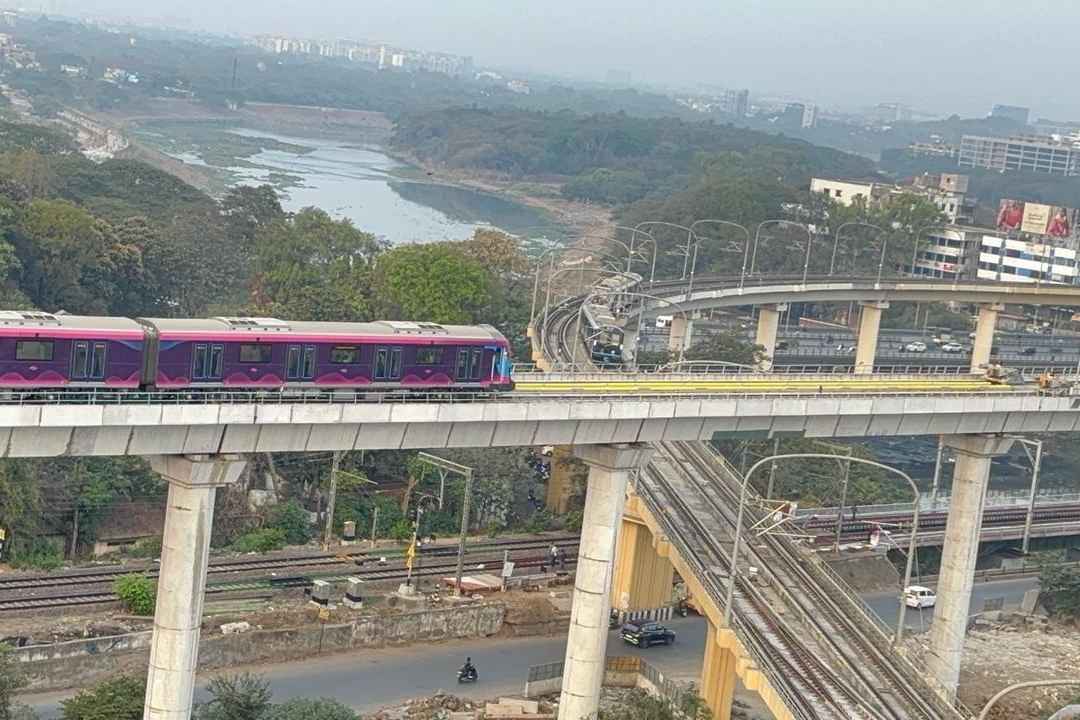
Pune Metro Line 3 has achieved a major milestone with the successful completion of end-to-end trial runs across its entire 23-kilometre elevated corridor, bringing the project closer to the start of commercial passenger services. The metro line, connecting Hinjawadi’s prominent IT hub with Shivajinagar, is set to significantly improve urban transportation and ease traffic congestion across one of Pune’s busiest routes.
The project has reached an advanced stage of readiness, with all critical civil construction and system integration works completed. Viaduct construction across the full corridor has been finished, while all 23 metro station structures are ready. Entry and exit facilities at stations are also progressing rapidly toward completion. Key operational systems, including track installation, third-rail electrification, and signalling infrastructure, have been fully commissioned throughout the route.
In addition, rolling stock testing has been successfully completed, including oscillation trials conducted under the supervision of the Research Designs and Standards Organisation (RDSO). The metro trains have received approvals from the Commissioner of Metro Rail Safety and the Ministry of Railways for operations at speeds of up to 85 kmph, reinforcing the project’s preparedness for public service.
The corridor will be opened in phases. The first phase will cover a 13.3-kilometre stretch between Maan and R. K. Laxman Museum, comprising 12 stations. This section is expected to begin operations following receipt of final statutory clearances. In the next phase, the line will be extended to District Court station, enabling seamless connectivity with the existing Maha Metro network.
Once fully operational, Metro Line 3 is expected to transform daily commuting patterns by reducing travel time between Hinjawadi and Shivajinagar to approximately 45 minutes, compared with the current average journey of around 90 minutes. The project is anticipated to benefit thousands of daily commuters, including IT professionals, students, and residents, while encouraging greater use of public transport and reducing dependence on private vehicles.
The metro system incorporates advanced technologies such as Communications-Based Train Control (CBTC), locally manufactured modern rolling stock, and smart ticketing solutions. Sustainability measures including rooftop solar installations, rainwater harvesting systems, electric vehicle charging infrastructure, and waste management initiatives have also been integrated into the project.
A notable feature of the initiative is its focus on gender inclusion. Metro operations will be supported by a dedicated team of women train operators, with nearly 100 women already recruited and trained to manage services, setting a new benchmark for participation in India’s urban transportation sector.
Pune IT City Metro Rail Limited (PITCMRL) is a Special Purpose Vehicle (SPV) formed through a joint venture between TRIL Urban Transport Private Limited, a Tata Group company, and Siemens Project Ventures GmbH to develop, implement, and operate Pune Metro Line 3. The project is being executed under a Public-Private Partnership (PPP) model in collaboration with the Pune Metropolitan Region Development Authority (PMRDA). PMRDA has awarded PITCMRL the Design, Build, Finance, Operate and Transfer (DBFOT) concession for Pune Metro Line 3 for an initial period of 35 years, with a provision for an extension of up to 25 additional years.
Pune Metro Line 3 is India’s first metro rail project to be undertaken under the Government of India’s New Metro Policy, 2017, marking a significant milestone in promoting private sector participation in urban mass transit infrastructure. The project is expected to strengthen sustainable urban mobility while setting a benchmark for future PPP-led metro developments across the country.








