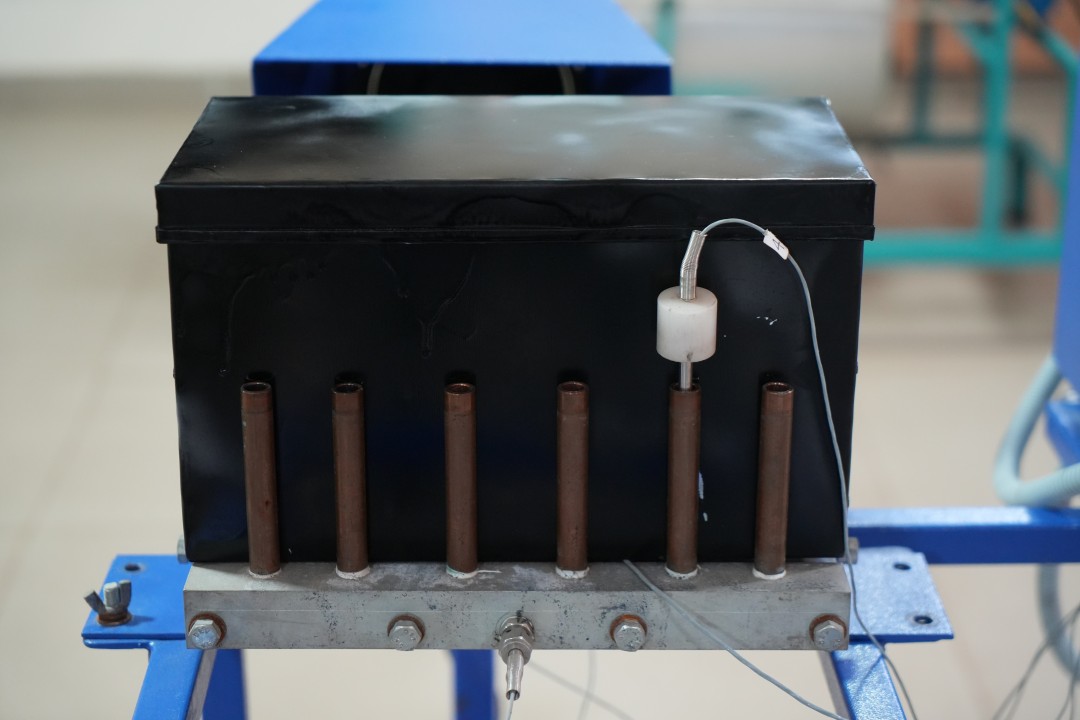
Researchers at MIT World Peace University (MIT-WPU), Pune have introduced a patented passive hybrid cooling technology—covered under the Indian patent “System for Thermal Management of Battery of Vehicle” (Patent No. 202121029238)—that delivers a major leap forward in EV battery safety and thermal performance. The system is built to withstand India’s demanding weather conditions and rising concerns over EV fire incidents, offering a solution that improves both efficiency and safety in electric mobility.
The innovation was developed by a multidisciplinary team comprising Dr Vaibhav Deshmukh (Mechanical Engineering), Dr S Radhakrishnan (Materials Science and Engineering), and Dr Vaidehi Deshmukh (Electrical and Electronics Engineering). Their approach uses an entirely passive hybrid structure that pairs high-efficiency heat pipes with a custom-formulated nanofluid. This combination provides a pump-free, low-energy, and highly effective alternative to existing cooling systems commonly used in EVs.
A standout aspect of this technology is its complete reliance on natural convection and phase-change mechanisms—removing the need for pumps, fans, or any additional electrical load. The engineered nanofluid, infused with thermally conductive nanoparticles and low-boiling-point liquids, rapidly pulls heat from battery hotspots. Coupled with heat pipes, the system maintains consistent thermal conditions even in harsh climates, offering an inherently safer, energy-independent solution well suited for Indian operating environments.
In contrast with traditional liquid or air-cooled systems, this patented design dissipates heat rapidly without any forced flow. By stabilizing battery temperatures, it enhances overall battery life, charging efficiency, and user safety.
Commenting on the development, Dr Vaibhav Deshmukh emphasized India’s climate challenges: “With high ambient temperatures and a surge in EV adoption, safety becomes just as crucial as performance. Our passive hybrid system keeps battery temperatures within safe limits without drawing power from the vehicle, improving reliability and efficiency.”
Dr Radhakrishnan highlighted the strategic leap: “We wanted to eliminate active components that can fail or consume extra energy. The result is a solution built for hot-weather markets and increasing fire-risk concerns.”
Dr Vaidehi Deshmukh added: “The integration of a thermally boosted nanofluid with heat-pipe design—minus pumps or fans—addresses two major OEM pain points: unnecessary energy load and localized heating. This significantly bolsters the safety profile of EVs, especially in regions like India.”
The relevance of this breakthrough is amplified by the rapid expansion of the EV market. The global Battery Thermal Management Systems (BTMS) market—valued at around USD 5.41 billion in 2024—is expected to surge to nearly USD 29.09 billion by 2030. In India, EV battery-cooling technologies are projected to grow from about USD 138 million in 2025 to almost USD 470 million by 2034. The broader Battery Management System (BMS) segment is forecast to rise from roughly USD 199 million in 2024 to USD 8.39 billion by 2035.
Growing safety concerns further underline the urgency for reliable thermal solutions. India’s EV penetration has reached nearly 7.8% in FY 2024–25, with two-wheelers and three-wheelers leading adoption. Industry assessments increasingly point to thermal runaway and inadequate cooling as major contributors to fire risks. While comprehensive national data on EV fire incidents remains limited, expert evaluations consistently stress the need for more dependable battery-cooling systems to prevent overheating and strengthen consumer trust.