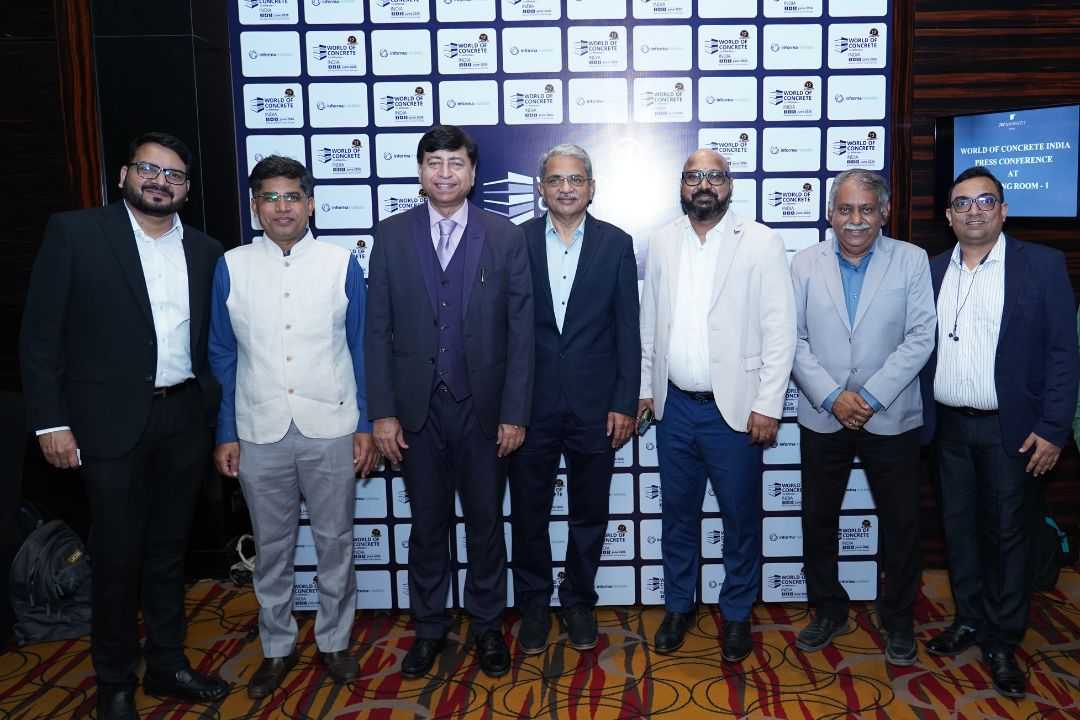
Informa Markets in India hosted an exclusive industry roundtable in Pune ahead of the 12th edition of World of Concrete India 2026, bringing together leading voices from the construction, infrastructure, architecture, industrial flooring, concrete technology, and construction chemicals sectors to discuss the future of sustainable and technology-driven construction in India. Scheduled to be held from June 3 to 5, 2026, at the Bombay Exhibition Centre in Mumbai, World of Concrete India 2026 is expected to feature more than 350 brands and attract over 18,000 industry professionals from India and overseas.
The event will include dedicated country pavilions, startup showcases, precast technology segments, live demonstrations, conferences, and networking platforms focused entirely on concrete technologies and construction innovation. Unlike broader construction exhibitions, the event serves as India’s only dedicated platform exclusively focused on the concrete industry, covering the complete value chain including raw materials, precast systems, machinery, construction chemicals, digital technologies, and infrastructure solutions.
The Pune roundtable brought together several industry leaders including Er Manoj Deshmukh from the Builders Association of India, Prof Mahesh Bangad from the Architects Engineers & Surveyors Association, Ajay Singam of the Industrial Flooring Association and Avcon Technics, Suyog Keluskar from 1Lattice, Jaswanth Sobhana from Sika India, Appasaheb D Bhosle from the Indian Concrete Institute, and Rajneesh Khattar from Informa Markets in India. The discussions focused on critical industry issues including mechanisation, labour shortages, sustainability, durability of infrastructure, technology adoption, construction waste management, and the need for better skill development and policy support.
Speaking during the discussion, Er Manoj Deshmukh highlighted the challenges faced by India’s construction sector, including rising project costs, labour-related issues, delays in payments, and shortages of skilled manpower. He stressed the need for stronger collaboration between industry and government to improve statutory recognition of engineers and accelerate technology adoption within the sector. He also noted that Indian construction companies continue to execute complex projects efficiently using local talent and resources.
Representing Sika India, Jaswanth Sobhana emphasised the growing importance of advanced repair and rehabilitation materials for ageing infrastructure assets across India. He stated that durability has become a critical design parameter for modern infrastructure and noted that structures designed for longer operational life cycles are more sustainable than frequent demolition and reconstruction. He also highlighted the increasing use of AI-enabled solutions for concrete mix design, curing guidance, and sand grading.
Suyog Keluskar from 1Lattice pointed to strong growth trends within India’s construction industry, supported by increasing government infrastructure spending and urban development initiatives. He observed that western India, particularly Pune and Mumbai, continues to witness strong demand in urban and high-rise construction, while tier-2 and tier-3 cities are emerging as important future growth centres. He added that blended cement adoption and sustainable construction practices are becoming increasingly important as India focuses on climate-resilient infrastructure development.
Ajay Singam of the Industrial Flooring Association highlighted the growing importance of mechanisation in improving productivity and efficiency in construction activities. He noted that industrial flooring projects have already demonstrated substantial productivity gains through mechanised operations, reducing manpower requirements while significantly increasing output. He also pointed to rapid growth in India’s data centre sector as a major driver for industrial construction and flooring demand.
Appasaheb D Bhosle from the Indian Concrete Institute stressed the importance of modular construction, mechanisation, and improved construction waste recycling practices. He noted that India currently recycles only a small percentage of construction waste compared to higher international benchmarks and highlighted the role of technology and training in addressing future industry challenges.
Prof Mahesh Bangad from the Architects Engineers & Surveyors Association underlined the importance of greater awareness, stronger policy direction, and accountability in sustainable construction practices. He stated that modern construction increasingly depends on technology integration, advanced materials, and practical implementation of sustainability principles.
Commenting on India’s rapidly expanding infrastructure sector, Yogesh Mudras, Managing Director of Informa Markets in India, said India’s real estate market is expected to reach USD 1 trillion by 2030, creating strong demand for durable and sustainable construction materials. He added that World of Concrete India 2026 aims to accelerate the adoption of advanced construction technologies and encourage knowledge sharing across the industry.
The exhibition will feature product launches, B2B and B2G meetings, live demonstrations, investor interactions, startup showcases, innovation forums, and conference sessions involving more than 100 global speakers. Leading companies expected to participate include UltraTech Cement, Sika India, JSW Cement, Mapei, Asian Paints, and several others from across the construction and infrastructure value chain.