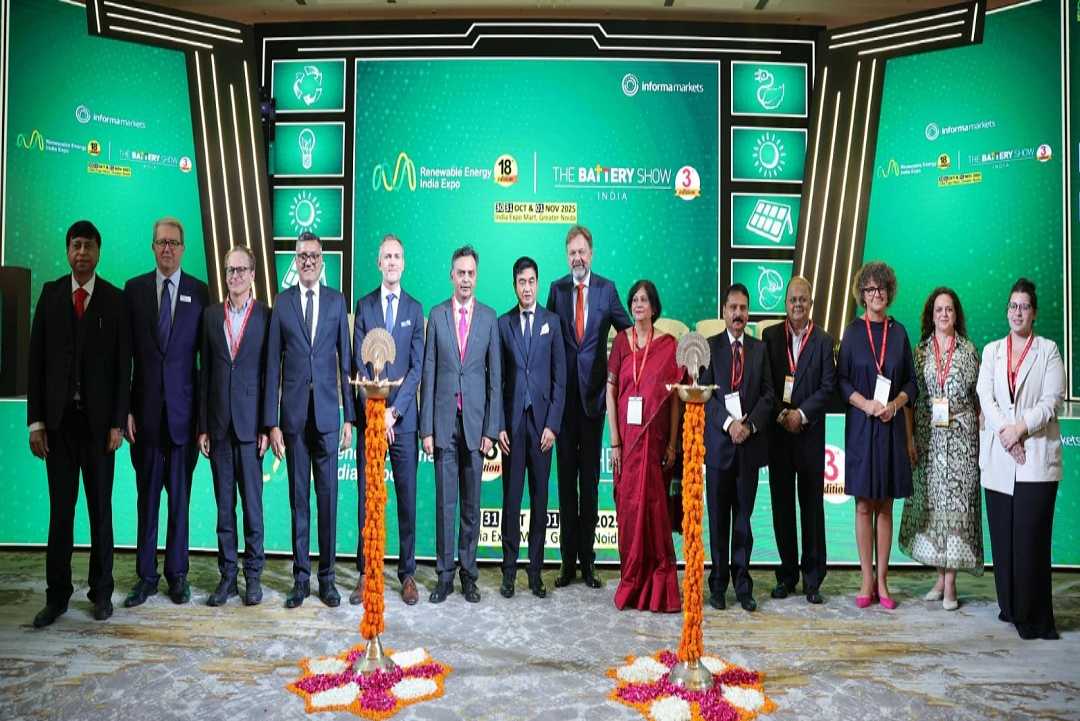
Marking a landmark chapter in India’s renewable energy journey, Informa Markets in India inaugurated the 18th edition of the Renewable Energy India (REI) Expo at the India Expo Mart, Greater Noida. Co-located with the 3rd edition of The Battery Show India (TBSI), the three-day event, from October 30 to November 1, 2025, brings together the world’s most influential voices in renewable energy under the theme “Decoding Pathways to Achieve Net Zero.”
Together, REI and TBSI form South Asia’s most comprehensive clean energy showcase—uniting global manufacturers, innovators, investors, and policymakers to advance sustainable technologies, boost cross-border collaboration, and accelerate the transition toward a carbon-neutral future. The inaugural session was attended by a distinguished lineup of leaders and dignitaries, including Dr Vibha Dhawan, Director General, TERI; Debashish Das, Head, RE Nodal Agency, Government of Odisha; HRH Prince Narithipong Norodom of Cambodia; Dr Ewa Suwara, Deputy Head of Delegation, European Union to India; Dr Philipp Ackermann, Ambassador of Germany to India; Manu Srivastava, Additional Chief Secretary, Power and Renewable Energy Department, Government of Madhya Pradesh; Peter Hall, President, IMEA Region, Informa Markets; Yogesh Mudras, Managing Director, Informa Markets in India; and Rajneesh Khattar, Senior Group Director, Informa Markets in India.
Manu Srivastava (IAS), Additional Chief Secretary, Government of Madhya Pradesh, emphasized that India’s renewable energy sector is now “a perfect intersection of innovation, economics, and sustainability.” He noted India’s success in achieving sub-₹3 per unit tariffs without subsidies and powering 65% of Delhi Metro’s daytime demand through renewables. Madhya Pradesh recently achieved ₹2.70 per unit (3 US cents) for solar-plus-storage power, setting a new global benchmark supported by partners such as the World Bank, IFC, ADB, and UC Berkeley. He highlighted the 440 MW solar-plus-storage project in Morena, which ensures 95% energy availability during peak hours, proving that stored solar power can be commercially viable and reliable.
Debashish Das, Head of the RE Nodal Agency, Government of Odisha, stated that the state is at a decisive point in its energy transition. Despite being a coal- and mineral-rich state contributing 25% of India’s coal reserves and 40% of its steel production, Odisha is committed to reducing emissions and expanding renewables under the Odisha Renewable Energy Policy. With initiatives such as floating solar projects across 2.25 lakh sq. km of reservoirs and pumped storage systems, the state aims to ensure affordable, accessible, and sustainable power while attracting international investment into its clean energy ecosystem.
Dr Vibha Dhawan, Director General, TERI, emphasized that India has already installed 127 GW of solar capacity and is on track toward 500 GW of non-fossil capacity by 2030. She noted that government programs like the National Green Hydrogen Mission and Production-Linked Incentive (PLI) schemes for solar and battery manufacturing are building a strong domestic supply chain. “India’s solar potential is estimated at 10,800 GW,” she said, adding that agri-photovoltaic initiatives can spur rural growth while aligning industrial competitiveness with sustainability goals.
Dr Philipp Ackermann, German Ambassador to India, lauded the participation of 46 German companies at REI 2025, calling it a “powerful signal of Europe’s commitment to India’s green transition.” He reaffirmed Germany’s support through the Green and Sustainable Development Partnership (2022), highlighting collaborative initiatives such as the India-Germany Solar and Wind Energy Working Groups to boost manufacturing, mobilize green capital, and develop a skilled global workforce.
Dr Ewa Suwara, Deputy Head of Delegation, European Union to India, cited an ADB report forecasting a potential 24.7% GDP loss by 2070 due to climate change, stressing that “clean industries are not optional—they are essential.” She underscored the EU’s commitment to climate resilience and innovation through Indo-EU cooperation.
HRH Prince Narithipong Norodom of Cambodia praised India’s leadership in sustainability and expressed a desire to strengthen bilateral collaboration. “India has been a long-standing friend and partner to Cambodia,” he said. “Platforms like the Renewable Energy India Expo create opportunities for knowledge sharing and joint innovation that can power mutual growth.”
Yogesh Mudras, Managing Director, Informa Markets in India, noted that India’s renewable capacity has surpassed 250 GW in 2025 and is steadily advancing toward 500 GW by 2030. He highlighted the government’s ₹5,400 crore Viability Gap Funding (VGF) for 30 GWh Battery Energy Storage Systems (BESS), expected to attract ₹33,000 crore in investment by 2028. He added, “This year’s REI and TBSI—the largest editions yet—serve as a critical nexus for innovation, manufacturing, and sustainability dialogue.”
The 2025 edition of REI features over 700 exhibitors, 1,000 brands, and 250 thought leaders, drawing more than 35,000 visitors from across the world. Covering the full spectrum of renewable technologies—from solar PV and energy storage to wind, bioenergy, and EV infrastructure—the event facilitates partnerships, investments, and policy dialogue.
Simultaneously, The Battery Show India (TBSI), supported by the Department of Science & Technology and the Ministry of Heavy Industries, hosts 350+ exhibitors and 400+ brands with participation from 20,000 professionals in mobility and storage sectors.
International presence is underscored by country pavilions from Germany, Belgium, China, Japan, and Korea, alongside the EU Cluster Collaboration Platform. The Bio Energy Pavilion, backed by MNRE, showcases innovations from 65 companies spanning biomass, biogas, and waste-to-energy solutions.
Prominent participants include Reliance New Energy, Adani Solar, Waaree Energies, Vikram Solar, Havells, Goldi Solar, FIMER, Axitec, Luminous, and Grew Energy. On the TBSI side, major exhibitors such as Semco, Thermo Fisher, PNT Korea, CBC Corporation, TVS Indeon, and BASF showcased advanced solutions across the energy storage value chain.
India’s total installed power capacity has now crossed 500 GW, with non-fossil fuel sources contributing over 50% — a major step toward achieving energy independence and sustainability. With 256.09 GW coming from renewables, and a robust pipeline of upcoming solar, wind, and storage projects, the nation is transitioning from capacity expansion to grid integration, storage innovation, and value-chain localization.