

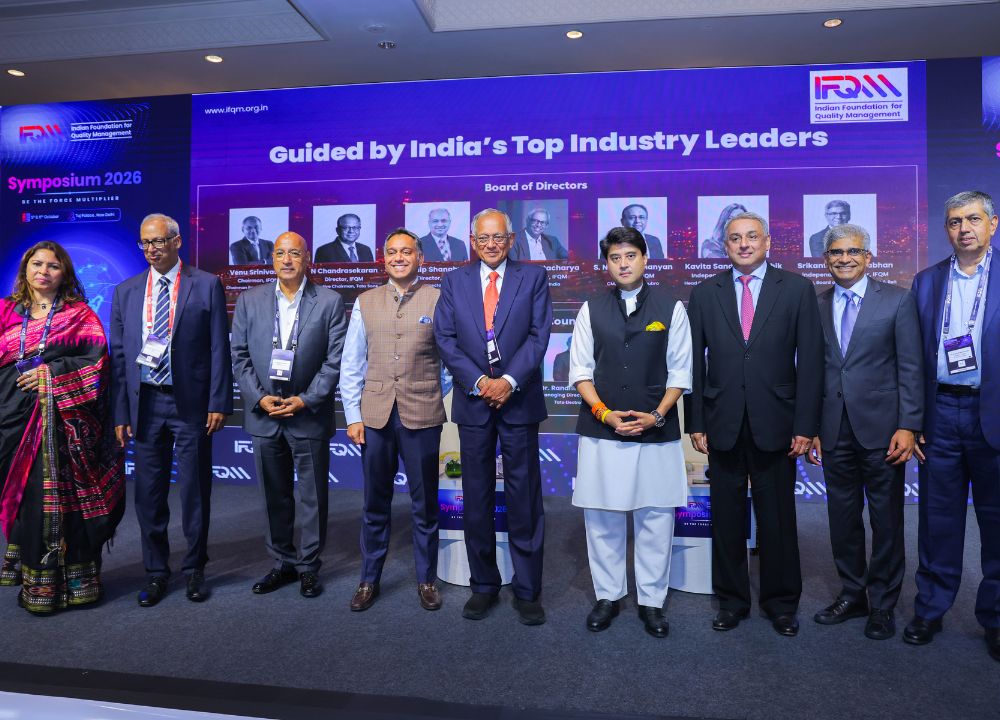
India’s move towards a developed and globally competitive economy will require stronger focus on quality, innovation and scale, industry leaders said at the third edition of the IFQM Symposium 2026 in New Delhi.The first day of the symposium brought together industry leaders, policymakers, global quality experts, CEOs, CXOs, academia and MSMEs to discuss how India can use its scale, technology and human capital to build competitive enterprises and institutions.
Delivering the keynote address on “Powering Viksit Bharat – Scale without Boundaries to Advance Development through Technology, Digital Innovation and Inclusive Connectivity”, Jyotiraditya M. Scindia, Union Minister for Communications and Development of North Eastern Region, said India would increasingly be looked upon by the world for its approach to quality, innovation and self-reliance. He highlighted the role of initiatives such as IFQM in supporting Viksit Bharat@2047 and Atmanirbharta.
N Chandrasekaran, Executive Chairman, Tata Sons, said India had made significant progress in developing sustainable infrastructure and institutions. He attributed the country’s economic performance in part to infrastructure development, manufacturing, precision manufacturing, education and skill development.
SN Subrahmanyan, Chairman and Managing Director, Larsen & Toubro, said quality needed to become part of organisational culture. He emphasised the importance of employee participation and learning from global practices, particularly in infrastructure.
A key event on the first day was the presentation of the Marcos EJ Bertin Quality in Governance Medal by the International Academy for Quality (IAQ) to Venu Srinivasan, Chairman, IFQM. The award recognised his contribution to applying quality principles to governance. The award was presented by Sunil Sinha, Trustee, IAQ, and Raúl Molteni, President, IAQ.
Mr Molteni said the IAQ was seeking to broaden the quality movement towards “quality for humanity” and pointed to the experience of Indian companies in applying Total Quality Management at scale. Srinivasan recalled TVS Motor Company’s association with Japanese quality experts and said the Deming Prize should be regarded as the beginning rather than the end of an organisation’s TQM journey.
The symposium also saw IFQM and the Karlsruhe Institute of Technology (KIT) sign a Memorandum of Understanding to strengthen cooperation in quality, innovation, research and industry-academia engagement. Soumitra Bhattacharya, CEO and Director, IFQM, exchanged the MoU with Prof. Dr.-Ing. Gisela Lanza of KIT in the presence of Srinivasan.
Day 1 included panel discussions covering pharmaceuticals and life sciences, infrastructure, electronics and the role of IFQM in supporting MSMEs. Five keynote sessions and a CEO session also examined technology, artificial intelligence, global competitiveness and the transition from boardroom priorities to shop-floor execution.
Established in 2023, the Indian Foundation for Quality Management (IFQM) is committed to strengthening a culture of quality across Indian industry and helping businesses meet global standards. It promotes continuous improvement in products, services and processes, with a focus on innovation, excellence and stakeholder engagement. Through its initiatives, IFQM supports Indian businesses in becoming globally competitive and contributing to India’s goal of becoming a developed nation by 2047.









