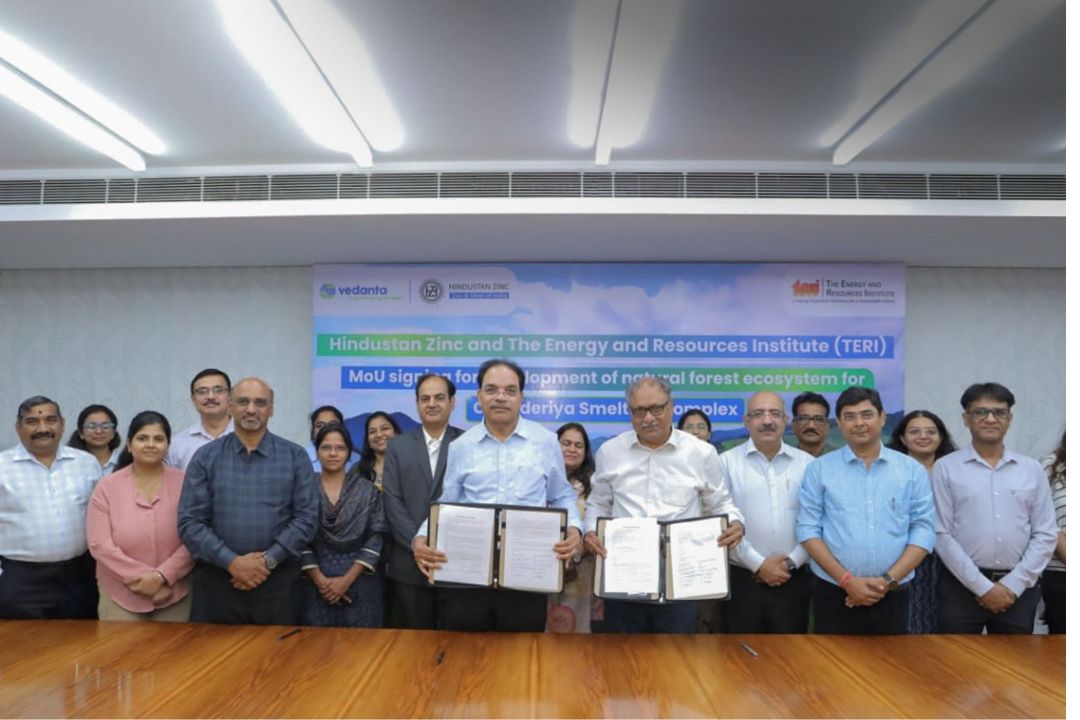
Hindustan Zinc Limited, the world’s largest integrated zinc producer and among the leading silver producers globally, has entered into a Memorandum of Understanding (MoU) with The Energy and Resources Institute (TERI) to undertake a large-scale ecological restoration project spanning 250 hectares in Rajasthan. The initiative, to be developed at the company’s Chanderiya Lead Zinc Smelter Complex in Chittorgarh district, is expected to create one of the largest green cover areas within an industrial facility globally.
The project underscores Hindustan Zinc’s commitment to integrating environmental stewardship with industrial development. Designed to transform industrial land into a resilient and self-sustaining ecosystem, the restoration programme aims to strengthen biodiversity, improve ecological balance, and contribute to climate resilience.
The initiative aligns with the company’s Sustainability Goal 2030, which focuses on halting and reversing biodiversity loss while progressively advancing towards a Net Positive Impact on nature. The restoration model will incorporate a scientifically planned mix of native trees, shrubs, grasses and herbaceous species adapted to local environmental conditions.
As part of the project, special emphasis will be placed on invasive species management, water body conservation, habitat enhancement, and long-term ecosystem maintenance. TERI will provide technical expertise throughout the planning, design and implementation phases, including species selection and ecological monitoring.
The new project builds on a successful partnership between Hindustan Zinc and TERI at the Chanderiya complex. Over the past several years, restoration activities covering 22.25 hectares at the Jarofix Yard have converted degraded industrial land into thriving green spaces.
A separate six-hectare biodiversity park is also being developed on a secured landfill site within the complex. Through the application of TERI’s Mycorrhiza-based ecological restoration technology, nearly 56,400 native trees have already been planted across the site, demonstrating the potential for biodiversity enhancement even in challenging industrial environments.
Commenting on the development, Arun Misra, Chief Executive Officer of Hindustan Zinc, said the collaboration reflects the company’s long-term commitment to responsible mining and sustainable industrial practices. He noted that environmental conservation remains central to the company’s strategy, alongside initiatives focused on water stewardship, renewable energy adoption, decarbonisation and circular resource management.
The ecological restoration initiative forms part of Hindustan Zinc’s broader ESG roadmap. The company has recently strengthened its sustainability profile through renewable energy investments, improved water recycling performance, and expansion of cleaner transportation solutions.
Hindustan Zinc, part of the Vedanta Group, remains one of the world’s largest integrated zinc producers and among the top global silver producers. The company supplies products to more than 40 countries and continues to focus on sustainability, renewable energy integration, circular economy practices, and low-carbon metal production initiatives.