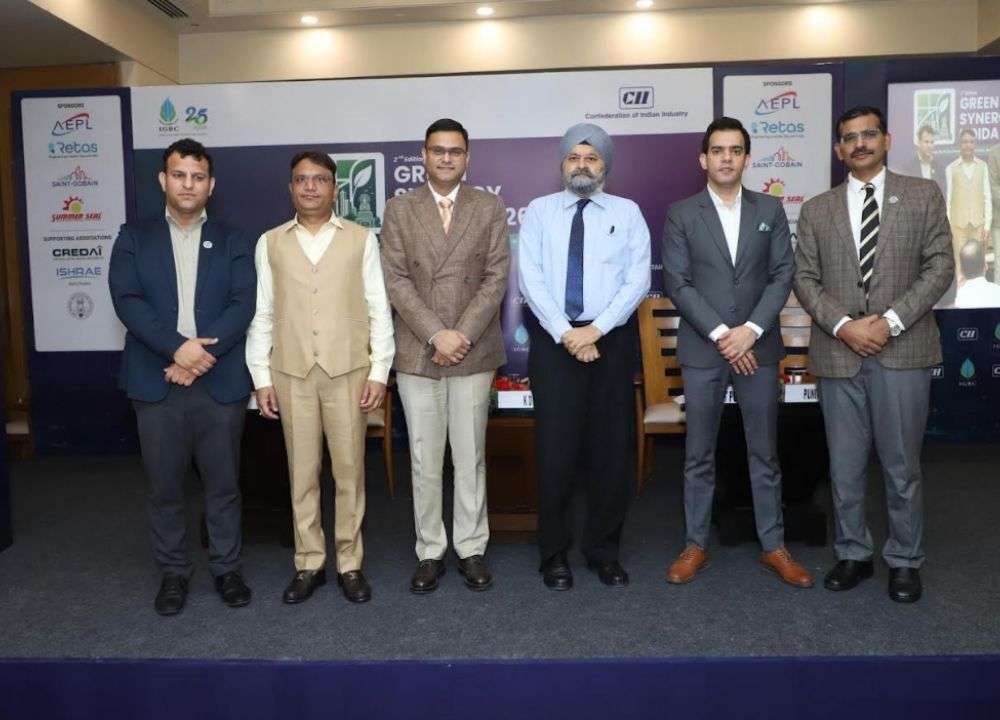
The Indian Green Building Council (IGBC), part of the Confederation of Indian Industry (CII), held the second edition of Green Synergy Noida 2026, bringing together government officials, real estate companies, infrastructure firms, industry representatives and sustainability professionals to discuss climate-resilient and resource-efficient development.
Held under the theme ‘Future-Ready Built Environment: Client Risk, Resilience & Business Value’, the programme focused on climate resilience, water security, energy-efficient buildings and low-carbon construction materials. The event comes as India’s green building movement continues to expand. According to IGBC, the country has 20,012 registered green building projects covering more than 16.33 billion sq. ft. These projects are spread across 33 green and net-zero rating systems and include around 41 lakh residential dwelling units, more than 11,770 commercial projects, over 1,320 transit infrastructure projects, more than 985 industrial buildings and 271 net-zero projects.
KD Singh, Chairman, IGBC Noida Chapter and Managing Director, Aircon Engineers, said climate resilience has become an important requirement for cities and the built environment. He said Noida’s growth as a real estate and infrastructure hub needs to be supported by buildings and infrastructure that use resources efficiently and can withstand climate-related risks.
Nikhil Hawelia, Co-Chairman, IGBC Noida Chapter and Managing Director, Hawelia Group, said the real estate industry needs to move beyond basic green building practices and give greater attention to resilience. He highlighted climate risks, water stress and extreme weather as factors that are increasingly affecting urban development and asset values.
The opening session, titled ‘Building a Future-Ready Built Environment: The New Imperative for Climate Resilience’, brought together views from government and industry. Dinesh Gupta, President, CREDAI Western U.P. and Managing Director, Samriddhi Group, said climate resilience is becoming an important factor for real estate development in the National Capital Region. He stressed the need to make resilience and resource efficiency part of development planning.
Rohit Puri, Convenor, CII Western Uttar Pradesh Government Affairs Panel and Director, APPL Packaging, said the region’s economic growth will increase the need for stronger resource management and climate-resilient infrastructure. A leadership panel examined the relationship between climate risk, water security and long-term asset value. Participants included representatives from the Airports Economic Regulatory Authority of India, Omaxe Group, Pacific Group, Gaurs Group, Brookfield India Real Estate Trust and Noida International Airport.
A technical session discussed ways to improve building performance under climate stress. Topics included advanced glass technology, reflective materials for net-zero buildings and smart rainwater management systems. The programme also held a stakeholder consultation on increasing the use of low-carbon cement in India. Discussions covered its applications, market potential and life-cycle performance.
The concluding session examined technical, economic, market, regulatory and procurement challenges affecting low-carbon cement adoption. The event ended with calls for stronger government-industry cooperation on climate resilience, water security and low-carbon construction across NCR and Western Uttar Pradesh.