Ericsson made a strong impression at the India Mobile Congress (IMC) 2025, showcasing a range of pioneering 5G solutions and AI-powered technologies that are set to accelerate India’s journey towards digital transformation. As India rapidly advances its 5G adoption, with networks covering over 80% of the population and more than 360 million subscribers, Ericsson continues to play a pivotal role in enabling service providers and enterprises to harness the full potential of high-speed, low-latency connectivity.
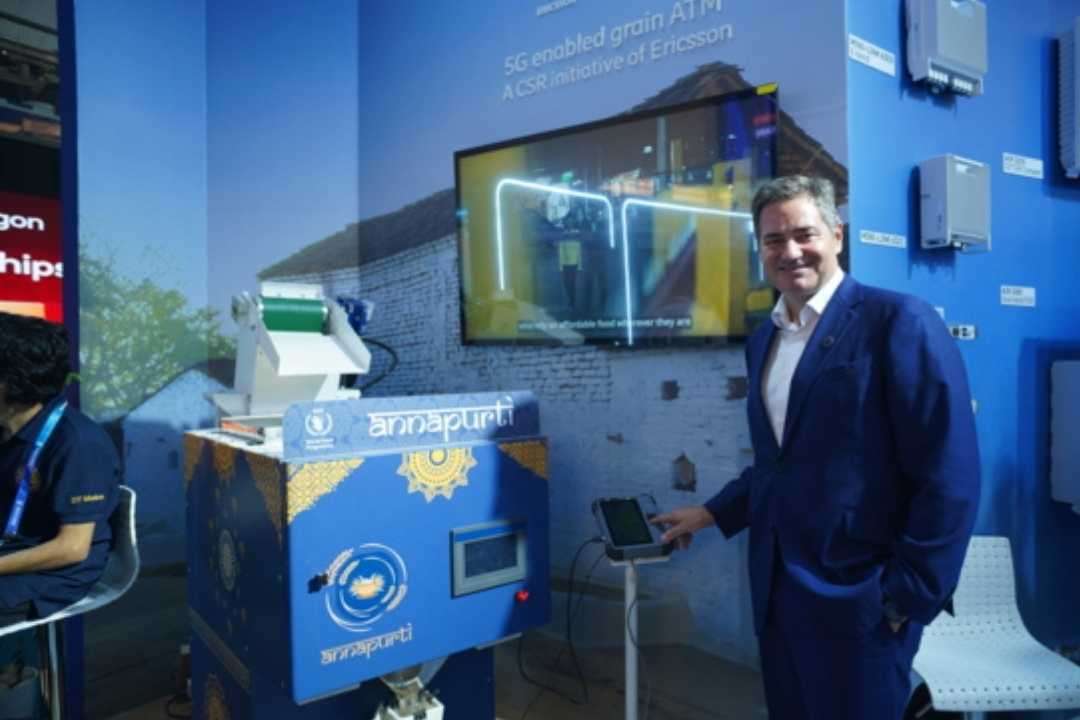
At IMC 2025, Ericsson presented several innovative solutions designed specifically for India, highlighting how 5G can deliver tangible benefits across sectors. Among the most notable was the 5G-enabled Grain ATM Annapurti, developed in collaboration with the World Food Programme. This system leverages Aadhaar-based biometric authentication to dispense multiple food grains with precision, supporting the One Nation One Ration Card initiative.
The Grain ATM provides 24×7 access to essential grains across cities such as Shillong, Varanasi, Gorakhpur, Lucknow, and Bhopal. This demonstration underscored how 5G technology can contribute to social welfare and streamline critical public services, showing the practical impact of digital connectivity on everyday life.
Healthcare solutions also featured prominently, with the StethoECG device exemplifying Ericsson’s commitment to leveraging connectivity for societal benefit. Developed with IIT Madras, this handheld digital stethoscope integrates ECG capabilities and enables real-time remote diagnostics over 5G networks. By facilitating immersive telemedicine experiences, the technology showcases how 5G can transform healthcare delivery, particularly in regions with limited access to medical professionals.
In the industrial domain, Ericsson unveiled its robotic railcar inspection system, which uses AI and sensors to autonomously monitor railcars for defects. Data is transmitted in real time over private 5G networks, enhancing operational safety and efficiency while demonstrating the potential for AI-driven automation in critical infrastructure. Additionally, Ericsson’s Fixed Wireless Access (FWA) solutions, which now serve 8.4 million subscribers in India, including 40% in rural areas, illustrate how 5G can bridge the broadband divide, delivering fibre-like speeds to underserved communities and empowering education, healthcare, and small businesses.
Ericsson’s commitment to India goes beyond deploying technology. With R&D centres in Chennai, Bengaluru, and Gurugram, the company continues to innovate in AI, 6G, and semiconductor design. At the same time, initiatives such as local antenna production reinforce India’s position in the global telecom ecosystem.
Andres Vicente, Head of Market Area Southeast Asia, Oceania, and India at Ericsson, remarked, “India is entering a dynamic era where connectivity, cloud, and AI converge to transform daily experiences and enterprise operations. The country’s vibrant developer and startup ecosystem can harness 5G in unique ways, creating solutions not just for India but for global markets.” He added, “By combining innovation with scale, India has the opportunity to lead in digitalization, and Ericsson is committed to supporting this journey through cutting-edge technologies, partnerships, and localized solutions.”
Founded in 1876, Ericsson has been a global pioneer in telecommunications for nearly 150 years, providing cutting-edge solutions that connect people, businesses, and societies. Operating in over 180 countries, the company drives the evolution of networks, 5G infrastructure, cloud solutions, and emerging technologies, empowering digital transformation across industries. Ericsson’s long-standing commitment to innovation, sustainability, and inclusive connectivity ensures it remains at the forefront of shaping the future of communications worldwide.