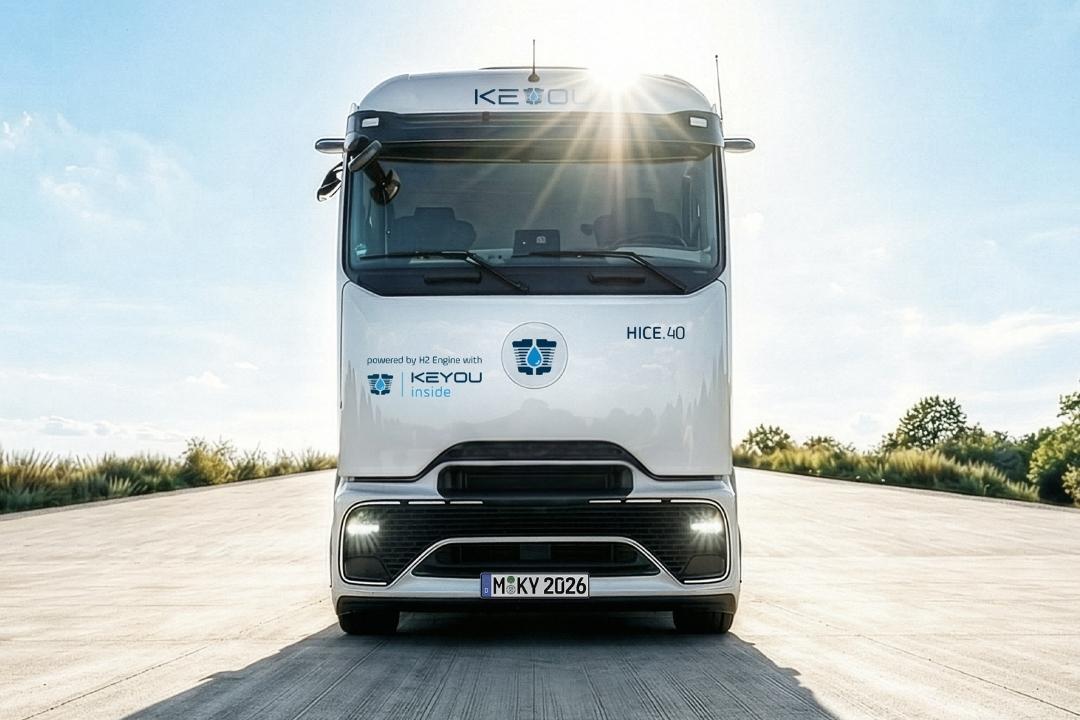
Daimler Truck AG and hydrogen engine specialist KEYOU GmbH have entered into a strategic partnership to accelerate the commercial deployment of hydrogen-powered internal combustion engine (H2-ICE) trucks, expanding the range of low-emission transport solutions available to the road freight industry. The collaboration is aimed at bringing market-ready hydrogen combustion trucks to customers by the end of 2027, offering a practical and economically viable alternative alongside battery-electric and fuel-cell technologies.
The partnership combines Daimler Truck’s expertise in commercial vehicle engineering with KEYOU’s proprietary hydrogen engine conversion technology. Under the agreement, Daimler Truck will supply Mercedes-Benz Actros L 1848 tractor units along with engines based on its established 12.8-litre platform, while KEYOU will convert the powertrain to operate on hydrogen. The integration work will be carried out in cooperation with certified engineering partners, enabling rapid commercialization without the need to develop an entirely new vehicle platform.
The collaboration reflects the growing need for multiple decarbonization pathways within the commercial vehicle sector, where operating conditions and customer requirements vary significantly. Hydrogen combustion engines are expected to offer a practical solution for heavy-duty transport applications that require high payload capacity, durability and operational flexibility while reducing greenhouse gas emissions.
According to Daimler Truck, the partnership allows the company to accelerate market introduction through a collaborative development model rather than pursuing a fully in-house programme. By utilizing proven production vehicles and existing engine architectures, both companies expect to shorten development timelines while lowering implementation costs.
The first product resulting from the collaboration will be the KEYOU HICE.40, a 40-ton hydrogen-powered tractor unit equipped with a modified internal combustion engine delivering up to 350 kW of power. Operating on 350-bar compressed hydrogen storage technology, the truck is expected to achieve a driving range of approximately 650 kilometres, making it suitable for demanding long-haul freight operations. The technology is also designed to be adaptable for additional commercial vehicle models in the future.
Beyond vehicle development, the partners will work together to establish long-term customer support through service and maintenance networks, ensuring fleet operators receive reliable after-sales assistance and high vehicle availability. Discussions are also underway to leverage Daimler Truck’s existing service infrastructure to support future hydrogen-powered fleets.
KEYOU plans to market the converted trucks directly to customers while supporting the gradual expansion of hydrogen refuelling infrastructure. The initiative complements ongoing public and private investments aimed at increasing hydrogen availability for commercial transport. Daimler Truck also supports the development of refuelling stations capable of supplying both gaseous and liquid hydrogen, creating greater flexibility for future hydrogen-powered vehicles.
The collaboration reinforces both companies’ commitment to advancing sustainable freight mobility through practical technologies that can be introduced using existing manufacturing capabilities and industrial infrastructure. By combining hydrogen combustion engines with battery-electric and fuel-cell vehicles, Daimler Truck aims to provide fleet operators with multiple pathways to reduce emissions while meeting diverse transport requirements. The partnership is expected to contribute to the broader transition toward low-carbon road freight transport while strengthening Europe’s position in hydrogen-powered commercial vehicle technologies.