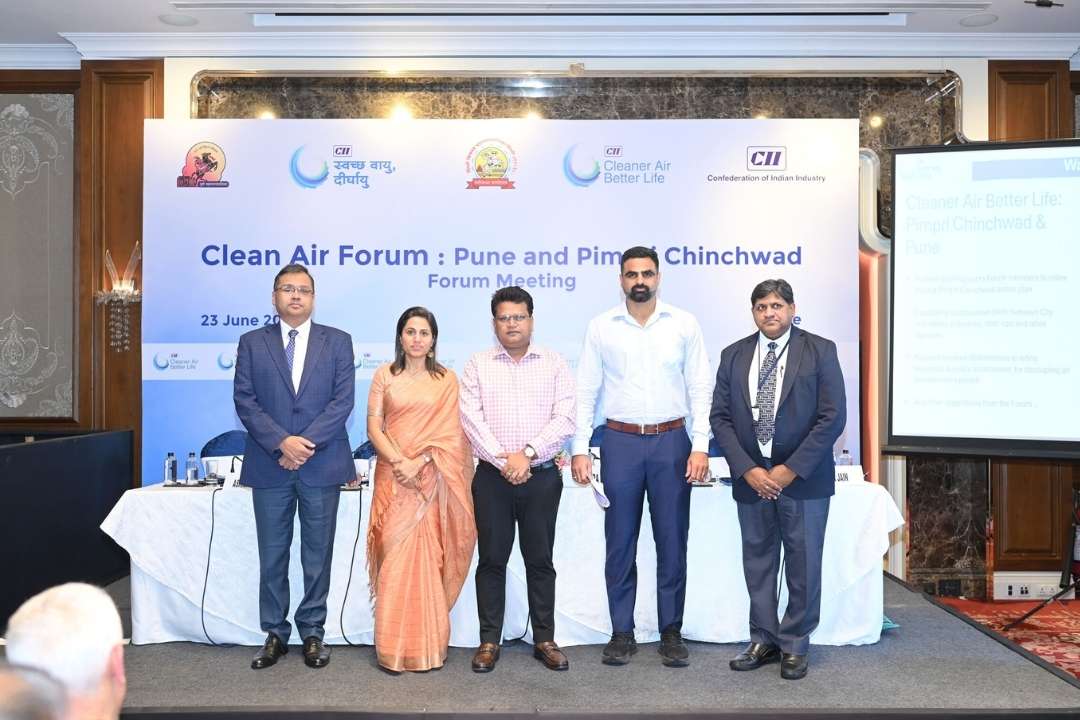
Cummins in India and the Confederation of Indian Industry (CII) have strengthened their long-standing collaboration on clean air initiatives with the launch of an advanced Decision Support System (DSS) designed to enhance air quality management in Pune and Pimpri Chinchwad. The new platform marks another milestone under the Cleaner Air Better Life (CABL) initiative, a national multi-stakeholder programme focused on tackling air pollution through technology, data-driven planning and collaborative action.
Originally conceptualised by Cummins in India, CII and NITI Aayog, the CABL initiative has evolved into a nationwide platform that brings together government agencies, industry, academic institutions, civil society organisations and local communities to address air pollution through coordinated efforts. The initiative focuses on four priority areas—clean transport, clean fuels, clean industry and biomass management—to deliver sustainable environmental solutions.
Developed in partnership with the Pune Municipal Corporation (PMC), Pimpri Chinchwad Municipal Corporation (PCMC) and Airvoice, the newly introduced DSS platform equips city administrators with predictive tools to improve urban air quality. The system provides up to 72-hour air quality forecasts, enabling authorities to identify pollution hotspots, anticipate deteriorating air quality conditions, investigate emerging pollution events and implement timely interventions to minimise their impact.
The platform combines advanced forecasting with actionable intelligence, allowing municipal authorities to make informed decisions based on real-time environmental data. By enabling proactive planning instead of reactive responses, the system is expected to strengthen urban air quality management and support healthier living conditions across the two cities.
Speaking on the initiative, Shveta Arya, Managing Director, Cummins India Ltd and Chairperson, CII Cleaner Air Better Life, said, “Every city faces unique air quality challenges that require localised solutions. By expanding this collaborative model from Delhi to cities such as Pune, we are creating a framework for cleaner and more resilient urban environments. Bringing together government, industry, academia, research institutions and technology partners allows us to develop data-driven solutions tailored to local emission sources, from transportation and construction to industrial activities, while delivering measurable environmental improvements.”
Since its launch, the CABL initiative has progressed beyond policy discussions to large-scale implementation. Across rural India, the programme has engaged more than one lakh farmers, prevented the burning of approximately 6.4 lakh tonnes of crop residue, conserved nearly 71 billion litres of water and reduced an estimated 1.3 lakh tonnes of carbon dioxide emissions. The initiative has also extended its reach to 432 villages, covering more than 4.8 lakh acres through sustainable agricultural practices.
Ashish Aggarwal, Executive Director and Chief Administrative Officer, Cummins India, said the company remains committed to extending its sustainability efforts beyond business operations. He noted that the Cleaner Air Better Life initiative demonstrates how collaborative action can generate measurable environmental outcomes while creating healthier and more resilient communities. Shikhar Jain, Executive Director, CII–Centre for Excellence for Sustainable Development (CESD), added that combining technology with collaborative governance enables cities to make better-informed decisions that improve air quality and safeguard public health.
The Decision Support System was unveiled during the Clean Air Forum in the presence of senior government officials, including representatives from the Pune Municipal Corporation, Pimpri Chinchwad Municipal Corporation and the Pune district administration, alongside industry leaders, research institutions and civil society organisations. The participation of diverse stakeholders reinforced the importance of public-private partnerships in addressing one of India’s most pressing environmental challenges.
With the launch of the DSS platform, Cummins and CII have taken another significant step towards strengthening India’s clean air ecosystem by equipping cities with advanced digital tools that support informed policymaking, environmental resilience and sustainable urban development.
Established in 1962 and headquartered in Pune, Cummins India operates five state-of-the-art manufacturing plants along with assembly and distribution facilities across the country. With more than 480 customer touchpoints and a workforce of over 3,000 employees, the company continues to support customers across power generation, aftermarket, and export businesses while advancing its mission of powering a more prosperous world.