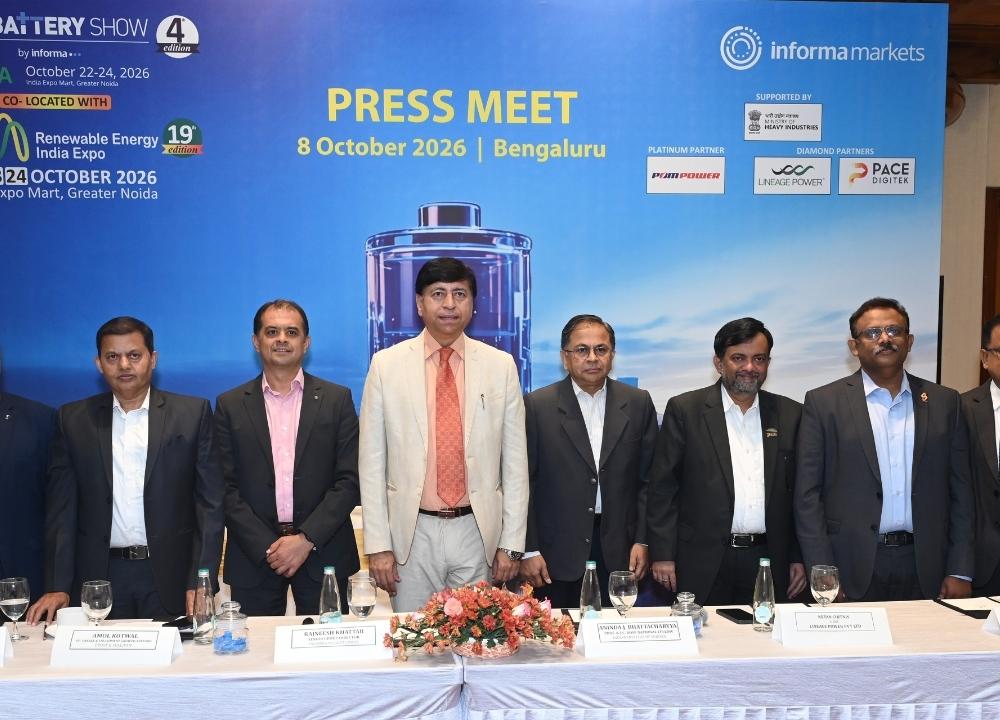
Industry representatives and researchers have called for stronger domestic capabilities in battery energy storage, power electronics and digital grid management as India works to integrate more renewable energy into its electricity network. The issues were discussed at a media roundtable in Bengaluru ahead of the fourth edition of The Battery Show India, scheduled for October 22–24 at India Expo Mart, Greater Noida.
India’s renewable energy target of 500 GW by 2030–31 is increasing the need for storage technologies that can manage fluctuations in solar and wind generation. Industry estimates cited at the discussion point to a requirement of 236 GWh of battery energy storage by 2031–32. Participants said domestic manufacturing, technology development and reliable procurement frameworks would be important to meet this demand.
I B Rao, Managing Director of Pom Power Systems, said the Indian storage market had expanded since the company entered the segment in 2022. Pom Power Systems works mainly in the commercial and industrial market, with systems of up to 5 MW. Its deployments include a 150 kW storage system at ANERT in Kerala, which has been operational for 18 months, and a solar, storage and EV-charging project at Bharat Electronics.
Rao said the company was showcasing battery-integrated EV charging systems that can support a 200 kW charger using 30–50 kW of grid power. It is also expanding its lithium-based uninterruptible power supply portfolio, hybrid inverters, battery management systems and battery energy storage solutions with liquid cooling.
Ketan Chitnis, Chief Operating Officer of Lineage Power, said the company’s experience with deployed systems had demonstrated that battery technology must be selected according to application requirements. Lithium-ion and sodium-ion batteries can serve different needs depending on response time, storage duration and lifecycle. He also stressed the importance of localising critical components and developing power conversion and energy management systems in India.
Tirumaleswara Reddy K, Co-Founder and CTO of Smartgrid Analytics, highlighted the role of software in managing renewable energy generation and storage. Variations in renewable output can affect scheduled power supply and expose generators to deviation settlement penalties. The company’s ARA platform combines generation forecasts, battery sizing, electricity price forecasts and 15-minute scheduling to support charging and discharging decisions. Smartgrid Analytics said it had supported around 95 GWh of renewable energy deployments and nearly 9 GWh of BESS deployments across 21 countries.
Amol Kotwal of Frost & Sullivan said India’s storage ecosystem would depend on cell manufacturing, locally produced power systems and clearer procurement and tariff structures. Professor Aninda J. Bhattacharyya of the Indian Institute of Science called for more research into sodium-ion and other emerging battery chemistries to reduce dependence on critical minerals and use materials available in India.
The roundtable also highlighted Karnataka’s potential to support energy storage and electric mobility. The state had 6,805 public EV charging stations as of March 31, 2026, while another 1,571 chargers had been approved under the PM E-DRIVE scheme. Bengaluru’s research institutions and engineering sector were identified as potential partners for industry-led battery and smart-grid development.
Organised by Informa Markets in India, The Battery Show India will feature international exhibitors, a dedicated German Pavilion, a specialised BESS Hall, more than 40 conference sessions, an Energy Storage Summit and four CXO conclaves. The event will run alongside the Renewable Energy India Expo, bringing together companies working across batteries, renewable power, electric mobility and grid infrastructure.