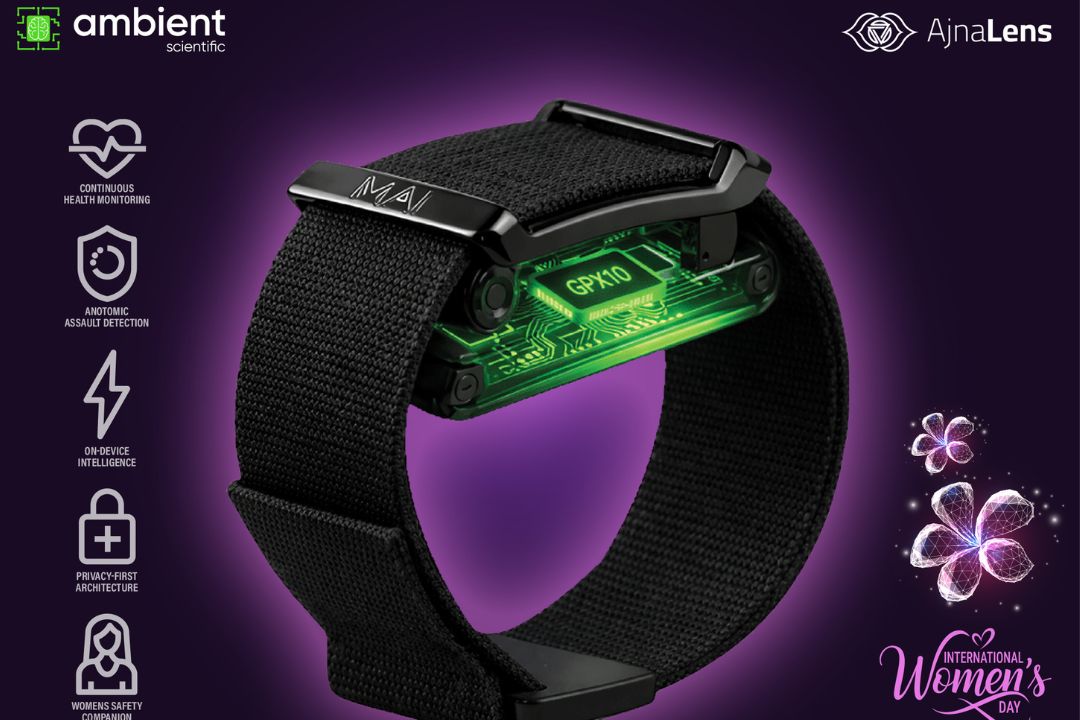
Ambient Scientific has announced a collaboration with Dimension NXG to power “MAI,” a new wearable device focused on women’s health monitoring and personal safety. The announcement was made at Embedded World, coinciding with International Women’s Day.
The MAI wearable is designed as a daily health companion equipped with integrated safety features. It continuously tracks vital parameters such as heart rate and oxygen levels, while also enabling insights into broader health patterns. Over time, the system develops an individualized baseline, allowing it to identify deviations that may indicate emerging health concerns.
In addition to health tracking, the device incorporates safety-focused capabilities, including fall detection, gesture-based alerts and stress indicators. These features enable rapid notifications during emergencies, offering users an additional layer of security in everyday environments.
A key differentiator of the device is its ability to process data directly on the wearable. By minimizing reliance on cloud connectivity, MAI ensures that sensitive information remains private unless users choose to share it. This approach also allows the device to function reliably in areas with limited network access.
The wearable is powered by Ambient Scientific’s GPX-10 processor, engineered to support continuous AI processing while maintaining low energy consumption. The chipset enables the device to operate for up to two weeks on a single charge, addressing a critical challenge in wearable technology—balancing performance with battery life.
The processor’s architecture combines analog and digital elements to execute complex computations efficiently. This allows multiple AI models, including sensor fusion and audio analysis, to run simultaneously without significant power draw. As a result, users benefit from real-time insights without the need for frequent charging.
Initial field trials for MAI are scheduled to begin in March 2026, with early deployments planned across India. The rollout will include pre-order customers and pilot participants, with broader availability expected later in the year.
The collaboration highlights the growing role of edge-based AI in consumer devices, particularly in applications where privacy, reliability and accessibility are critical. By combining advanced processing capabilities with practical design, the MAI wearable aims to deliver meaningful value in real-world conditions.