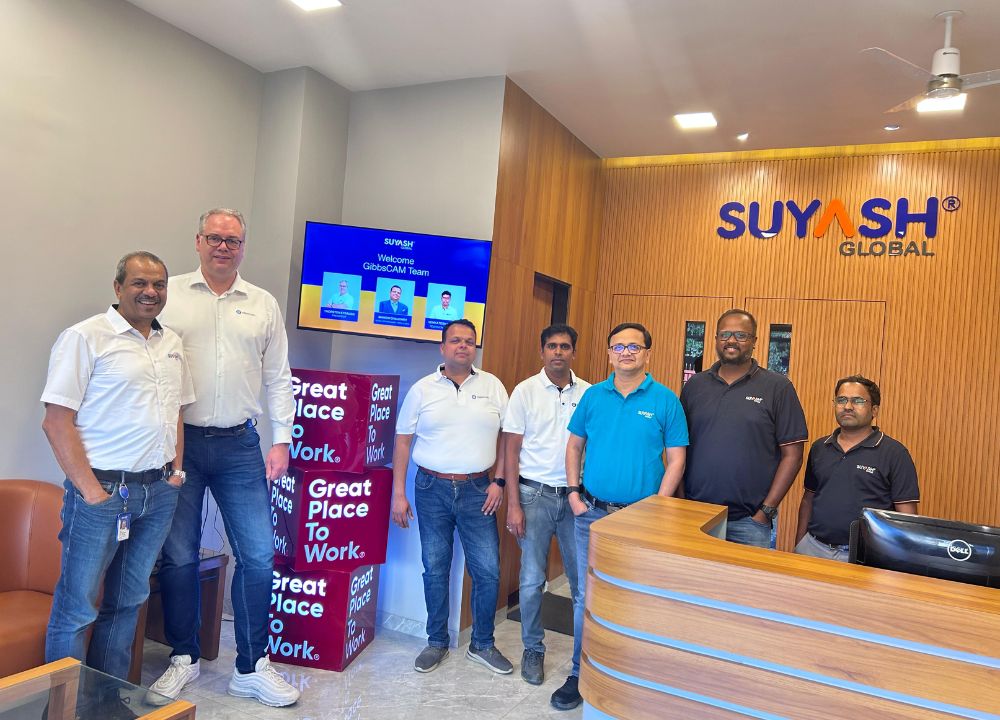
Suyash Global found GibbsCAM the way most good manufacturing decisions happen. They ran into a problem, looked for a solution that actually worked, and stayed with it long enough to understand it properly. Once they did, the experience was convincing enough that they wanted other manufacturers to have it too.The story behind that starts in 1999, in a modest machining operation near India’s largest port, and has grown into a fully integrated contract manufacturing ecosystem exporting over 95 percent of its output to global OEMs across Europe, the UK, the United States, and Australia. Seven manufacturing units. More than 70 CNC machines. And a philosophy that has not changed much since the beginning: complex manufacturing works best when responsibility stays under one roof.
Built to Handle What Others Send Out
Most subcontractors grow by adding machines. Suyash Global grew by adding capabilities. Precision CNC machining, sheet metal fabrication, tube bending, certified welding, surface finishing, and full mechanical and electromechanical assemblies. Progressive die design developed in-house. Laser cutting and press brake machines from Amada alongside 5-axis machining centres and multi-tasking turn-mill centres from DMG Mori and Mazak.
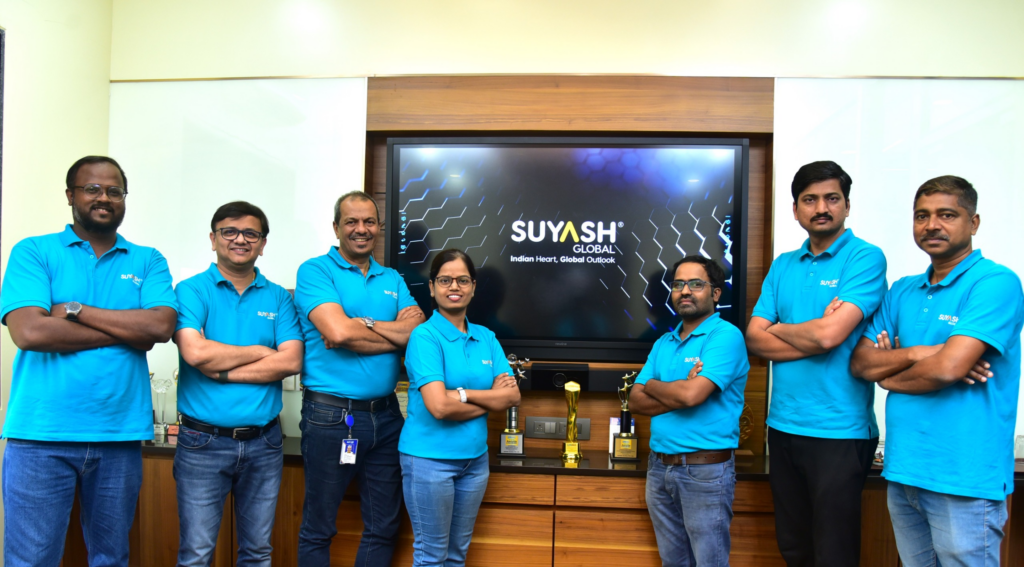
The result is an operation where programmers, engineers, and production teams work in close proximity, not in separate departments. Every CAM decision gets evaluated against real machine behaviour, actual tooling limits, and the kind of setup constraints that only become visible once a part is on the machine.
Customers typically come to Suyash Global when previous suppliers have struggled with consistency, when parts require simultaneous milling and turning in a single setup, or when tolerances are tight enough that cumulative errors across multiple operations become a real risk. The company is regularly engaged for components where conventional approaches fall short.
One example that reflects this well is a high-precision air gun component machined on a multi-tasking turn-mill centre. The job required tolerances in the 5 to 10 micron range alongside clearly defined GDT requirements, complex profiles, and simultaneous multi-axis machining. Holding those results consistently across batches demanded a CAM strategy that left nothing to chance.
What Changed When GibbsCAM Arrived
Before GibbsCAM, the challenges Suyash Global faced were familiar to anyone running complex multi-axis work: toolpath validation that was not quite reliable enough, cycle time estimates that did not survive contact with the machine, and shop-floor proving cycles that took longer than they should.GibbsCAM addressed those problems in a way that felt practical rather than theoretical. Simulation accuracy improved to the point where programs reached the machine with far fewer surprises. Cycle time estimation became something the team could actually rely on during quoting and scheduling. And VoluMill, GibbsCAM’s high-efficiency roughing strategy, changed the economics of material removal on difficult jobs, improving tool life, surface finish, and cutting rates at the same time.
For multi-tasking turn-mill work specifically, GibbsCAM’s ability to handle milling and turning operations within a single environment made a visible difference. Programs stopped behaving unpredictably. Setups became clearer. Machines ran through production with less operator intervention, and first-off acceptance rates went up.
The post-processor flexibility mattered too. With multiple machine platforms across the facility, having post-processors that produce accurate output across different controllers removed a category of risk that previously required constant attention.
What the team at Suyash Global appreciated most was reliability. Not reliability in a marketing brochure sense, but the practical kind where a program behaves the way it was written, consistently, job after job. That quality has a direct impact on throughput, on machine utilisation, and on the confidence the team brings to each new job.
From Using It to Selling It
The move into GibbsCAM reselling was not a strategic pivot. It was a gradual recognition that Suyash Global was already doing the work. Other manufacturers were coming to them with programming and machining challenges, and the team was solving those challenges using GibbsCAM, drawing on experience from their own shop floor.
Becoming a formal reseller made that arrangement official. It also clarified what kind of reseller Suyash Global would be. Not one that installs software and delivers training manuals. One that works alongside customers to understand their machines, their parts, and their production constraints, then helps them apply GibbsCAM in ways that produce measurable results.
Support from Suyash Global’s team often covers process planning, tooling and setup strategy, post-processor tuning, and cycle time optimisation. In some cases it extends to live prove-outs. The guidance is grounded in what works on their own machines, not in what should theoretically work.
The customers who benefit most are typically those handling complex, tolerance-critical components on multi-axis or multi-tasking machines, particularly where previous approaches have involved too much trial and error. What those customers get is not just software. They get access to a team that runs GibbsCAM daily and understands the difference between a toolpath that looks good on screen and one that runs well in production.
What the GibbsCAM Partnership Looks Like in Practice
Suyash Global describes their relationship with GibbsCAM as genuinely collaborative. The GibbsCAM team engages with real-world inputs from their production environment, takes feedback seriously, and works with resellers to continuously improve how the software is applied. That open approach has strengthened the team’s own understanding of the software and made them more effective as both a manufacturer and a reseller.
GibbsCAM’s product philosophy, focused on stability, practical usability, and real-world machinability, maps closely to how Suyash Global operates. Neither side is interested in solutions that look impressive but require extensive rework before they run reliably. That shared emphasis on production-ready outcomes is what makes the partnership work.
Suyash Global continues to invest in GibbsCAM for their own production because the demands on their shop floor keep growing. As multi-axis and multi-tasking work becomes more complex, GibbsCAM’s stability and flexibility allow the team to take on more demanding jobs without compromising on consistency or efficiency.
Looking Ahead
Suyash Global is already expanding its role beyond contract manufacturing. The ambition is to get involved earlier in the product lifecycle, contributing manufacturability inputs and process development before production begins, rather than receiving a drawing and being asked to make it work. GibbsCAM sits at the centre of that. The team uses it every day, and that daily use is what allows complex engineering intent to be translated into machining programs that run predictably and scale reliably.
For manufacturers considering GibbsCAM, Suyash Global’s advice is direct. The software is capable. But capability only matters when it is applied well. The real difference comes from a reseller who runs production on the same machines, deals with the same shop-floor pressures, and has already proven the strategies they are recommending. That is what separates getting GibbsCAM installed from getting GibbsCAM to work.