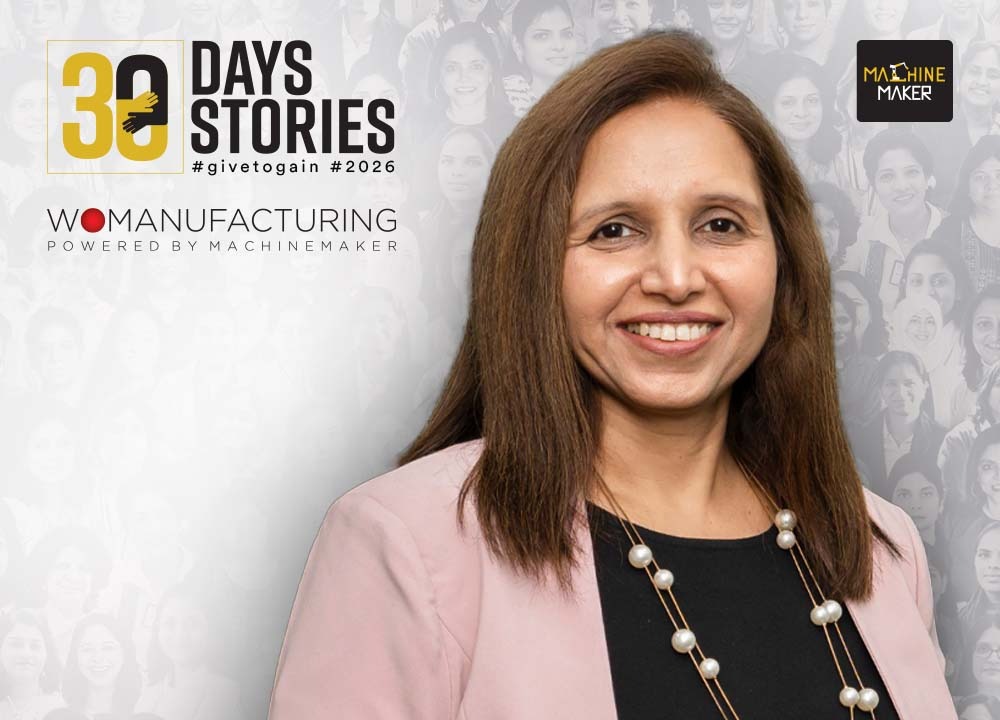
In a small town in Gujarat, where expectations for daughters often followed familiar and conservative paths, a young girl found herself fascinated by something entirely different. Avani Shah was curious about how things worked, how machines were built, and how ideas on paper could eventually transform into something real. While many around her might have imagined traditional roles for a girl, her imagination travelled to machines, manufacturing, and the engineering that powered the world around her. For her, joy came from understanding how things were made and shaped.
What made this curiosity grow into confidence was the environment she grew up in. In a family rooted deeply in values of integrity, care, and trust, she never experienced the boundaries that society often places around daughters. Avani grew up as the elder of two sisters in a supportive household where her parents believed that their daughters should have the freedom to pursue their ambitions.
Her father, Vinod Dalal, worked in a transferable government job, which meant the family moved frequently. Those constant shifts in cities and schools turned out to be an unexpected advantage. Every move introduced Avani and her younger sister, Grishma, to new cultures, new people, and new ways of thinking. Adaptability became second nature.
At home, the nurturing influence came from her mother, Bharti Dalal, a homemaker who ensured that both daughters grew up independent and self-reliant. While she managed the household, she also quietly instilled a sense of responsibility and confidence in her children.
Among the many influences that shaped Avani’s early thinking, one person stood out profoundly: her maternal grandfather, Rasiklal Shah. Coming from a small village with limited means, he had pursued education with determination and eventually rose to become the Commissioner of Surat. For young Avani, watching his journey was deeply inspiring. His commitment to continuous learning and his ability to rise through sheer dedication left a lasting impression.
Seeing someone from her own family achieve such heights planted an important belief in her mind that ambition should never be limited by circumstance.
Choosing a Different Path
When Avani decided to pursue mechanical engineering, it was far from an obvious choice. Even today, mechanical engineering remains a male-dominated field, and at the time she entered college, the gender gap was even more visible.
Her family, however, responded with enthusiasm rather than hesitation. In fact, when she secured admission to mechanical engineering, her father celebrated the occasion by hosting a family gathering.
The excitement was genuine because Avani was the first engineer in the family. Coming from a business-oriented Gujarati background where many relatives worked in finance and banking, engineering was an entirely new direction.
But Avani’s fascination with engineering had always been clear. She was drawn to the process of creation; the journey from an idea to a working product. Engineering, particularly mechanical engineering, offered exactly that. Designs could be imagined on paper, built through manufacturing, assembled into systems, tested, and eventually used in the real world.
The tangible nature of engineering deeply appealed to her.
Learning to Navigate the Real World
College brought with it the first glimpse of how uncommon her choice really was. In a classroom filled mostly with male students, Avani and a handful of other girls stood out immediately. There were barely eight to ten female students in the entire batch.
The same reality continued when she entered the manufacturing industry. In some situations, early in her career, she found herself as the only woman on the shopfloor or the only woman participating in technical discussions.
These moments could have easily discouraged someone entering the industry. But Avani saw them differently.
Instead of viewing it as a barrier, she treated it as an opportunity to learn, adapt, and grow. Her early career was spent working in smaller organisations, an experience she now considers extremely valuable. These companies offered fewer rigid boundaries between functions, allowing her to explore different aspects of engineering and manufacturing.
She gained exposure to cross-functional work, understood how different departments connected, and developed a deeper understanding of how organisations truly function.
Looking back, she describes those years as learning to swim by jumping directly into the water. There were challenges, moments of doubt, and occasional failures. But each experience added to her confidence and shaped her ability to handle ambiguity and complexity.
The first multinational company she worked for was Larsen & Toubro. At Larsen & Toubro, she led engineering teams through complex projects, combining technical expertise with operational discipline to ensure customer success.
Two Decades of Growth at Cummins
When Avani moved to Pune after her marriage, she joined Cummins, a global leader in power solutions. What initially appeared as a new professional chapter gradually evolved into one of the most defining phases of her career. Over the next two decades, Cummins would become the platform where her technical depth expanded, her leadership matured, and her global exposure took shape.
The organisation provided an environment where engineers were encouraged to evolve beyond narrow functional roles. For Avani, this meant constantly learning, adapting, and stepping into new responsibilities. Rather than remaining confined to a single technical function, she moved across multiple roles that allowed her to understand engineering not just as a discipline, but as a business enabler.
Working in a global organisation also meant collaborating with teams and customers across different geographies. These interactions helped her develop a broader perspective on how engineering solutions must adapt to diverse market requirements, regulatory environments, and customer expectations.
Alongside her professional responsibilities, Avani actively invested in strengthening her leadership capabilities. She pursued advanced executive education at the Indian Institute of Management Calcutta, where she developed strategic and managerial skills that complemented her engineering background. She also participated in international leadership programs such as “From Specialist to Strategist” and “Directing Innovations,” organised by the Society of Women Engineers and Smith College in the United States.
Over time, Avani transitioned from being an engineer solving technical problems to a leader responsible for building teams, fostering innovation and shaping engineering strategies.
Building a Remanufacturing Technical Centre
One of the most defining milestones in Avani’s career came when Cummins decided to establish a remanufacturing technical centre in India. The initiative was part of the company’s broader effort to expand sustainable lifecycle solutions while leveraging India’s engineering capabilities.
For Avani, this was the first time she had the opportunity to build something almost from scratch.
Until then, she had worked within established teams and organisational structures. This project required her to assemble a new team, define technical processes, and build engineering capabilities that could support remanufacturing operations for global markets.
Under Avani’s leadership, the technical centre began developing engineering solutions that allowed used products to be restored, tested, and redeployed with the similar reliability expected from new products.
The initiative eventually evolved into a globally integrated technical centre supporting remanufacturing operations across multiple markets.
For Avani, the experience was both technically and professionally transformative. It allowed her to work at the intersection of engineering innovation and sustainability, while also strengthening her ability to build and lead teams in a new organisational environment.
Leading Engineering Across Asia Pacific
As Avani’s leadership responsibilities expanded, she stepped into a role that extended her influence beyond India. She began leading engineering teams that supported the Asia-Pacific region, including countries such as Japan, Korea, several Southeast Asian markets, Australia, and New Zealand.
Working across such a diverse region introduced new layers of complexity. Each market had its own set of customer expectations, regulatory standards, and operational challenges.
Engineering solutions that worked perfectly in one region often required adaptation to meet the specific needs of another.
Leading global teams strengthened Avani’s ability to embrace cultural diversity, enable seamless cross‑time‑zone collaboration, and build clear, effective communication channels.
In this phase of her career, she demonstrated that true engineering leadership blends technical excellence with cultural awareness, strategic clarity, and the ability to collaborate across borders.
It was also during this period that she became increasingly aware that the gender imbalance in engineering leadership was not limited to India. Across many countries, women remained underrepresented in technical and manufacturing roles.
Rather than seeing this as a limitation, Avani began contributing actively to initiatives that encouraged more women to pursue engineering careers and leadership roles.
The Importance of Family Support
Throughout her journey, one constant source of strength has been the support of her family.
Her husband, Samir Shah, has been an important pillar of encouragement throughout her career. With a professional background that understands the demands of engineering and industry, he has consistently supported her ambitions and responsibilities. Recently, Samir started his own entrepreneurial venture in logistics and industrial safety products, marking another chapter of growth within the family.
Their son, Nirmit Shah, is currently pursuing mechanical engineering in the United States, continuing the family’s connection with the world of engineering and technology.
For Avani, family support has played a crucial role in enabling her to pursue demanding professional responsibilities while maintaining balance at home.
She also fondly remembers the encouragement she received from her father-in-law Chandrakant Shah, who passed away last year. His belief in her capabilities and his unconditional support during important phases of her career left a lasting impact.
Avani often reflects that professional success rarely happens in isolation. Behind every career journey is a network of people who quietly provide encouragement, stability, and confidence.
Leadership with Purpose
Beyond her corporate responsibilities, Avani actively chose to contribute to a broader mission: encouraging more women to pursue careers in engineering.
She became closely associated with the Society of Women Engineers (SWE), eventually serving as a global ambassador representing India. Through this platform, she helped organise mentoring sessions, career guidance workshops, and outreach programs in schools, particularly targeting students who lacked access to professional guidance.
Her belief was simple: exposure creates aspiration.
If young students, especially girls, could see role models in engineering and manufacturing, they would begin to imagine those possibilities for themselves.
At the same time, Avani continued to grow into larger leadership roles within the industry. Her journey eventually led her to Atmus Filtration Technologies, where she played a key role in establishing and leading the company’s presence in India after the filtration business was spun off from Cummins.
Building the organisation required far more than engineering expertise. It meant setting up teams, systems, governance structures, and operational frameworks, essentially building a company from the ground up. She led the establishment of Atmus Global Capability Center and state of the art R&D lab in India. Today, the Global Capability Center has evolved into a strategic pillar for the organization.
For Avani, the journey from a curious girl fascinated by machines to a global leader has been shaped by curiosity, resilience, and a strong support system at home.
Today, as she reflects on that journey, one belief remains central to her story: true empowerment begins with the confidence that families instil in their children, and the courage individuals bring to pursue their dreams beyond societal expectations.