


In many production environments, the decision to install overhead lifting equipment is straightforward. The question is rarely whether lifting support is needed — it is how best to implement it. This discussion narrows the lens to applications involving loads of approximately 100 kg or less (and up to around 160 kg in electrically driven systems). At this scale, equipment choice exerts a disproportionate influence on ergonomics, workflow fluidity, and operator fatigue.
The loads themselves may not be heavy in absolute terms, but they are often handled frequently, guided manually, and integrated into dynamic production steps. In such cases, proportionality matters. A lifting system designed for heavier industrial demands may function adequately, yet still introduce unnecessary resistance, inertia, or operational friction. For lighter loads, it is not just about how much the system can lift, but how naturally it integrates into the way operators move and handle parts.
Why Slewing Cranes Are Often the First Choice
Slewing cranes are a familiar and proven solution. For decades, they have represented the standard approach to overhead lifting in workshops and assembly environments.
Their widespread adoption is not accidental. The structural concept is robust and mechanically uncomplicated: a fixed column or wall-mounted pillar, a horizontal jib, and a hoist travelling along a defined arc. This simplicity supports straightforward integration and helps keep investment requirements predictable. Engineering teams understand them, maintenance personnel are familiar with their servicing requirements, and safety managers can assess them using well-established standards and procedures.
For clearly defined, point-to-point transfers within stable layouts, a slewing crane performs reliably. When movement follows a consistent arc and tasks are repetitive—for example loading fixtures, transferring components between two stations, or supplying a machine interface—the concept is both efficient and durable.
In short, slewing cranes became the default because they solve many lifting tasks reliably. Their capability is not in doubt. What merits closer examination is whether they remain proportionate when loads become lighter and movement patterns more variable.
Limitations Buyers Often Overlook
Where challenges arise is not in capacity, but in proportionality.
A slewing crane does not move only the load. With every lift, the operator must accelerate and decelerate the structural mass of the boom and trolley assembly. That mass — and the inertia it generates — becomes part of the handling dynamic. In effect, the system’s own weight contributes to the effort required for each movement.
In higher load ranges, this relationship is less noticeable. But when handling components around 100 kg or below, the ratio changes. The operator may find that guiding the crane structure demands a level of input that feels out of scale with the part itself. Over repeated cycles, this affects fine positioning accuracy and disrupts the natural rhythm of the task, contributing to cumulative operator fatigue over a full shift.
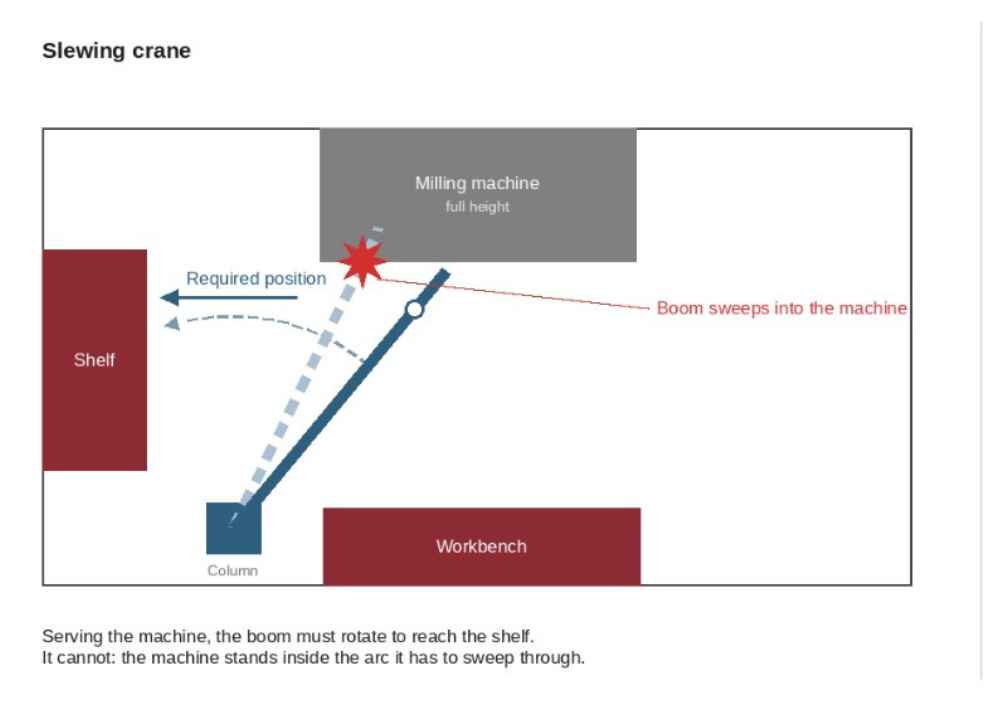
Responsiveness is another factor. Because a slewing crane operates around defined pivot points and arcs, movement is geometrically constrained. For straightforward, repetitive transfers, this is entirely suitable. However, when tasks involve angled insertions, positioning close to walls or columns, or frequent reorientation between adjacent workstations, the fixed geometry can introduce additional corrective movements. Where an obstacle stands within the crane’s sweep, the position behind it cannot be reached at all.
These characteristics are not weaknesses but inherent outcomes of the crane’s mechanical design. The critical consideration is whether that design principle matches the real demands of the application.
Where Articulated Arms Offer a Better Fit
An articulated arm is built on a different geometry. Two rigid links, connected by pivoting joints, extend from a column or wall mount. The rope balancer stays at the column, with its rope running along the boom and deflected downward at the tip. The arm positions the load, the rope carries it, and the mass of the lifting unit never travels with the movement. Because each joint rotates independently, the arm can also reach a given point in more than one configuration, folding or extending to suit what is around it.
Because the moving mass is lower, manual guidance becomes more immediate and predictable. The operator’s input is transferred more directly to the load, rather than being absorbed in accelerating the supporting structure. In repetitive handling or precision placement tasks, this translates into finer control and reduced corrective movements — small differences that compound over several cycles per shift.
The geometry of the working envelope also plays a practical role. An articulated arm’s effective working radius extends to the tip of the boom. By contrast, a conventional slewing crane typically sacrifices several centimetres of usable reach due to the trolley undercarriage travelling along the beam. On a three-metre boom, the usable travel is closer to two metres.
While this may appear marginal on paper, in compact production cells, it determines how closely a component can be positioned to walls, columns or machine frames. The result is greater layout tolerance and more freedom in workstation design.
Articulated systems also accommodate multi-directional movements more fluidly. Because motion is not limited to a single pivot arc, operators can approach parts from varying angles without repositioning the entire structure. In tasks involving angled insertions, fixture loading or assembly steps that require nuanced alignment, this flexibility becomes operationally meaningful.
Where further reduction of structural mass is necessary, articulated arms can also be manufactured in carbon fibre. The material’s high stiffness-to-weight ratio reduces inertia without compromising structural stability, enhancing responsiveness in light-load handling environments.
Choosing the Right Concept for the Application
The objective is not to categorically replace cranes. Slewing cranes remain highly effective for heavier loads and clearly defined, predictable lifting paths. In many industrial environments, they are entirely appropriate.
However, within the lighter load range — up to approximately 100 kg in pneumatic systems and around 160 kg in electrically driven configurations — the choice of handling principle has a pronounced impact on daily operations. Within this application segment, articulated arms often deliver measurable advantages in manoeuvrability, operator comfort, and workflow adaptability.
The decisive factor is alignment between task and concept. This alignment becomes clearer when the application is examined systematically:
- How frequently is the handling cycle repeated?
- How variable is the movement sequence?
- How constrained is the available workspace?
- What degree of positioning precision is required?
These parameters determine whether structural mass, movement geometry, or system responsiveness will influence performance over time. When the lifting equipment complements the task logic, it supports productivity. When it is mismatched, it quietly shapes — and sometimes restricts — the process.
Evaluating these factors at the outset ensures that overhead lifting remains proportionate to the load and appropriate to the workflow. By analysing tasks, layouts, and operational objectives in detail, ZASCHE supports customers in selecting the handling principle that best fits their environment — balancing performance, ergonomics, and long-term efficiency.
ZASCHE handling — the world’s leading provider for load handling technology — develops and supplies customised, ergonomic solutions that caters to every industry and application. Founded in 1932, the company has a large portfolio of products that reflects its rich history in steel and crane construction, and its deep expertise as an industrial handling specialist.









