

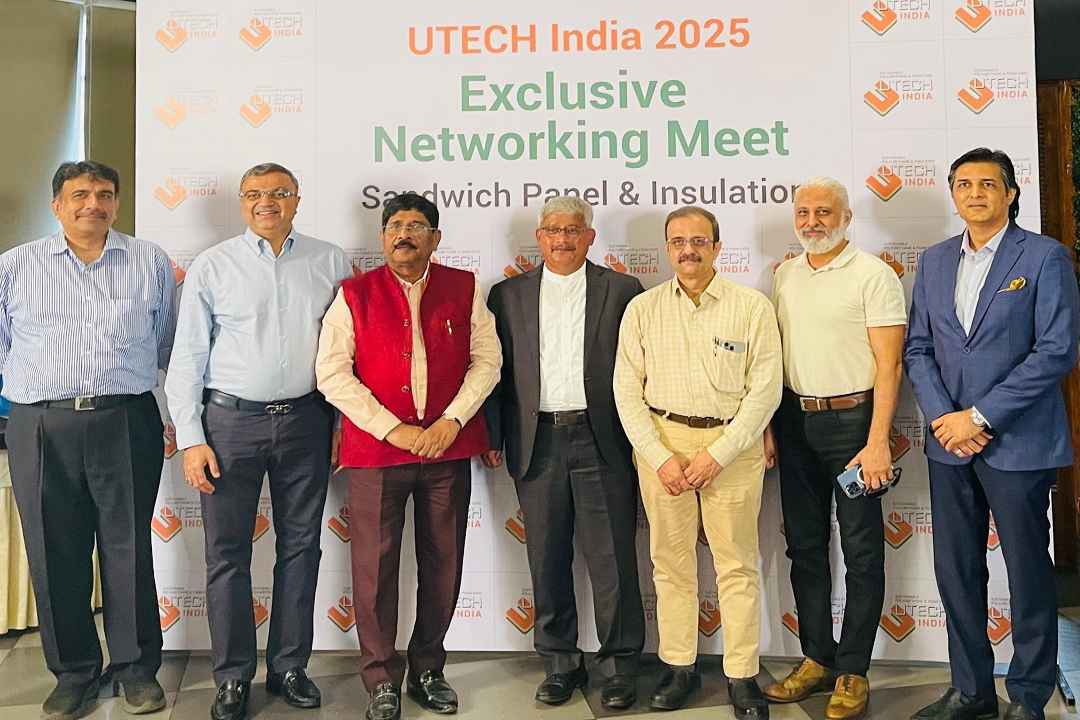
Industry leaders have emphasized the need for stronger government policies, modernized Bureau of Indian Standards (BIS) norms, and coordinated industry efforts to globalize India’s polyurethane (PU) and foam sector. The call to action came during an exclusive Leadership Dialogue organized as a prelude to the upcoming second edition of UTECH INDIA – Sustainable Polyurethane & Foam (ISPUF) Expo, which will take place from November 13 to 15, 2025, at the Bombay Exhibition Centre, NESCO, Mumbai.
Organized by Crain Communications and Media Fusion, the UTECH India Expo, held alongside the Sleep Expo India Pavilion, is India’s only dedicated platform for the polyurethane, foam, and insulation industries. The Leadership Dialogue, themed “Transforming PU Applications, Insulation & Cold Storage Solutions,” convened industry experts and policymakers to discuss the future of sustainable construction materials, energy-efficient insulation, and cold storage solutions.
Participants highlighted polyurethane’s growing importance in enabling energy-efficient construction, green buildings, and modern cold chain infrastructure. Abasaheb Kale, Managing Director of pdkASM Consulting, noted that India’s construction landscape is rapidly evolving with a greater focus on dry and prefabricated methods. He explained that with the government mandating 25 percent prefabricated components in upcoming projects, metal sandwich panels are becoming essential for achieving faster, more sustainable, and thermally efficient construction. However, he observed that while such panels are well-established in cold storage and industrial projects, their adoption in commercial and residential buildings remains limited despite their benefits in addressing rising temperatures and energy demands.
Prashant Deshmukh, Founder and Principal Architect of Prashant Deshmukh Projects Pvt Ltd, described India’s construction sector as entering a “golden phase” for sandwich panel adoption, driven by growing demand for efficient, fire-rated, and sustainable building solutions. Badruddin Sudanwala, National Business Development Manager at ROCKWOOL, noted that the sandwich panel industry in India is expanding rapidly due to its role as an energy-efficient and fire-safe alternative to traditional construction systems.
Nitin Kolekar, Director of Aryanvi PU Solutions, said that UTECH India offers a valuable platform for stakeholders to discuss innovations, sustainability practices, and regulatory updates that will help the industry grow responsibly and maintain high safety and quality standards. Kunal Karad of EPACK Prefab Technologies added that sandwich panels are playing a critical role across diverse industries, including pharmaceuticals, construction, and cold storage, offering temperature control, durability, and faster project completion.
Speakers also addressed the policy landscape and the need for global competitiveness. Abhay V Udeshi, Chairman of Jayant Agro-Organics Ltd, emphasized that India’s polyurethane and foam industry has the potential to emerge as a global leader in sustainable materials. He noted that initiatives such as Atmanirbhar Bharat, PLI schemes, and Green Building Codes are helping the sector transition toward energy-efficient and environmentally responsible manufacturing. He called for reduced raw material dependency, strengthened BIS standards, and technological support for MSMEs to accelerate self-reliance and sustainability.
Anup Dhave, Head of Metecno Asia BV, highlighted the need for updated certification standards, pointing out that outdated BIS 12436 norms and the lack of a specialized certifying body are hindering innovation. He also cited challenges such as scrap disposal, high logistics costs, and regulatory inconsistencies that need to be addressed to make the industry globally competitive.
Sanjay Gupta, President of the Indian Footwear Components Manufacturers Association (IFCOMA), linked India’s PU and foam sector to international trends, emphasizing that innovation, sustainability, and lightweight material technologies such as nano-structured and hybrid release agents are shaping global demand. He projected strong growth in India’s footwear, construction, and automotive industries, driven by rising adoption of energy-efficient and high-performance materials.
According to market data presented at the event, the India Sandwich Panel Market is projected to grow at a compound annual growth rate (CAGR) of 8.07 percent, rising from USD 558.61 million in FY2024 to USD 1,039.32 million by FY2032. The prefabricated composite sandwich panel segment is forecasted to grow at a CAGR of 7.2 percent between 2025 and 2035, expanding from USD 6,797.3 million to USD 13,623.3 million. Currently, sandwich panels make up about 8 percent of the overall building materials market and 12 percent of the prefabricated building components market, reflecting their growing relevance in sustainable infrastructure, commercial projects, and residential development.
Taher Patrawala, Managing Director of Media Fusion, said that polyurethane is becoming a critical enabler of India’s vision to position itself as a global manufacturing hub. He noted that the consistent growth of the sandwich panel market demonstrates the material’s role in driving innovation, efficiency, and sustainability across industries.
The Leadership Dialogue successfully set the stage for collaboration, innovation, and regulatory advancement, which will shape the agenda for UTECH India 2025. As the country’s only dedicated event for sustainable polyurethane, foam, mattresses, and insulation technologies, UTECH India will bring together manufacturers, suppliers, policymakers, and innovators to discuss new opportunities for growth, self-reliance, and global competitiveness in India’s polyurethane ecosystem.








