

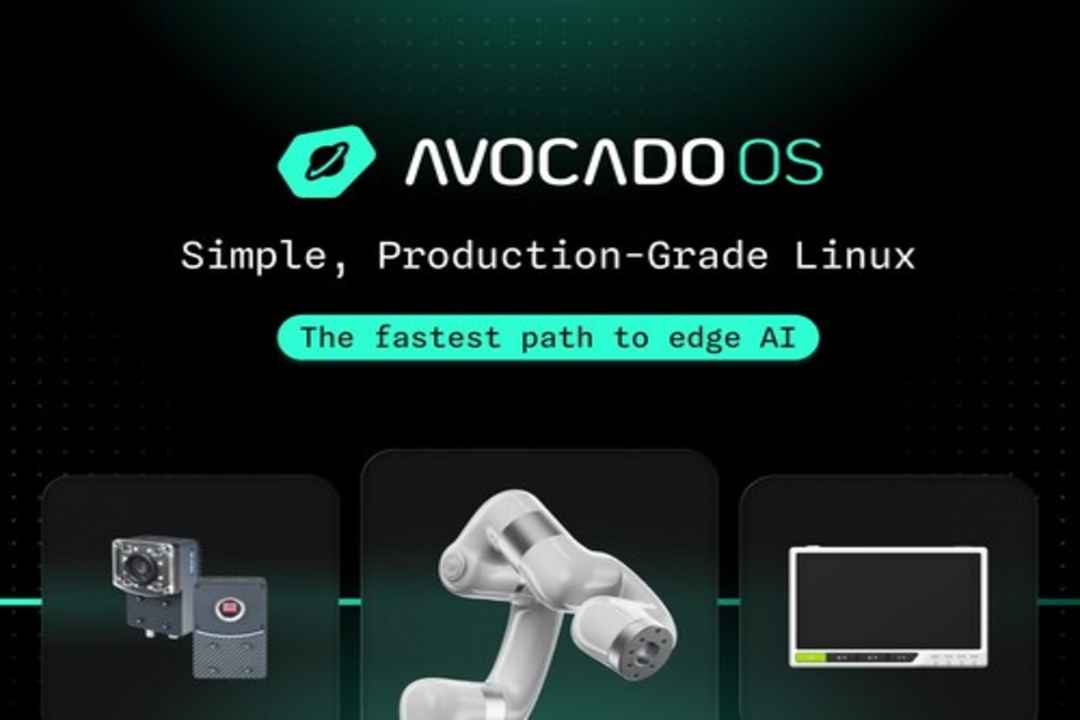
At Embedded World North America today, Peridio unveiled a new vision AI robotics demonstration highlighting how embedded device manufacturers can accelerate development using NVIDIA Jetson boards paired with Peridio’s Avocado OS. The demo illustrates how production-grade Linux software can reduce the timeline for moving from prototype to volume deployment from months to just days.
Avocado OS is a ready-to-use Linux distribution designed for both prototyping and high-volume production. Unlike standard Linux distributions for PCs, it is optimized for embedded and robotics systems, offering secure updates, device management, and maintenance features that allow manufacturers to deploy devices without lengthy rework cycles.
At the Peridio booth 4044 (Anaheim Convention Centre, 4-6 November 2025), the company showcased a dual-arm robot that responds to natural language commands, uses a vision-language-action model to identify and pick specific items from a scattered set, and places them on a conveyor. An Advantech ICAM-540 with a Jetson NX™ module runs Roboflow and Solo Tech software for object detection, while a Jetson AGX Orin™ board handles motion control to pick up the selected item. Both endpoints operate on Avocado OS, which provides versioned, reproducible images suitable for large-scale production.
The demo underscores how production-ready software enables real-world AI applications in areas such as industrial automation and logistics while maintaining security, reliability, and maintainability. Visitors also had the opportunity to learn how Avocado OS combines developer-friendly prototyping with hardened production capabilities.
“What used to take months of rework now takes days,” said Bill Brock, CEO and Co-founder of Peridio. “We designed Avocado OS so teams can move fast and ship with confidence. The OS you prototype on should be the same OS you trust in production.”
Launched in April 2025, Avocado OS was created to streamline deployment of physical AI at the edge. By eliminating the need to port prototypes from Ubuntu or Debian to custom Yocto-based builds, developers can move from lab setups to repeatable, secure production units quickly. The OS preserves the R&D environment, locks dependencies, and simplifies over-the-air updates and fleet management. Being open-source, Avocado OS packages the software stack into a reproducible, production-ready platform for Linux-based edge hardware.
“Teams often spend six months reworking a prototype built on a typical commercial Linux distro for PCs. Avocado OS allows them to skip that step and deploy working R&D setups to production in one to two weeks,” Mr Brock added.
Built on a composable architecture, Avocado OS separates core OS functionality from extension layers, enabling the addition of modules without compromising security or stability. The OS is developed in collaboration with the Linux Foundation and aligns with industry standards, with Peridio actively contributing to both the Linux Foundation and Yocto Project technical working groups.








