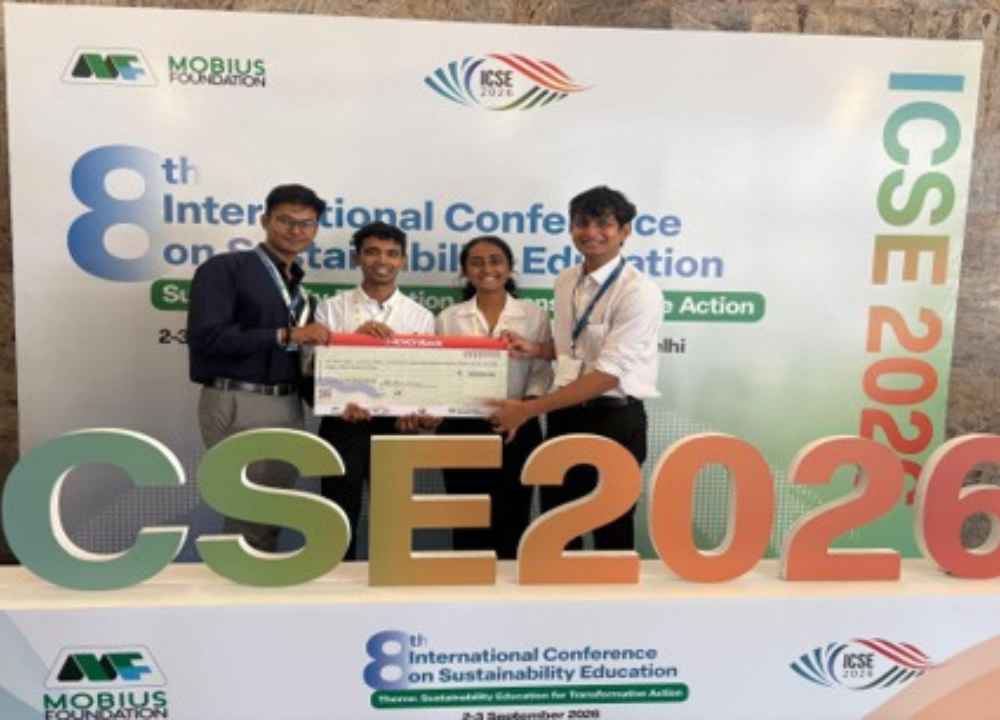
A team of students from MIT World Peace University (MIT-WPU) has developed a living façade system using algae, cyanobacteria and moss to explore sustainable cooling solutions for buildings in India’s increasingly hot urban environments. The project, titled Bioreceptive Façade System for Passive Cooling in Indian Climates, was recognised as a winner of the Youth for Earth (Y4E) Campaign 2026, organised by the Mobius Foundation and The Climate Reality Project.
The team received recognition at the 8th International Conference on Sustainability Education (ICSE) 2026, held at the India Habitat Centre, New Delhi. The interdisciplinary project brought together four final-year B.Tech students from MIT-WPU’s Department of Bioengineering and two students from the Department of Computer Science and Engineering, working under faculty mentorship.
Unlike conventional green walls that require soil and irrigation infrastructure, bioreceptive façades use specially developed coatings that provide a surface for biological growth. The system explores two natural cooling mechanisms: evapotranspiration, through which evaporation draws heat away from surfaces, and biological shading, which reduces direct solar exposure.
Similar systems studied in temperate countries such as the Netherlands and Belgium have demonstrated surface temperature reductions of up to 30°C. The MIT-WPU team is investigating how such technology can be adapted to India’s hotter and more variable climatic conditions, with the potential to reduce surface temperatures by 15–30°C.
The students developed a porous coating using locally available materials, including recycled brick powder, silica fume, expanded clay and kaolin. The research also involves identifying heat-tolerant Indian algae and moss species, developing a carrageenan-based bio-gel to support biological growth and evaluating the coating’s thermal performance and durability.
The initial prototype comprised a five-brick clay wall section with a 10 mm cement base, coated with locally sourced green algae and Chlorella vulgaris. The north-facing structure was monitored twice weekly from June 7 to July 7, 2026, with temperature readings compared against an identical cement-coated wall without biological growth. The study covered both pre-monsoon and monsoon conditions.
Dr Sharbani Kaushik, Program Director, Department of Bioengineering, School of Engineering and Technology, MIT-WPU, and project mentor, said algae and cyanobacteria use sunlight and carbon dioxide to produce their own food, making them promising candidates for sustainable building coatings. The research focuses on identifying species and materials suited to Indian climatic conditions and examining how biological systems can contribute to climate-responsive buildings.
Dr Sheetal Kulkarni, Assistant Professor, Department of Computer Science and Engineering Technology, MIT-WPU, and project mentor, said the project provides students from different disciplines an opportunity to address a real-world challenge by combining bioengineering, application development and real-time data visualisation.
The research aims to contribute to urban heat mitigation, reduced dependence on mechanical cooling, carbon reduction and urban biodiversity. The team is also examining long-term durability, performance across building orientations and potential alignment with India’s National Building Code and GRIHA green building framework.