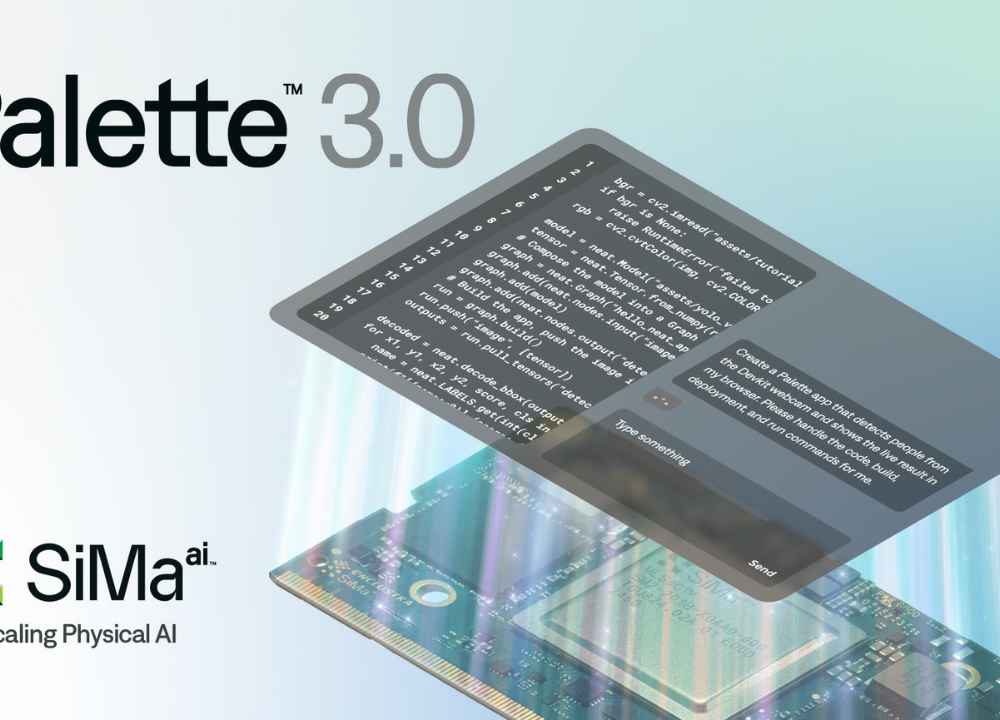
SiMa.ai, a company specialising in Physical AI, has announced the launch of Palette 3.0, its latest software release aimed at improving the performance of a wide range of Physical AI models. The new release builds on the company’s Agentic Palette software suite announced in June and introduces improved concurrent model execution, enabling complex AI reasoning and multiple workloads to run on a single chip within strict power limits.
Palette 3.0 is designed to increase the processing capabilities of AI systems used in autonomous machines, including drones and robots. The software delivers up to 3.5 times higher model tokens per second (TPS) through advanced speculative decoding techniques, while maintaining low power consumption. This improvement strengthens SiMa.ai’s focus on delivering high performance with lower energy requirements.
” The fundamental bottleneck in Physical AI today is the glaring mismatch between software that evolves monthly and legacy silicon that takes years to adapt. We are breaking that cycle,” said Krishna Rangasayee, Founder and CEO of SiMa.ai. He said Palette 3.0 builds on the company’s approach of developing hardware that can keep pace with software advancements, allowing customers to run new AI capabilities on existing hardware and accelerate the development of fully autonomous systems.
The company’s new Model Browser provides performance details for key AI models used in autonomous drones, robotics and other Physical AI applications. The models are tested under real-world power constraints, helping developers assess their performance for practical applications.
Unlike companies adapting data centre technologies for physical applications, SiMa.ai develops its software and silicon specifically for Physical AI requirements. Palette 3.0 also provides developers with open-source code that can be modified to suit their applications. The company’s Agentic Palette software is designed to reduce development timelines from months to days or even hours.
One of the major features of Palette 3.0 is optimised concurrent model execution. It allows multiple AI models to run simultaneously on a single Modalix MLSoC while maintaining low power consumption. Developers can run separate Docker containers on the chip and manage complex workloads involving large language models (LLMs) and vision-language models (VLMs) within limited power and memory resources.
The software also improves the processing of perception, depth and reasoning models required for autonomous drones and robots. Through its ecosystem partners, SiMa.ai is adding unified sensor fusion, dense neural depth fields and closed-loop digital twin simulation to support the development and testing of autonomous systems.
Palette 3.0 introduces open-source capabilities for generative AI application development. It supports EAGLE3, DFlash and Gemma 4 MTP speculative decoding algorithms, which can increase model processing speeds by up to 3.5 times. The release also supports Mixture-of-Experts (MoE) models with large parameter counts, including OpenAI’s GPT-OSS-20B, on SiMa.ai’s Modalix MLSoC 16GB System-on-Module (SoM). With Palette 3.0, SiMa.ai aims to help developers improve AI performance, reduce power consumption and accelerate the development of autonomous machines and other Physical AI applications.