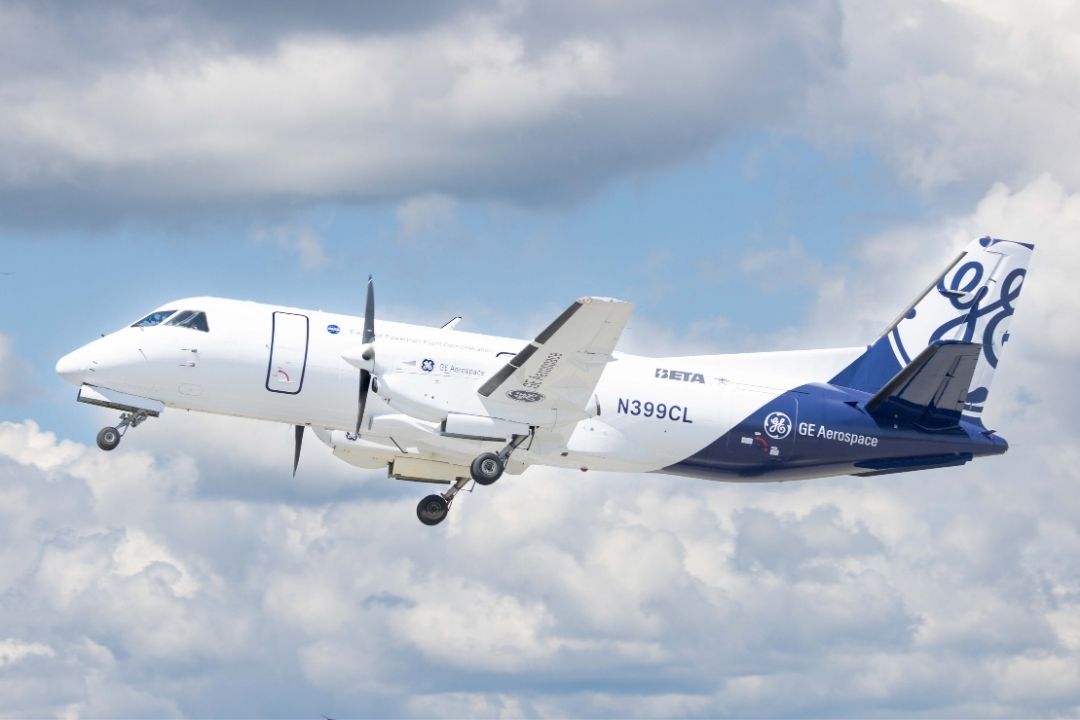
GE Aerospace has successfully completed the world’s first hybrid electric flight above 30,000 feet in collaboration with NASA, BETA Technologies and Boeing, marking a major milestone in the development of next-generation aviation technologies. The achievement was announced at the Farnborough International Airshow, where the aircraft also made its first public demonstration flight.
The breakthrough demonstrates the potential of hybrid electric propulsion systems to support future commercial aviation by improving fuel efficiency, operational performance and aircraft range. During the flight test campaign, the aircraft operated in hybrid electric mode for more than two hours, reaching altitudes comparable to those of commercial passenger aircraft.
The project was carried out under NASA’s Electrified Powertrain Flight Demonstration (EPFD) programme using GE Aerospace’s fully integrated megawatt-class, multi-kilovolt hybrid electric propulsion system. The successful flight is expected to accelerate the development of more electric aircraft capable of reducing emissions while maintaining the reliability required for commercial operations.
The modified test aircraft, a Saab 340B, was equipped with a hybrid electric propulsion system installed in an externally mounted nacelle designed to provide additional cooling. The integrated system included GE Aerospace-developed electric motor-generators, power converters, inverters, control systems, gearboxes, propellers, heat exchangers, torque sensors, wiring systems and a CT7 engine. BAE Systems supplied the battery technology, while Aurora Flight Sciences, a Boeing company, developed the specialised nacelle.
Flight testing was carried out in the United States by pilots from GE Aerospace and BETA Technologies before the aircraft was flown to the United Kingdom for the Farnborough International Airshow. The aircraft operated in hybrid electric mode during each stage of its transatlantic journey, demonstrating the capability of the technology under real operating conditions.
H Lawrence Culp Jr, Chairman and Chief Executive Officer of GE Aerospace, described the achievement as a landmark moment for the aviation industry. He said the successful high-altitude hybrid electric flight highlights the value of collaboration between GE Aerospace, NASA, BETA Technologies and Boeing in advancing technologies that improve aircraft efficiency, durability and operating performance.
Kyle Clark, Founder and Chief Executive Officer of BETA Technologies, said the hybrid electric propulsion system significantly improved climb performance and high-altitude capability while serving as a flying test platform for future hybrid aircraft designs. He noted that the programme represents the beginning of a new phase in hybrid electric aviation development.
Graham Drozeski, Chief Technology Officer of Aurora Flight Sciences, said the project successfully integrated a high-voltage electric propulsion system into an aircraft operating at commercial cruising altitudes, demonstrating important advances in aircraft electrification.
Hybrid electric propulsion combines a conventional gas turbine engine with an electric powertrain, allowing power to be managed more efficiently during different stages of flight. The technology is compatible with future aircraft designs and alternative aviation fuels, offering the potential to lower fuel consumption and reduce carbon emissions. During the test programme, engineers addressed technical challenges related to thermal management, high-altitude operation and power density while meeting aviation safety and reliability standards.
GE Aerospace has been working with NASA on hybrid electric propulsion technologies since receiving the EPFD contract in 2021. The company has achieved several important milestones over the past decade, including megawatt-class propulsion testing, advanced hybrid engine demonstrations and strategic collaborations with industry partners. Many of these technologies are also supporting the CFM International RISE programme, which aims to develop future aircraft engines capable of delivering more than 20% lower fuel consumption than today’s commercial engines while maintaining high standards of safety and durability.