India’s e-commerce story has evolved from scheduled deliveries to same-day fulfilment and, increasingly, deliveries within minutes. E-commerce has expanded beyond the metros, quick commerce has reshaped expectations around speed, and fulfilment networks have become more distributed and technology-driven. Behind this acceleration, however, another flow has been growing just as steadily: products moving back through the supply chain.
Returns are no longer an occasional exception to an otherwise linear journey. They are becoming a recurring inventory flow that warehouses must receive, inspect, sort and redirect, often at considerable speed. DHL’s 2025 analysis found that 81% of Indian internet users had returned an online purchase in the preceding 12 months, while India’s reverse-logistics market was valued at $33.2 billion in 2024.
A returned product also presents a different operational problem from a new unit entering a warehouse. Its next destination is uncertain. It may be ready for resale, require repackaging or refurbishment, have greater value in a secondary channel, or need to be sent for material recovery. The longer it takes to establish that destination, the longer inventory remains tied up in the reverse network.
As e-commerce accelerates, the next frontier of warehouse intelligence may therefore lie not in getting products out faster, but in getting returned products back into the value chain smarter.
Giving every return a route
Conventional returns processing depends heavily on manual inspection and fixed rules. An operator identifies the item, assesses its condition and determines what happens next. That model becomes difficult to sustain when warehouses are processing thousands of returns across multiple categories and locations.
This is where AI-powered sorting can change the economics of the process. Computer vision can identify products, read labels and flag visible damage or anomalies. Machine learning can combine these observations with inventory levels, demand forecasts, product information and location data to determine the most appropriate next step. The important shift is from classification to disposition.
Knowing that a returned product is in good condition is useful. Knowing that it should be sent to a particular fulfilment centre because demand exists there is more valuable. The decision can account for the product’s condition, where it is needed, how quickly it needs to move and which recovery route offers the greatest commercial value.
Sorting therefore becomes less about placing products into predefined bins and more about determining their next role in the supply chain.
Closing the gap between decision and action
A better disposition decision only delivers value if the warehouse can act on it quickly.
Consider a returned product that has been cleared for resale. If it remains in a returns area awaiting manual sorting or travels through several unnecessary handling points, much of the benefit of faster decision-making is lost.
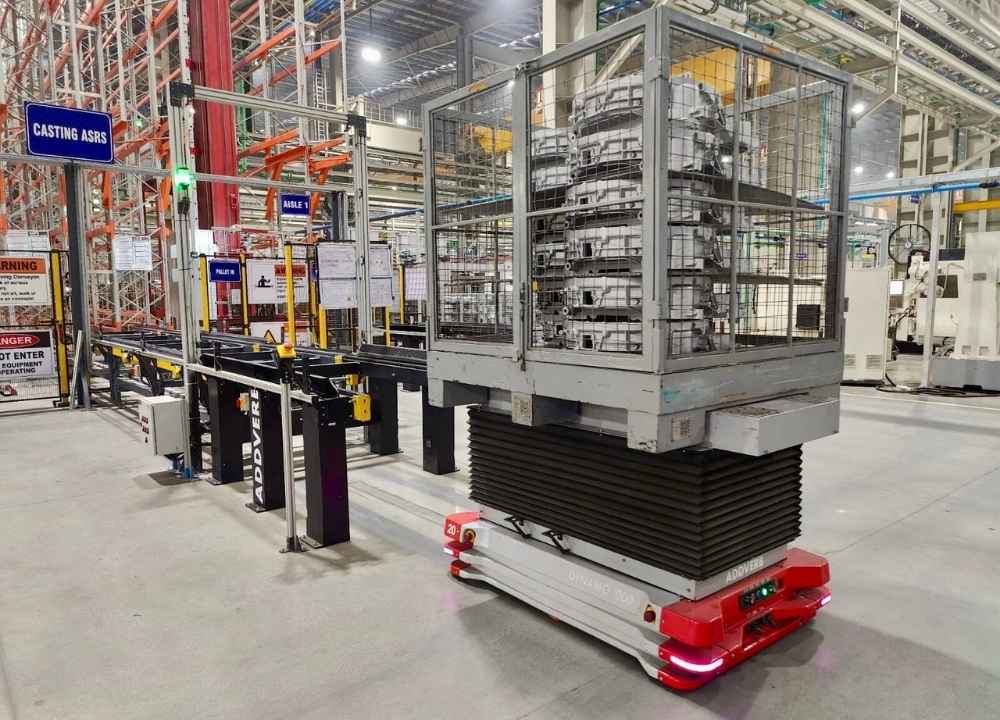
Automated sortation, autonomous mobile robots and automated storage and retrieval systems can connect the decision layer with the physical flow. Products can be directed towards inspection, refurbishment, storage or dispatch based on their assigned disposition. Warehouse execution systems can coordinate these movements as priorities, inventory positions and volumes change.
This is particularly relevant in India, where e-commerce networks are extending into Tier 2 and Tier 3 markets and demand can shift sharply around festive and promotional periods. Reverse flows can be just as variable. A warehouse therefore needs the ability to add capacity and change routing without redesigning its entire operation. Robotic systems provide that flexibility while reducing the amount of repetitive movement that has to be handled manually.
Recovering more than the product
The business case for better reverse logistics extends beyond the cost of processing a return. Every product sitting in a returns queue represents inventory that cannot be sold, replenished or redeployed. Faster assessment and routing can shorten that period, release working capital and make existing storage and handling capacity more productive.
Accurate disposition can also improve recovery. Products suitable for resale can return to circulation sooner. Those requiring repair can be directed to the appropriate process. Products with limited resale potential can move to secondary channels, while those that cannot be economically recovered can be directed towards recycling or material recovery.
The result is a more productive inventory cycle, with fewer products becoming stranded between the point of return and their next commercial use.
For an e-commerce industry built around speed, this is an important evolution. Fulfilment can no longer be measured only by how quickly an order reaches the customer. The health of the supply chain also depends on how quickly it can assess, redirect and recover what comes back.
The next generation of warehouses will be designed around this complete cycle. Products will not have a single journey through the supply chain; they will have multiple possible journeys, and the ability to identify and execute the best one will determine how much value businesses can extract from the inventory they already have.
-POWERED