


For a young professional who has spent years studying abroad, exploring global career opportunities, and building expertise in finance, consulting, and digital transformation, such a journey might lead to a corporate career in international markets. But for Vasudha Ghai, the path eventually led back home to Jalandhar, Punjab, India, where a different kind of opportunity awaited her. In its 2026 “30 Days 30 Stories” Womanufacturing campaign, Machine Maker brings forward the story of Vasudha Ghai, Director of Marketing at GVK Metalforms.
Founded by Vikas Ghai in Jalandhar, Punjab, GVK Metalforms was established with a clear vision to help Indian manufacturers access reliable tooling, machinery solutions, and technical expertise required for modern sheet metal processing. Over the years, the company has worked closely with fabricators and engineering companies that depend on precision in bending, punching, and forming operations, providing them with tools and technology that help improve productivity and process reliability.
What began as an entrepreneurial effort by Vikas Ghai gradually grew into a trusted partner for the sheet metal industry. By bringing advanced tooling solutions and working with global technology partners, GVK Metalforms has helped many Indian manufacturers strengthen their fabrication capabilities, particularly in areas such as press brake tooling, levelling systems, and laser cutting consumables. Through consistent engagement with customers and the industry, the company has positioned itself as a solution provider for fabricators looking to improve efficiency and quality in their production processes.
A Daughter’s Early Connection to Manufacturing
Vasudha grew up in Jalandhar in a family where entrepreneurship and responsibility were part of everyday life. GVK Metalforms, the company founded by her father, had already established itself as a trusted name in the metal fabrication industry. From a young age, she remembers observing the dedication with which her father built relationships with customers and technology partners. Over the years, those relationships helped the company grow steadily and build credibility within the industry.
Being one of two daughters, Vasudha and her sister were always encouraged to pursue education and independence. Her father strongly believed that daughters should have the same opportunities as sons, and that belief shaped the family’s approach to learning and career choices. “Since I was in middle school, I always felt that I wanted to join my father’s company and understand the business,” shares Vasudha.
After completing her schooling in India, she pursued higher education abroad. She went on to complete a double master’s degree and later worked in the Netherlands, gaining exposure to global work environments. Her academic and professional journey covered areas such as finance, digital marketing, consulting, and digital transformation, providing her with insights into modern business strategies and international markets. Her academic and professional journey had already shaped her perspective. She studied finance and digital marketing during her bachelor’s degree, and later pursued consulting and digital transformation during her master’s programme abroad. Marketing had remained a consistent part of her interests throughout her education.
“I have always been connected with marketing since my bachelor’s studies,” she explains. “When I joined the company, it felt natural for me to begin from that area because there had never been a dedicated person handling marketing earlier.”
“After studying and working abroad, I felt this was the right time to move back to India and join GVK Metalforms. I wanted to see how I could contribute, improve processes, and create a meaningful impact on the company,” she explains.
Eventually, she made the decision to return home and become part of the company’s journey. For her, joining the business was about supporting the legacy built by her father. “My father has been doing this alone for a very long time. I wanted to be a pillar of support for him and help take the company forward,” she adds.
Connecting Manufacturing with Modern Communication
When she joined GVK Metalforms, she was aware that manufacturing is a deeply technical industry where expertise is built over years of experience. Rather than stepping directly into leadership decisions, she chose to begin by understanding the company’s operations and the industry it serves. Her father had spent more than fifteen years building the organisation, developing relationships with customers across India and working with technology partners in Europe. She saw her role as supporting that foundation while gradually bringing new capabilities into the business.
In discussions with her father about how she could contribute to the business, the direction became clear. She would start by strengthening the company’s communication and marketing activities while also learning the industry’s technical aspects.
“I told my father that I could help with marketing because I did not yet have the full technical expertise,” she recalls. “He encouraged me to learn everything from the beginning to understand the processes, go through the entire cycle of how the company works, and then gradually take on responsibilities.”
At GVK Metalforms, Vasudha now leads the company’s marketing and communication initiatives. Her work includes managing the company’s digital footprint, website presence, social media communication, marketing campaigns, and product catalogues. Every aspect of how the company presents itself to the outside world, particularly in the digital space, falls within her area of responsibility.
However, her role is not limited to improving marketing materials alone. She believes that manufacturing companies must communicate their capabilities more effectively to remain visible in a competitive industry. “A product is only a product until you communicate about it,” she says. “The way you talk about it, the branding around it, and the conversations you create around your work are what help people understand its value.”
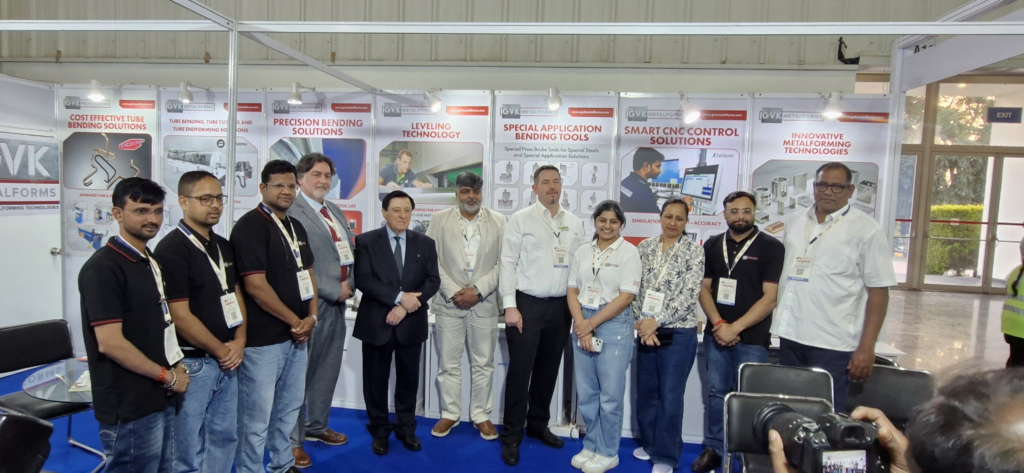
Having joined the company only recently, Vasudha is gradually building these communication channels. “Our company already has strong relationships in the industry,” she explains. “My goal is to make sure more people know about what we do and how we can support fabrication businesses across the country.” To achieve this, she has begun focusing on digital outreach, targeted campaigns, and participation in industry exhibitions such as IMTEX and other trade events, helping the company connect with a wider network of manufacturers.
Vasudha also believes that the manufacturing sector needs stronger communication platforms where companies can share their work and contributions to the economy. “Manufacturing is a very big industry, one without which the world cannot run,” she says. “Many companies are doing incredible work, but they rarely talk about it. Platforms that help communicate these stories are extremely important because they allow businesses to show how they contribute and how they can support others.”
Relationships and Communication in Manufacturing Industry
While the technologies involved in sheet metal forming are highly technical, Vasudha believes that the human side of the industry is equally important. “Manufacturing and sheet metal forming is a very B2B business,” she explains. “It is not consumer-based. You always need strong technical knowledge about machines, processes, physics, and materials.”
At the same time, she believes that soft skills and relationship management play a crucial role in the manufacturing ecosystem. “Manufacturing is still very much a relationship-driven and word-of-mouth industry,” she says. “You have to know how to communicate with customers, build trust, and understand their problems.”
She sees digital transformation playing an increasingly important role in how manufacturing companies communicate with the industry. “A lot has changed in the digital era, especially after COVID,” she says. “Earlier, many manufacturing companies did not even think about having social media, maintaining a website, or running digital campaigns.”
Today, however, the importance of a digital footprint is becoming clear across the sector. “People now research companies online before even contacting them,” Vasudha explains. “Even if our current customers may not always belong to the younger generation, the next generation certainly does.”
For her, digital presence is about building credibility and accessibility. “If someone searches for your company online, they should be able to find you, understand what you do, and see that you are credible,” she says. “Digital platforms make it easier for companies to showcase themselves and communicate their capabilities.” While manufacturing remains largely relationship-driven, Vasudha believes digital tools help companies extend their reach and strengthen communication with the industry.
“It is always better to have that presence than not to have it,” she adds.
Privilege, Responsibility, and Proving Yourself
As a second-generation member of a family business, Vasudha openly acknowledges that joining her father’s company comes with a certain level of privilege. At the same time, she is equally aware that privilege alone cannot sustain success. “It is a privilege to have the support of my father and the opportunity to be here,” she says. “But it also means I must maintain the same standards and relationships that he has built over the years.”
For Vasudha, this responsibility means continuing the values on which the company was built, strong relationships, trust with customers, and consistent commitment to quality. Her goal is to ensure that the company continues to grow through its credibility and the solutions it provides to the industry. For young women considering careers in manufacturing, Vasudha believes that confidence and preparation make the biggest difference. Challenges may exist, but they should not be seen as barriers.
Instead, she encourages women to focus on building knowledge, understanding the industry, and trusting their own abilities. “Know your work. Come prepared. When your work speaks for you, everything else follows,” she says. She also believes that supportive mentors, colleagues, and industry platforms can play an important role in encouraging more women to step forward and explore opportunities in manufacturing.
Navigating a Male-Dominated Industry
Despite the progress made in recent years, manufacturing continues to remain largely male-dominated. Vasudha experienced this reality firsthand while attending industrial exhibitions and interacting with industry professionals. At one such event, she noticed that among hundreds of participants, only a few were women, and even fewer came from technical roles within the industry.
“There are times when people question why you are here,” she says.
Such situations can sometimes make women feel the need to prove themselves more than others. However, she prefers to approach these moments with a practical mindset. Rather than focusing on stereotypes, she chooses to focus on learning the industry, building knowledge, and demonstrating her capability through her work. For her, consistency matters the most. Showing up, participating in discussions, and gradually building credibility within the industry is what helps overcome these perceptions over time.
The Strength Behind the Journey
When asked who her biggest supporter has been, Vasudha answers without hesitation, her father.
Growing up in a small-town environment, she credits him for encouraging both daughters to pursue education and independence. While societal expectations often questioned investing equally in daughters, her father believed strongly that education and self-reliance were essential. “He has always broken barriers for us,” Vasudha says. “He made sure we received good education and opportunities. Everything I have been able to do today is because of that support.”
For the broader manufacturing industry, she believes that change towards greater inclusivity will come gradually, starting within organisations themselves. “If we can create workplaces that support and encourage women, change will eventually follow,” she says.
For her, progress may begin with small steps, hiring more women, supporting their growth, and ensuring they have the opportunity to learn and contribute. And as she continues her own journey in the industry, Vasudha believes the most important thing is to focus on the work itself.
“If you know your skill and your trade well, success will follow,” Vasudha Ghai concludes.







