

India generates somewhere between 500 and 600 million tonnes of agricultural residue every year. For a long time, that was a disposal problem. Now, with the Ministry of Power’s National Mission on Biomass pushing 10% co-firing mandates across thermal plants and standalone biomass boiler installations growing steadily, it’s a fuel supply challenge. A serious one.
Combustion systems have kept pace. Conveying systems mostly haven’t. That’s where the trouble starts. Conventional conveying systems were built around materials that behave themselves. Coal settles evenly. It flows through converging chutes without drama. It loads buckets with reasonable consistency and exerts predictable forces on belts.
Biomass doesn’t do any of that.
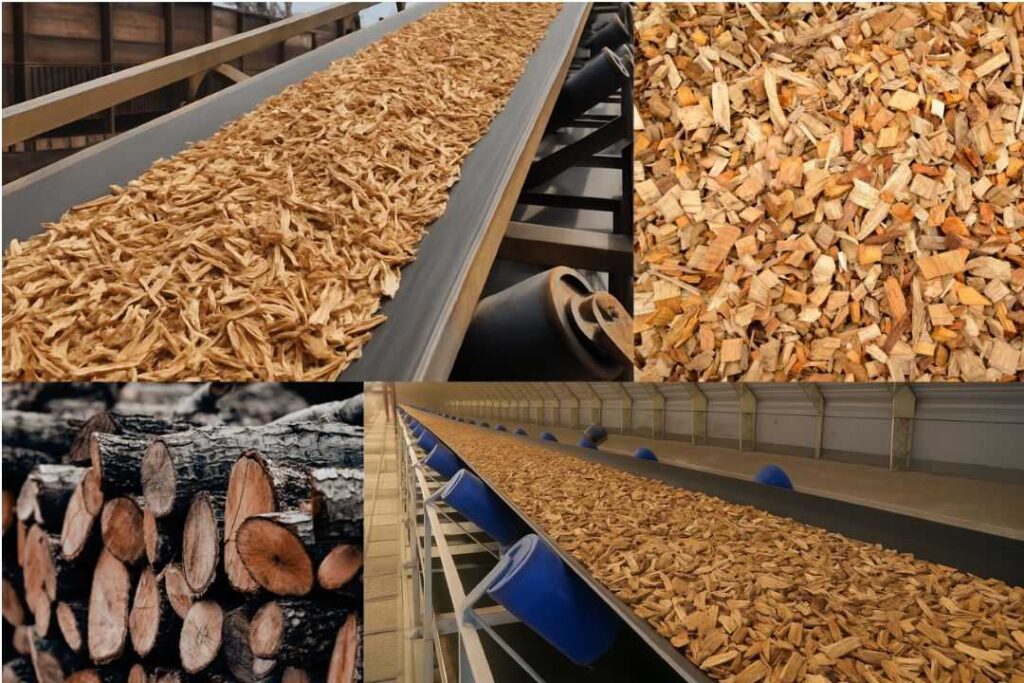
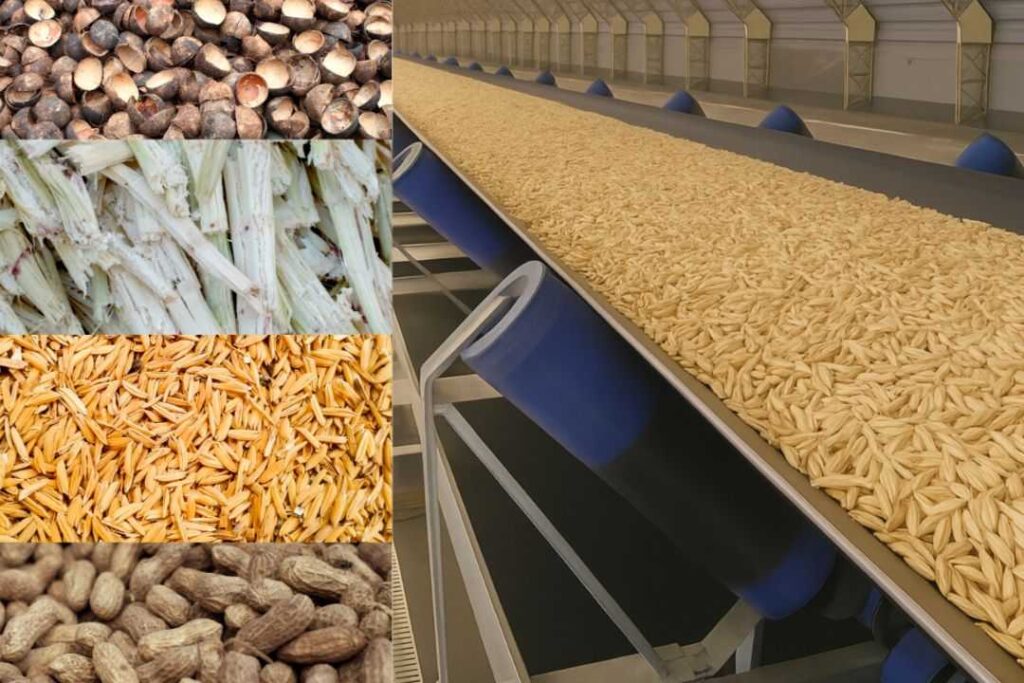
Mustard husk, cotton stalk, shredded bagasse, paddy straw, these materials interlock. They bridge across openings. They compact under pressure. They choke chutes that would handle coal without complaint. The particle geometry, bulk density, and moisture content vary with season, storage duration, and the material’s processing prior to reaching the conveyor.
Taking a system designed around coal and running biomass through it isn’t conservative engineering. It’s the wrong starting point entirely.
What Actually Happens Inside a Vertical Elevator
In a vertical bucket elevator conveying free-flowing granular material, filling efficiency typically ranges from 65–75% of the struck bucket capacity. That’s by design; controlled filling keeps belt tension manageable. With non-free-flowing biomass, that number drops. More importantly, it becomes inconsistent. Some buckets overfill. Others are nearly empty. The belt is now carrying an uneven load along its entire length.
Uneven loading creates uneven tension. Uneven tension creates localised elongation. Elongation causes sag. Sag causes lateral deviation. And in a vertical elevator casing with standard clearances, even minor deviation brings buckets into contact with the casing wall. That’s what’s generating the wear.
Most plants log this as a maintenance issue and replace the components. The failure repeats on the same timeline. It repeats because the geometry hasn’t changed, only the parts have. In reality, what appears to be a maintenance failure is often a design-geometry problem rather than a component-quality issue.
There’s a second failure mode that gets less attention. Biomass particles that don’t fully enter buckets fall back and accumulate around the boot pulley. That accumulation increases resistance, adds to belt tension, and accelerates wear on both belt and pulley. In a vertical casing, accessing the boot section for cleaning isn’t straightforward. So the accumulation continues between shutdowns, quietly compounding the problem.
Why Inclined Systems Handle This Differently
Inclined bucket elevators — typically configured at angles between 30° and 60° from vertical alter the loading mechanics in a way that directly addresses these problems. In a vertical elevator, the bucket scoops material aggressively from the boot. For interlocking, irregular biomass, that scooping action is exactly where filling inconsistency begins. The material resists clean entry.
In an inclined system, the bucket approaches the material at an angle that allows biomass to settle and heap into it naturally. No aggressive scoop. Filling becomes more consistent, routinely reaching or approaching full struck bucket capacity. In many cases, effective filling can approach or even exceed nominal struck bucket capacity due to natural material heaping — without proportionally increasing vertical belt stress.
Consistent filling means consistent belt loading. Consistent belt loading eliminates the differential tension that drives elongation, sag, and deviation. The root cause is addressed, not the symptom.
The trade-off worth acknowledging: as the incline angle reduces toward horizontal, discharge becomes the challenge. Material needs to exit the bucket cleanly at the head end. That’s managed through bucket profile, head pulley diameter, and discharge chute geometry. It requires the system to be designed as a whole, not selected component by component.
The Chute Problem Nobody Talks About
Non-free-flowing biomass needs a divergent chute geometry at the inlet. The opening has to widen in the direction of flow, the material bridges and the system chokes.
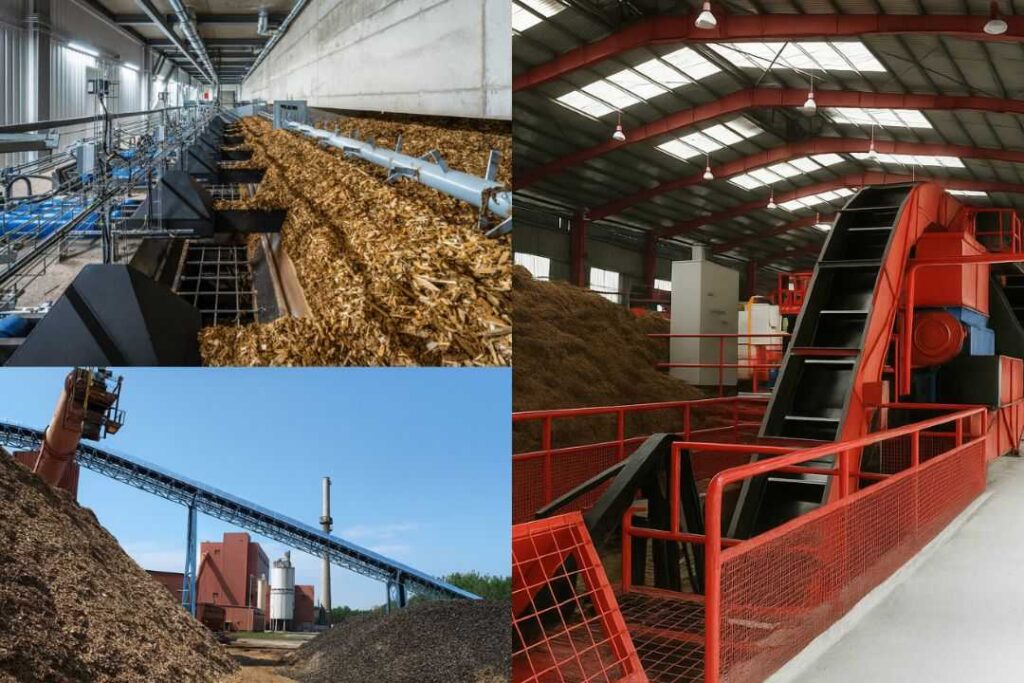
In a vertical elevator, the boot section geometry limits how much divergence is physically possible in the inlet chute. The casing constrains the design. Inclined systems position the feed zone at an angle, providing considerably more spatial flexibility for inlet chute design. Boot section access is also better, which means blockage recovery is faster.
In a biomass boiler plant, fuel feed continuity is directly linked to combustion stability. A conveying stoppage isn’t just a maintenance event it affects boiler performance and plant availability. Conveying stability is foundational to combustion stability. Faster blockage recovery has real operational value that doesn’t show up in equipment specifications but absolutely shows up in plant availability numbers.
Design for What Actually Arrives, Not What the Spec Sheet Says
Paddy straw moisture content varies across harvest seasons. Cotton stalk particle size depends on the shredder condition. Mustard husk bulk density shifts with storage duration. A conveying system that performs at rated capacity only under ideal conditions will underperform for most of its operating life. That’s not a component quality problem. It’s a design scope problem.
Proper biomass conveying design requires material characterisation across the realistic range of variability angle of repose, wall friction, particle size distribution, not just the nominal values on a specification sheet. At Rollcon, the difference we consistently observe between projects where this characterisation was done properly and those where it was skipped shows up not in the factory acceptance test but in the first operating season in downtime frequency, maintenance call frequency, and how often the plant actually runs at designed throughput. The spec sheet optimism doesn’t survive first contact with actual material.
India’s biomass utilisation is scaling up. The materials entering these plants will continue to vary in size, moisture, and flow behaviour. That’s a permanent operating condition, not a temporary one. Plants that integrate conveying design early into the engineering process, treating it as a primary system rather than a secondary one, operate more reliably. Those who don’t spend their operational life addressing consequences instead of causes.
In practice, plants usually recognise the problem through symptoms rather than design analysis, such as frequent bucket damage, excessive belt wear, chute choking, or unusually high maintenance frequency. The geometry of a conveying system is not a detail. For non-free-flowing biomass, it determines whether the plant runs or whether the maintenance team does.







