


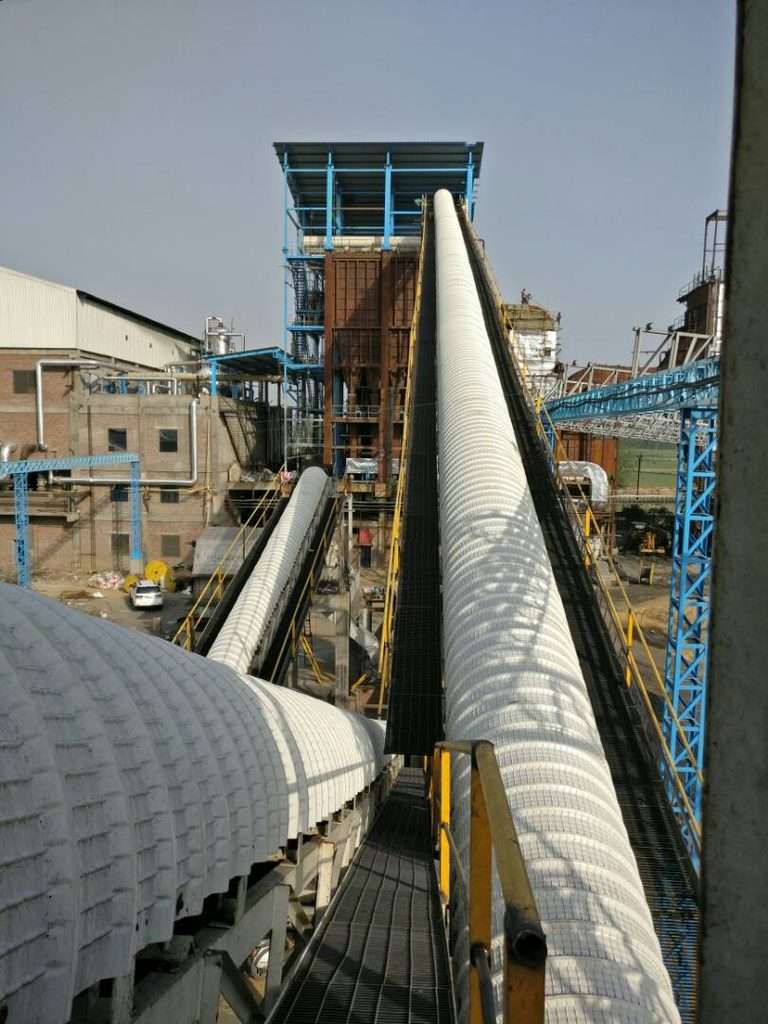
An auditor’s vehicle pulls up to the plant gate. Before anyone has signed the visitor register, the first observation has already been made: the conveyor gallery is visible from the road, and the hood cover line running along it is wavy. One panel sits high, the next sits low, and the line never settles straight. The plant team walks under those covers every day and has stopped seeing them. The visitor sees them in the first thirty seconds.
Waviness is a symptom, not a finish defect
On a well-executed line, hood covers run straight and consistent, panel to panel. Waviness appears when panels are hand-bent, because each panel’s radius then depends on the operator, the shift and the individual sheet. The same forming process produces both surfaces of the panel, so a radius that drifts on the outside, where it can be seen, is drifting at the overlaps and end seals on the inside, where the cover actually does its work. That is where water enters and material escapes.
In gallery inspections at Rollcon, the correlation has held with very few exceptions: lines that look wavy from the road show gap-related spillage and moisture staining at the overlaps once the covers are opened up. External appearance is a usable proxy for internal fitment, and auditors and clients read it that way, with fresh eyes, before the plant’s own team does.
The question every environmental audit reduces to
Fugitive dust regulation reads as complicated on paper. In the field it collapses into one question: is the material fully enclosed, and is the dust contained?
The honest answer depends on cover fitment. A poorly fitting hood leaves gaps at overlaps, at ends, wherever hand-bent panels fail to align, and fine dust escapes through those gaps every shift, whether or not anyone is watching. That escape is fugitive emission, and it sits squarely inside the consent-to-operate conditions that State Pollution Control Boards issue under the Air (Prevention and Control of Pollution) Act, 1981. CPCB directions on fugitive emission control have pushed boards toward stricter enforcement of exactly this point, particularly around coal and mineral handling.
The commercial consequence follows directly. A leaking cover can convert a plant that was otherwise prepared to pass into a plant that receives a notice, and a notice is rarely a penalty line alone; it can hold operations until the deficiency is corrected. The fix that stops the line was usually available on day one, as a properly engineered cover, at a small fraction of what a stoppage costs. The audit exposure is created at procurement, years before any inspector arrives.
Spillage is a standing bill
A second cost runs alongside audit risk, and most plants have stopped noticing it because it has been absorbed into routine. When covers do not seal, material slips along the line continuously, and someone cleans it up. Every shift… indefinitely… for as long as the fitment stays poor. That is a standing labour cost with no natural end date.
Add the material lost outright, product that should have reached the transfer point but ended up on the gallery floor, and over a year the figure becomes serious and calculable. It rarely appears as its own line in a budget review. It hides inside “routine housekeeping” and gets treated as a fact of plant life. It is actually the delayed output of a fitment decision made at procurement, appearing months and years later as a permanent operating cost. A cover that seals correctly retires that cost quietly: the cleanup labour, the lost material, and often a staffing requirement that nobody connects back to the covers overhead.
A fifteen-minute internal audit
No plant needs to wait for an external inspector to run this assessment. Five checks, no instrumentation:
- Stand back from the gallery, at the road if possible, and sight down the cover line. Flat and consistent, or wavy panel to panel?
- Inspect overlap joints at several points along the line for visible gaps, especially at ends and transitions.
- Walk the ground beneath the gallery. A dust or material trail that reappears shift after shift, regardless of cleanup, marks a containment failure above it.
- Count the labour-hours per week spent specifically on cleaning spillage from this line, then annualise the number. In our experience the result surprises the person who signs the housekeeping contract.
- After rain or wash-down, check overlap points for internal moisture. The gaps that let dust out let water in.
The whole exercise takes fifteen minutes. It is the same look an auditor or a client gives the plant on a first visit.
What the waviness is announcing
A hood cover is the physical boundary of containment, and containment is what the audit, the housekeeping bill and the material-loss figure all trace back to. The waviness visible from the road is advance notice. It marks the exact overlaps where the next audit finding, and the next year of cleanup labour, will originate.







