


The most expensive word in biomass plant engineering is “biomass.” It implies a single fuel. It is not one. From a material handling perspective, rice husk, bagasse, and briquettes behave as differently as sand, cotton, and stone. Yet plants keep specifying generalised conveyor layouts, identical feeder geometries, and uniform storage assumptions across all three. The results are predictable: unstable flow, bridging, choking, dust generation, inconsistent combustion, and premature equipment fatigue.
The furnace only reflects what the handling system delivers to it. Whether fuel arrives consistently or destructively is decided upstream — in the conveyors, hoppers, and feeders.
Fuel Properties Dictate the System
Biomass handling is governed by material mechanics: bulk density, particle geometry, surface friction, moisture retention, abrasiveness, and compressibility. Each fuel produces a different mechanical response inside conveyors, screw feeders, storage hoppers, chutes, and reclaim systems.
Designing around an “average biomass condition” fails for a simple reason: no fuel actually operates at the average.
| Property | Bagasse | Briquettes |
| Typical bulk density | 100–180 kg/m³ | 600–900 kg/m³ |
| Flowability | Poor | Moderate |
| Abrasiveness | Low | Moderate |
| Moisture retention | Very high | Low |
| Bridging tendency | Severe | Moderate |
| Dust / fines generation | Moderate | High (after degradation) |
| Impact loading | Low | Very high |
| Compressibility | Very high | Low |
| Storage stability | Poor | Good (if kept dry) |
| Dominant mechanical risk | Choking and plugging | Impact stress and fines |
Note: Values are typical as-received ranges. Actual behaviour varies with source, moisture content, and upstream processing.
These differences are not academic. They determine equipment lifespan, maintenance cycles, and combustion consistency.
Rice Husk: Flowable but Abrasive
Rice husk has earned its reputation as an easy material. It is light, dry, and free-flowing. It discharges from storage without drama. That reputation hides the real problem: continuous abrasive wear.
Dry husk aerates readily and, under certain conditions, behaves almost like a fluid. Feed consistency becomes unstable. Dust entrains at transfer points. And because the material is light, plants routinely raise conveyor speed to hold throughput. Higher velocity multiplies wear.
The abrasion comes from silica. Rice husk carries among the highest silica content of any common biomass fuel, and its ash is predominantly silica. Screw flights, chute liners, bends, bucket edges, and transfer points wear first. As metal thins and flights degrade, the flow geometry the system was designed around begins to change. Wear alters the machine. The altered machine then handles the material worse. The degradation compounds.
At Rollcon, one pattern we see repeatedly in the field: handling layouts engineered for bagasse are switched to rice husk without corresponding changes to conveyor speed, liner selection, or flight metallurgy. The system keeps running. The wear rate does not stay the same.
Storage discharge is generally reliable. The instability is subtler — fines accumulation, dust pockets, and aeration produce fluctuating feed density at the screw. The flow looks smooth. The combustion is not.
Bagasse: The Bridging and Moisture Problem
Bagasse is mechanically the opposite of rice husk. Its problems are structural, not abrasive. Fresh mill bagasse typically arrives at around 45–50% moisture. The fibres interlock. They mat. They compress. The material does not behave like a granular solid; it behaves like a compressible fibrous mass. Chute choking, feeder starvation, and uneven reclaiming follow directly from that structure.
In storage, the structure is the enemy. Bagasse bridges, rat-holes, forms stable arches, and leaves stagnant zones. Enlarging the hopper opening rarely solves it, because the failure is fibre cohesion, not opening size — the material locks itself together mechanically. Without effective agitation or live-bottom reclaim, discharge becomes intermittent. Feeder loading fluctuates, combustion stability deteriorates, and steam generation starts to oscillate.
Wet bagasse also degrades in storage. Piles ferment and heat, and prolonged wet storage carries a self-heating risk. Storage duration is a design parameter, not an afterthought. Wear is the one place bagasse is forgiving — abrasion is low. The stress shows up elsewhere: torque spikes, motor overload, shaft stress, and feeder stalls under compacted material. The failure mode is not erosion. It is repeated mechanical stalling.
Briquettes: Dense, Predictable, and Mechanically Aggressive
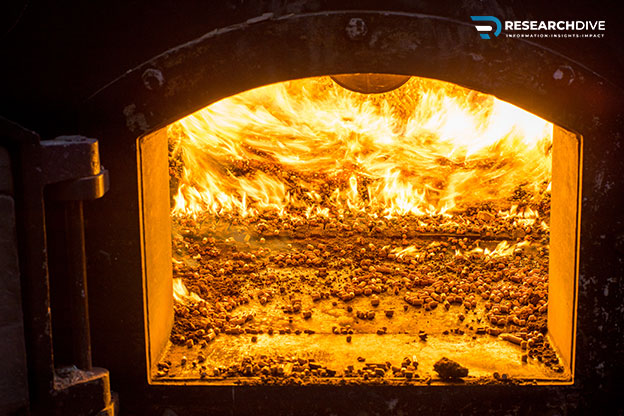
Briquettes look like the stable option. Uniform geometry, high energy density, predictable discharge. All true — and all beside the point mechanically. At typical bulk densities of 600–900 kg/m³, briquettes are roughly five to eight times denser than loose husk or bagasse. Every transfer point becomes an impact zone. Point loads concentrate on belts, chutes, and pulley lagging in a way that loose biomass never produces. Chute plate life, lagging life, and feeder integrity are all shortened by repeated impact fatigue.
The second problem develops over time. Briquettes fragment during handling. Every drop and every transfer generates fines. The fuel gradually becomes two materials in a single stream: intact lumps and accumulating particulate matter. A system designed for lump handling begins behaving like a mixed-fines system — with the dust, wear, and feed-density problems that follow.
Discharge from storage is generally predictable, provided the briquettes stay dry. Moisture disintegrates them.
Rice husk demands abrasion-resistant engineering. Bagasse demands anti-bridging flow control. Briquettes demand an impact-resistant mechanical design. A system optimised for one will run inefficiently on the second and fail prematurely on the third. “Biomass handling system” is a procurement term, not an engineering specification. Plants that design for the actual fuel build once. Plants that are designed for the category build twice.







