The failure often starts quietly. Belt stretch. Tracking drift. A maintenance crew adjusting tension every few weeks. Nobody connects it to the geometry of the elevator itself — because the machine looks fine. It was working fine, until the material changed.
The Problem With Straight Geometry in Difficult Materials
Straight bucket elevators work well when material is free-flowing and consistent — uniform particle size, predictable bulk density, dry conditions. Under those conditions, bucket filling is even, belt loading is symmetric, and the system runs as designed.Change the material — introduce irregular biomass, partially wet granules, or fibrous waste — and the load profile shifts. Buckets fill unevenly. Impact at the boot becomes inconsistent. The belt absorbs asymmetric stress on every cycle.
Over weeks, that asymmetry accumulates as elongation. Elongation causes tracking problems. Tracking problems cause premature wear.Operators often treat this as routine maintenance. In reality, it is a geometry and loading mismatch.
What Inclined Geometry Changes
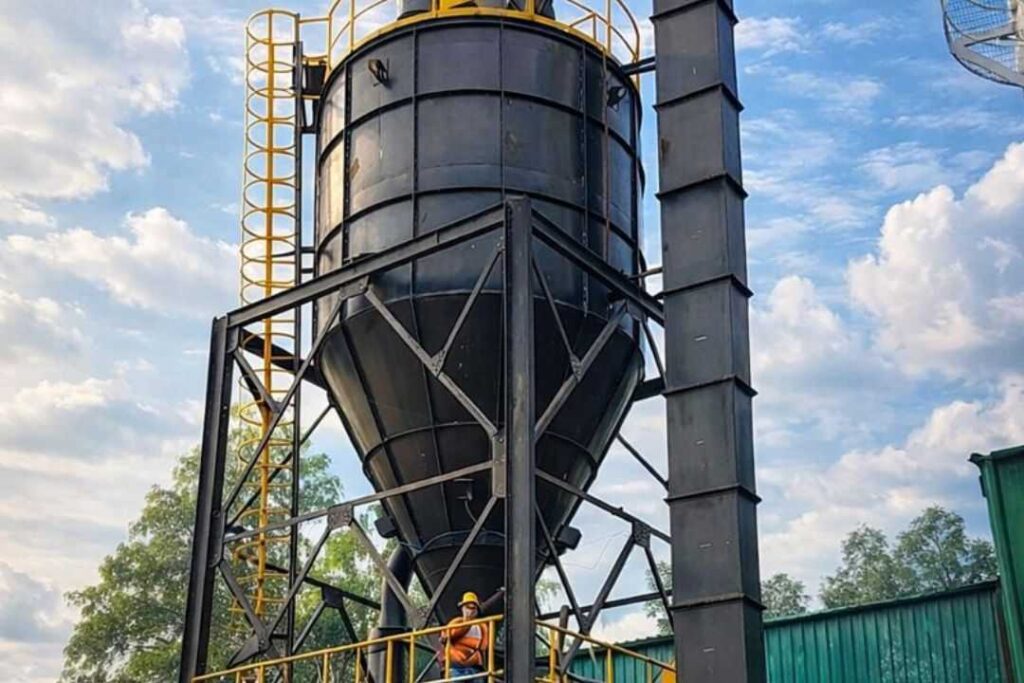
An inclined bucket elevator changes the loading condition at the boot. Material is picked up along a gradient rather than dropped into a vertical pocket. Filling becomes progressive. The material settles into the bucket incrementally rather than slamming in at the lowest point. This reduces impact loading at the boot and smooths the stress signature across the belt circuit.
On roller-supported inclined configurations, load is distributed across guide tracks rather than concentrated on the belt alone. Dynamic stress is lower. Tracking is more consistent over time.Chute integration also improves. In inclined configurations, chute angles can be optimised to reduce bridging and choking — a persistent problem with irregular biomass in vertical systems.
The Trade-Off: Land Footprint
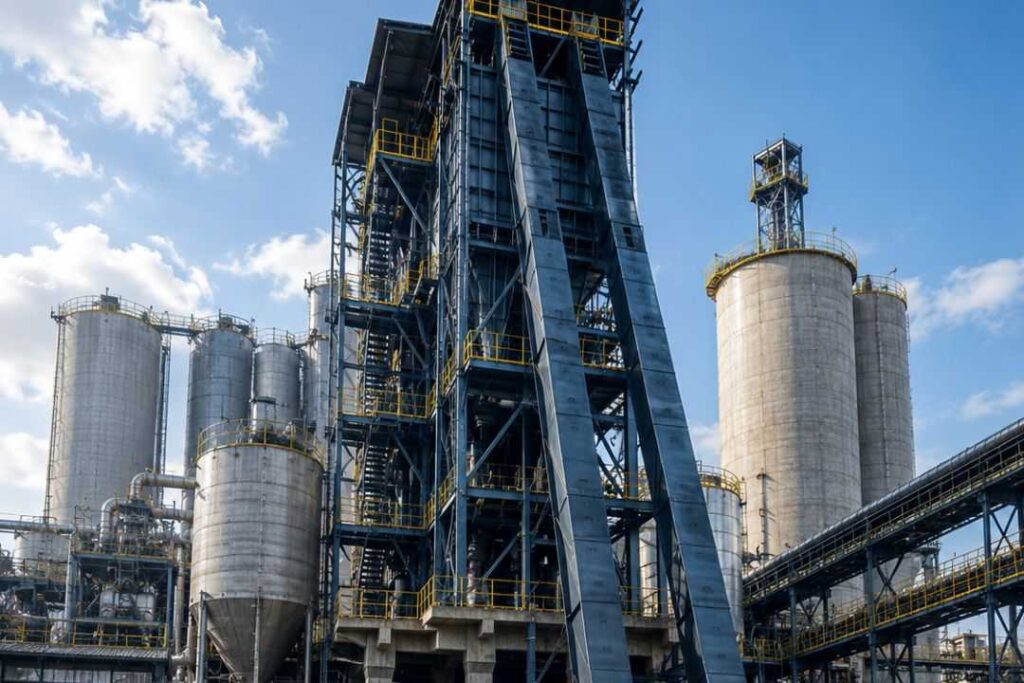
Inclination requires horizontal space. A straight elevator occupies a compact vertical footprint. An inclined elevator requires room for the gradient — typically two to three times the horizontal distance relative to lift height, depending on the angle of inclination. In congested plant layouts, this can be a hard constraint.
The geometry change must be evaluated against available floor space, structural clearances, and civil modification costs. It is not always feasible, and it should not be assumed feasible without a layout check.
When to Choose Inclined
The case for inclined geometry strengthens when:
- Material is abrasive, irregular in particle size, or prone to bridging
- Chute choking has been recurring despite operational adjustments
- Belt wear and bucket damage are accelerating between shutdowns
- The plant intends to process multiple material types across the equipment’s operating life
At Rollcon, the difference we consistently observe between projects where inclined geometry was specified correctly and those where it was applied as a retrofit, shows up not in factory testing but in the second and third operating season — in maintenance intervals, belt change cycles, and chute replacement frequency.
Selecting for Real Operating Conditions
Capacity charts tell you what a system can move. They do not tell you how the system degrades under the actual material it will handle for the next ten years.
The decision between inclined and straight geometry should be made with material characterisation data in hand — bulk density, particle size distribution, moisture content, abrasivity index, and flow behaviour. Without that data, the selection is a guess dressed as engineering.