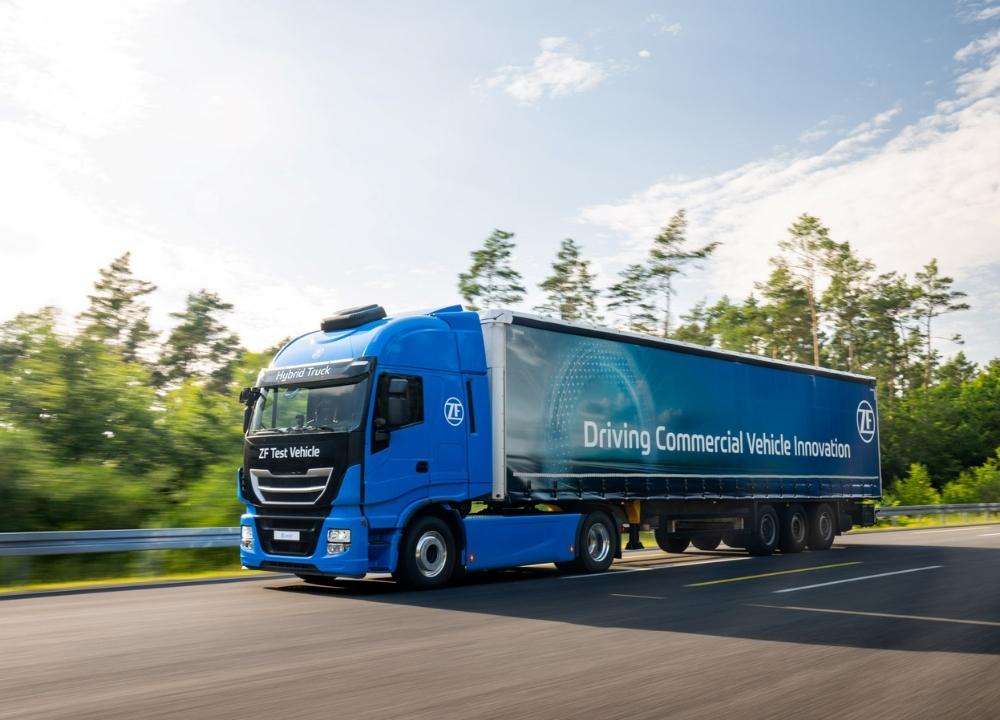
ZF is advancing a technology-open approach to commercial vehicle decarbonization, giving manufacturers and fleet operators flexible options to reduce emissions while maintaining vehicle performance and controlling operating costs. Ahead of IAA Transportation 2026, ZF is highlighting a portfolio that combines hybrid and electric driveline technologies with advanced braking, air management and software solutions. The approach recognises that commercial vehicles operate across different duty cycles, applications, infrastructure conditions and markets, requiring solutions that can be adapted to specific requirements.
At the centre of ZF’s strategy is a modular driveline portfolio covering conventional, hybrid and fully electric configurations. By using scalable platforms and proven components across different vehicle architectures, ZF enables customers to select technologies based on their operational needs and regional conditions.
“There is no single pathway to decarbonization in commercial vehicles,” said Winfried Gründler, Head of Business Unit Driveline Solutions at ZF. “Customers need solutions that reduce emissions today and still make economic sense. Our technology-open portfolio enables OEMs and fleets to decarbonize step by step while maintaining operational performance.”
ZF’s TraXon 2 Hybrid transmission provides a transition option for heavy-duty applications where full electrification may not yet be practical because of infrastructure, range or cost considerations. The system combines conventional and electric driving modes, supports energy recuperation and enables electric operation in low-emission zones.
For vehicles suited to full electrification, ZF is expanding its electric driveline range. The CeTrax 2 family offers scalable electric central drive systems for existing vehicle architectures, with future developments aimed at higher power levels, wider application coverage and Power Take-Off availability. The AxTrax 2 electric axle family is designed for dedicated electric vehicle platforms and is being developed with higher torque outputs to support greater gross combination weights. Production of AxTrax 2 in China also reflects growing demand for electric axle technology in commercial transport.
ZF is extending efficiency improvements beyond the driveline. Electrified trailer solutions, advanced braking systems and air management technologies can further reduce energy consumption. The e-comp Scroll air compressor features an oil-free design that improves compressed air quality, reduces maintenance needs and provides low-noise operation for applications such as urban buses. ZF is also using software and system integration to improve vehicle efficiency. Integrated controls can coordinate driveline, braking and energy management systems to optimise energy use and reduce operating costs.
“Hybrid and electric driveline technologies are key building blocks for decarbonization,” said Dr Johannes Heseding, Manager Innovation Electrification & Efficiency. “Further efficiency gains can be achieved through the intelligent interaction of systems across the vehicle.”
ZF will showcase its latest commercial vehicle technologies at IAA Transportation 2026 in Hanover, Germany, at Hall 21, Booth B42, including developments in hybrid and electric driveline solutions. ZF is a global technology company that develops advanced mobility solutions for passenger cars, commercial vehicles and industrial applications. Its broad portfolio serves vehicle manufacturers, mobility providers and start-ups across the transportation and mobility sectors.
The company offers technologies for a wide range of electrified vehicles, helping customers reduce emissions, improve energy efficiency and support safer, more sustainable mobility. In addition to passenger and commercial vehicles, ZF serves industries including construction and agricultural machinery, wind power, marine propulsion, rail systems and testing technology.
ZF employs around 153,000 people worldwide and recorded sales of €38.8 billion in fiscal 2025. The company operates 162 production facilities across 29 countries.
ZF’s Commercial Vehicle Solutions (CVS) division is focused on advancing the future of commercial transportation. The division develops technologies that make commercial vehicles safer, smarter and more sustainable, supporting the industry’s goals of reducing accidents and emissions.
ZF CVS provides a wide range of technologies and integrated solutions for vehicle manufacturers and fleet operators. Its products and systems are designed to support customers throughout their transition towards increasingly automated, connected and electrified commercial vehicles.
The division combines expertise in commercial vehicle technology and vehicle control systems. Its capabilities include advanced vehicle control, safety systems, automation, connectivity and digital solutions that improve vehicle intelligence and operational efficiency. ZF CVS also helps manufacturers and fleet operators address the growing complexity of commercial transportation by offering technologies that can be integrated across different stages of vehicle development and fleet transformation.
The division was formed by bringing together ZF’s former Commercial Vehicle Technology and Commercial Vehicle Control Systems divisions. The latter was established following ZF’s acquisition of WABCO in 2020. Through its technology portfolio and digital capabilities, ZF CVS is working to shape the next generation of commercial vehicles and transportation systems, with a focus on safety, efficiency, connectivity, electrification and automation.